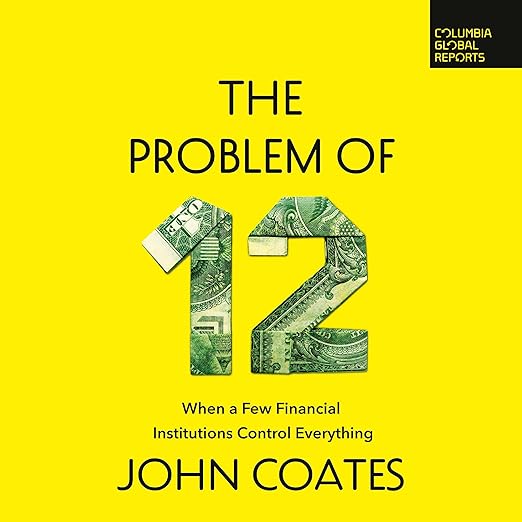
Vanguard, State Street, and BlackRock together control more than twenty percent of the voting power across the entire S&P 500, and John Coates spends this audiobook explaining why that concentration should worry listeners regardless of where they sit politically. Coates, a Harvard law professor, calls this dynamic the problem of twelve, a small enough number of institutions to exert outsized influence over both the American economy and its politics, and he extends the argument to private equity giants like Apollo, Blackstone, Carlyle, and KKR, which now control $2.7 trillion in assets.
Twelve Firms Combined From Two Different Worlds
Coates treats this fundamentally as a legal and political power question, not an investment guide. The synopsis frames index funds and private equity as two distinct mechanisms producing the same underlying concentration: one through voting power across public companies, the other by taking companies private entirely and removing them from public accountability and government regulation. That dual structure gives the argument more range than a book focused on just one side of modern finance.
Reviewer Michael Friedman credits Coates with 'a refreshing instance of extensive learning that is explained thoroughly and patiently,' praising his grasp of the interconnections within the subject matter. That patience matters given how much ground the book covers, spanning corporate governance, securities law, and antitrust-adjacent concerns within a relatively compact runtime.
Coates writes from a specific institutional vantage: a Harvard law professor working in corporate and securities law, not a financial journalist or an activist investor. That background shows in how the book handles its central claims, treating the concentration of voting and ownership power as fundamentally a legal and regulatory question, with named specific players, Vanguard, State Street, BlackRock, Apollo, Blackstone, Carlyle, and KKR, functioning as case studies for a broader structural argument rather than the entire point of the book.
The term problem of twelve itself is worth unpacking briefly. Coates arrives at that number by combining the small handful of index fund giants with the small handful of dominant private equity firms, arguing that despite operating in different corners of finance, both groups produce the same structural outcome: enormous influence concentrated in very few hands, largely outside normal public accountability or shareholder democracy as most people understand it.
Four Efficient Hours on the Biggest Shifts
Reviewer Phillip Nguyen calls it the only book he's found that explains private equity in genuinely accessible terms, though he's candid that it will likely intensify an already unfavorable view of the industry rather than complicate it. That's a useful preview for listeners deciding whether the book's perspective matches what they're looking for.
At just over four hours, this is an efficient way to understand two of the biggest, least-visible shifts in modern American capital markets, index funds' growing voting power and private equity's move to take companies fully private, without committing to a much longer read. For listeners who've heard these terms in the news without a clear sense of why they matter, that efficiency is a real advantage.
The book's compact runtime relative to its subject matter reflects a specific editorial choice: depth on the mechanism of concentration itself rather than breadth across every possible remedy or counterargument. Listeners wanting a more exhaustive treatment of alternative solutions, or a longer historical account of how index funds grew to their current scale, will find Coates's focus narrower and more pointed than a comprehensive survey would be.
Coates's proposed remedy, that only politics, meaning legislative and regulatory reform, can effectively check this concentration of power, gives the book a clear destination rather than leaving the problem diagnosed but unresolved. Listeners frustrated by business books that spend all their time describing a problem and little time proposing what to actually do about it will find Coates commits to an actual position by the book's end, even if that position itself invites its own debate.
Pretty Good and Pretty Knowledgeable, Rodriguez Says
This argues a clear point of view rather than surveying the field neutrally. Coates isn't laying out a menu of competing solutions for a listener to weigh; he's building toward one specific conclusion, and reviewer Nguyen's warning that it will intensify existing skepticism of private equity rather than complicate it is worth taking at face value before starting.
Reviewer Rach Rodriguez offers a useful counterweight to the more enthusiastic reviews, calling it 'pretty good' and 'pretty knowledgeable' while noting it 'wasn't exactly my favorite,' a reminder that the material, while credible, doesn't land as essential listening for every audience. The downloadable PDF of charts and illustrations is worth grabbing, since financial concentration data generally communicates better visually than by ear alone.
Rodriguez's more measured four-star rating is worth reading alongside the five-star reviews specifically because it still calls the author knowledgeable despite not loving the book overall, suggesting the material's credibility isn't really in dispute even among its less enthusiastic listeners, only its ranking against other business titles a given reader happens to prefer.
71 Ratings Is Still a Small Sample
At 71 ratings, this is a newer or less broadly discovered title than some of the other books in its category, and the 4.2 average, while solid, reflects a smaller sample than a more established finance title might carry. That's not a knock on the material itself, reviewer Friedman's praise for how thoroughly and patiently the material is explained suggests real quality, but it does mean less of a crowd-sourced consensus to lean on before committing to the listen.
Listeners should also know this was written for a general audience rather than finance professionals specifically, despite covering genuinely technical territory. Coates avoids excessive jargon throughout, which reviewer Nguyen's layman's-terms comment backs up, though some familiarity with how public companies and investment funds work generally will still make the material easier to follow than approaching it with zero background at all.
A Political Argument About Concentrated Power
Listeners interested in corporate governance, antitrust, and financial regulation, anyone who wants to understand how index funds and private equity firms actually accumulate power beyond headline numbers, and readers of business and finance nonfiction looking for a compact, focused argument rather than a sprawling survey will get the most from this one.
Listeners who appreciate legal-scholarship-grounded nonfiction specifically, material coming from an academic with genuine expertise in corporate and securities law rather than a journalist synthesizing outside reporting, will find Coates's specific professional vantage point a real point in the book's favor.
If you're looking for investment advice or a neutral, mechanical explanation of how index funds work day to day, this isn't that book, since Coates is building a political argument about concentrated power rather than writing a personal-finance guide.
- Voice: Sean Patrick Hopkins delivers the material with clarity that keeps dense financial-regulatory concepts moving over a compact runtime.
- Big ideas: index fund voting power, private equity buyouts, concentrated economic power
- Atmosphere: Urgent and argumentative
- Worth it?: A focused, efficient listen for anyone interested in financial power concentration, though it argues a clear point of view rather than staying neutral.
Good to Know
Does The Problem of Twelve audiobook cover both index funds and private equity firms?
Yes, it treats them as two related mechanisms of the same underlying problem, covering the Big Three index funds and the major private equity firms taking public companies private.
Is this audiobook biased against private equity, or does it present a balanced view?
It argues a clear point of view rather than surveying the field neutrally, and one reviewer notes directly that it will likely intensify an already unfavorable view of private equity rather than complicate it.