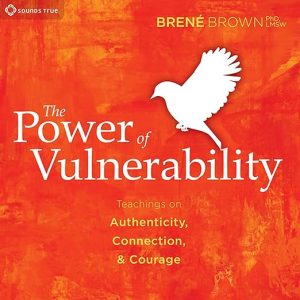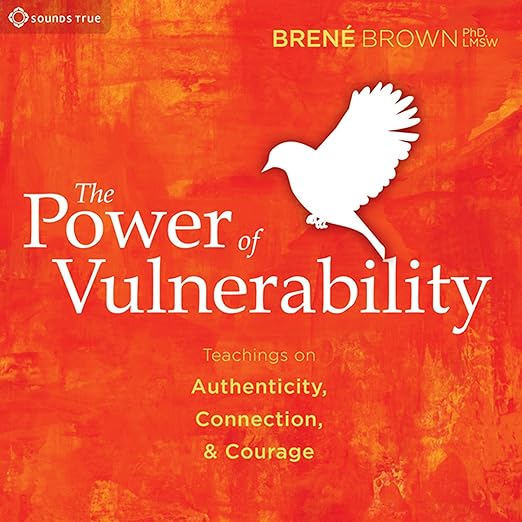
- Narrator: Brene Brown narrating her own work is the only acceptable arrangement here, and she is consistently warm, funny, and disarming across six hours.
- Subjects: Shame resilience, wholehearted living, the courage required to be seen
- Tone: Conversational and often surprisingly funny, with moments of genuine emotional exposure
- Bottom line: The audio format adds something the text alone does not have, and Brown's own voice is a significant part of why.
I first encountered Brene Brown's work through the TED talk, like a significant portion of the audience that eventually arrives at her books. What I did not expect, when I finally sat with The Power of Vulnerability as an audio course, was how much the format would change the experience. I listened to most of it on a train from London to Edinburgh, which is a long enough journey to spend real time with an idea, and by the time the Pentland Hills came into view I had written more notes in the margin of my phone than I had after any purely academic text in recent memory.
That is partly a function of the material and partly a function of Brown's voice, both literally and figuratively. She is a qualitative researcher who has spent over twelve years interviewing people about vulnerability, shame, and what she calls wholehearted living, and she presents that research in the form of stories, which is a choice she is explicit about: stories, she says, are data with a soul. The course draws from all three of her books up to the point of recording, making it the most comprehensive single-volume introduction to her thinking available in audio form.
First, the Big Picture
Most audiobooks are improved by skilled professional narrators. The Power of Vulnerability is not most audiobooks. It is a six-hour audio course derived from live teaching, and what makes it work is the sense that you are in a room with someone who is thinking through difficult material in real time rather than reading a finished text. Brown's Texas drawl, her timing, her willingness to use humor to approach ideas that might otherwise feel confrontational, all of these things would be lost or degraded under a professional reader's interpretation. One reviewer described the experience of listening with a grumpy spouse on a long road trip, with both of them laughing and saying wow at regular intervals. That reviewer captured something important: Brown is genuinely funny in ways that academic writing rarely allows, and that humor does real work in keeping listeners open to ideas that otherwise might trigger defensive resistance.
The recording quality is strong throughout. The presentation is clear and structured, organized around key topics including the myths of vulnerability, the concept of emotional armor, the ten guideposts of wholehearted living, and the relationship between shame resilience and a sense of worth and belonging. These sections build on each other coherently, and the course has a shape that rewards listening all the way through rather than sampling.
Why The Power of Vulnerability Works as an Audiobook
One reviewer, identifying themselves as familiar with qualitative research methods, made the observation that Brown's approach is exactly what qualitative methodology looks like done well: real-life examples with genuine depth, presented as data that has not been stripped of its human texture. This framing is useful for listeners who might approach self-help audio skeptically. Brown is not offering intuitive wisdom or motivational assertion. She is presenting findings from a systematic research program conducted across more than a decade, and the findings have been replicated and refined over time.
The specific concept of shame resilience is worth dwelling on because it is the least intuitively obvious element of the course. Brown makes a careful distinction between shame, which she describes as the intensely painful feeling that we are flawed and therefore unworthy, and guilt, which is the feeling that we have done something bad. The research finding that shame is correlated with destructive behavior while guilt is correlated with change is counterintuitive and well-supported, and the audio course gives it enough time to settle and be understood before moving on.
A Few Reservations
Brown describes this as the first place all her work comes together, and that description is accurate. The three books she draws from address vulnerability, shame, and wholehearted living as distinct but related subjects. The audio course treats them as a single integrated investigation, moving between them as the subject requires. For listeners who have read some but not all of her books, this provides connective tissue that fills in gaps. For listeners coming to Brown for the first time, it is a more complete map of the territory than any single book would provide.
A reviewer from 2012 wrote that he was listening after only five of the six discs and was already deeply grateful. That response has repeated itself across years of reviews. The 4.7 average rating across nearly five hundred reviews reflects a consistency of impact that holds up over time.
Who Should Listen to The Power of Vulnerability
Listeners who are already using Brown's research framework in therapy, coaching, or personal development work will find this course fills in context and extends their understanding. Those who are encountering the ideas for the first time and are genuinely open to the subject matter are likely to find it one of the more useful things they have listened to this year. Listeners who are firmly opposed to the self-help genre and suspicious of emotional language in research contexts will find those reservations tested here, though Brown anticipates that resistance and addresses it directly. At six hours it is a manageable investment for the breadth of ground it covers.