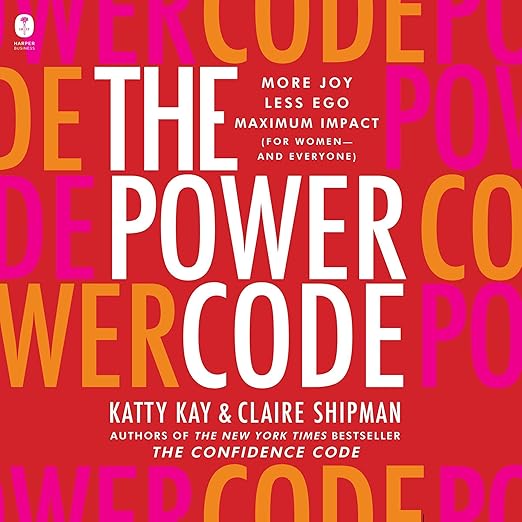
Katty Kay and Claire Shipman open this audiobook with a blunt reframing: the problem isn't women failing to adapt to power as it currently exists, it's that power itself, as currently structured, doesn't work well for most people, women or men. That's a sharper argument than the standard women's-leadership pitch, and the two veteran journalists build it methodically across nine and a half hours, moving from historical context about how workplace power got defined in the first place toward a genuinely alternative model grounded in purpose rather than hierarchy. Kay narrates the audiobook herself, and her broadcast background is audible immediately in how cleanly she paces dense research-driven material without letting it go flat.
This is technically a sequel of sorts, following the pair's earlier bestseller on confidence with a book aimed squarely at what comes after confidence: actually holding and using power once you have it. The pivot makes sense. A generation of women were told to fix their confidence gap and did the work, and Kay and Shipman are now asking a harder structural question about what happens next, once individual women are ready to lead but the systems around them still reward an older, narrower definition of what leadership looks like.
Aizenman's Review Names Three Books in One
The reporting backbone is substantial: dozens of interviews spanning ages, races, and backgrounds, paired with academic research the authors translate into accessible, conversational prose rather than dense citation. Jeremy Hillman's review captures something real about the book's reach beyond its stated audience, noting that its analysis of power dynamics felt genuinely valuable to him even as a man reading a book explicitly framed around women's experience. That crossover appeal isn't accidental; Kay and Shipman are explicit that a remade version of power, built more around purpose and collective impact than dominance, appeals to most men too, not just women.
What keeps this from reading as pure manifesto is the practical scaffolding underneath the argument. Reviewer avid reader describes a blend of accessible how-to advice alongside more academic material, and that combination shows up structurally throughout: a chapter making a systemic argument about workplace design is reliably followed by something closer to a workbook chapter, concrete steps for negotiating differently, building a support network, or recognizing when you're absorbing an old, narrower definition of ambition that was never actually yours to begin with.
N.C. Aizenman's review nails the book's tonal range, calling it 'equal parts practical guidebook, collection of...stories from power brokers from all walks of life, and fascinating exploration of the science...' among its other qualities. That range is ambitious for one book to hold together, and Kay and Shipman mostly manage it, though the science sections move faster than a dedicated behavioral-science audiobook might, functioning more as supporting evidence for the central argument than a deep dive in their own right.
The title itself does some quiet work worth noticing: a code implies both a system to be cracked and a set of rules to live by, and Kay and Shipman play both meanings simultaneously, decoding how power currently operates while proposing a new code, in the ethical sense, for how it should. That double meaning holds up better than most business-book titles manage, and it previews the book's actual balance between diagnosis and prescription fairly accurately.
Kay Sounds Like She's Actually Talking to You
Hearing Kay narrate her own reporting adds a layer the print edition can't replicate: the cadence of someone who has spent decades on television translating complex material for a broad audience live, under time pressure, without losing clarity. That skill transfers directly to audiobook narration in a way that isn't guaranteed for every author who chooses to read their own work; Kay sounds like she's genuinely talking to you rather than reading a manuscript aloud, which suits a book explicitly trying to start a cultural conversation rather than just report findings.
The book's structure, alternating between systemic critique and individual-level guidance, works well in audio specifically because you can absorb the bigger argument during a commute and return to the more actionable chapters later for closer attention, almost like using two different books depending on what you need that day. Business and career audiobooks often struggle to make research-heavy material feel personally relevant; this one largely avoids that trap by grounding abstract findings in specific interview subjects Kay and Shipman return to across multiple chapters.
Real-world texture keeps the book from drifting into abstraction, too: Kay and Shipman ground their argument in specific, recognizable workplace scenarios, the meeting where credit gets misattributed, the promotion cycle that rewards visibility over actual impact, rather than staying at the level of general theory throughout. That specificity is easier to absorb by ear than a purely academic argument would be, since each example gives the listener a concrete scene to hold onto between more conceptual stretches.
Dozens of Named Women, Each Getting Brief Treatment
Expecting a tidy checklist of five power moves to adopt immediately will lead to some frustration, since the book's ambitions run more structural and cultural than purely tactical. Kay and Shipman are as interested in changing how listeners think about power's definition as in giving direct instructions, and readers who want a pure how-to guide with minimal framing might find themselves waiting through more contextual and research-based material than expected before getting to the actionable parts.
The interview-heavy structure, dozens of named women across different industries and life stages, means some individual stories get relatively brief treatment before the book moves on to the next example. Listeners who prefer a narrower, more deeply profiled set of case studies over Kay and Shipman's wider, more panoramic approach may wish for fewer examples explored in greater depth rather than the breadth the authors chose to prioritize instead.
It's also worth noting this is explicitly framed around workplace and structural change rather than personal branding or visibility tactics, so listeners hoping for guidance on self-promotion, negotiation scripts, or interview technique specifically will find those topics addressed only briefly within a much broader argument about redefining power itself.
Confidence-Gap Advice Followed, Still Hitting a Wall
Women navigating workplace politics, career transitions, or the specific frustration of doing everything the confidence-gap advice recommended and still hitting a wall will find this speaks directly to that experience. It's equally worth a listen for men in leadership positions genuinely curious about redesigning how their own teams and organizations define and reward power, not just as an act of allyship but because Kay and Shipman make a real case that the current model shortchanges most men too.
Career tacticians hunting a numbered checklist will find Kay and Shipman more interested in reframing the whole conversation than handing over five bullet points to memorize, so readers wanting pure tactics over structural argument should adjust their expectations accordingly. Anyone already deeply immersed in workplace-equity research may also find some of the framing familiar territory rather than genuinely new ground.
Quick Take
- Voice: Katty Kay narrates her own reporting with the clean, confident pacing of a veteran broadcast journalist.
- Big ideas: Redefining power at work, structural barriers for women, purpose over hierarchy
- Atmosphere: Direct, research-grounded, motivational without being saccharine
- Worth it?: Recommended broadly for anyone navigating workplace power, not just the women it's explicitly framed around.