Quick Take
- Narration: Dominic Hoffman delivers Sheinkin’s documentary prose with the restraint the material demands, treating the testimony of real people with care and keeping the narrative’s moral weight intact
- Themes: Racial injustice in the US military, civil rights before the movement, the cost of conscience
- Mood: Urgent and quietly devastating, with the particular weight of injustice that has been largely forgotten
- Verdict: Steve Sheinkin at his most ethically serious, and Hoffman’s narration honors the material fully.
I was already familiar with Steve Sheinkin’s work when I started The Port Chicago 50, having spent time with Bomb and Lincoln’s Grave Robbers, so I came in knowing what kind of writer Sheinkin is: someone who treats documentary history as narrative, who finds the human story inside the archival record, and who is particularly good at revealing the moments when large historical forces press down on specific individuals. The Port Chicago 50 is that talent applied to material that most American listeners will not know, and the effect is significant.
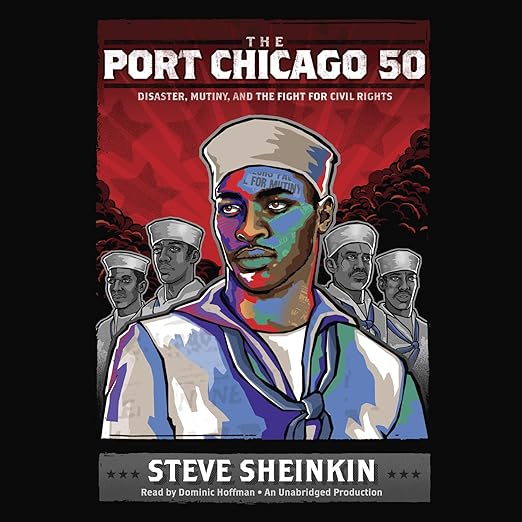
The explosion on July 17, 1944, at Port Chicago Naval Magazine in California killed more than 300 sailors. It was the deadliest home-front disaster of World War II. The subsequent refusal by 244 Black sailors to return to the unsafe docks, the reduction of that group to fifty charged with mutiny, and the court-martial that followed: Sheinkin treats these events with the same meticulous sourcing and narrative discipline he brought to Bomb. The result is a book that functions as civil rights history, military history, and an argument about courage that doesn’t need to announce itself as such.
The Segregated Navy and the Logic of Injustice
Sheinkin’s strongest historical writing tends to operate through accumulation: individual incidents, decisions, and moments of choice that, taken together, build an undeniable picture of how systems work. He applies that method here to the segregated US Navy of 1944, where Black sailors were assigned the most dangerous dock work, overseen by white officers whose expectations of Black performance were shaped by the racism of the era, and denied the combat roles that might have offered better conditions and faster advancement. Sheinkin documents this without editorializing, which is more effective than editorializing would be.
The men who refused to return to the docks after the explosion are presented in their specificity. This is not a story about a monolithic movement. Some men joined the refusal out of fear, some out of principle, some out of both. Sheinkin’s account of the decision-making, the social pressure, the debates among the sailors themselves, gives the audiobook its most complex and human passages. The fifty who were eventually court-martialed are individuals rather than symbols, which is a harder and more important thing to achieve.
Dominic Hoffman and the Requirements of Testimony
Documentary nonfiction about racial injustice places particular demands on narrators. Hoffman, who has a substantial catalog across multiple genres, handles this material with consistent dignity. He doesn’t perform outrage on behalf of the listener, and he doesn’t smooth over the weight of what Sheinkin is documenting. The sections drawn most directly from trial testimony and firsthand accounts are read as primary documents, with the slight change in register that such passages require.
At three hours and forty-nine minutes, the audiobook is efficient. Sheinkin doesn’t pad, and Hoffman doesn’t dawdle. The pacing is close to that of an excellent podcast documentary, which is both a compliment and a description: this material could have been a radio piece, and in Hoffman’s hands it has something of that focused, forward-moving quality that distinguishes documentary audio from academic lecture.
A National Book Award Finalist That Should Be Better Known
Reviewer Annette Lamb’s thorough summary of the book’s award history, National Book Award finalist, YALSA Excellence in Nonfiction finalist, reflects a critical consensus that is entirely merited and somewhat puzzling given how little-known the Port Chicago disaster remains in mainstream American historical consciousness. Sheinkin argues implicitly that this obscurity is part of the story: what gets remembered and what gets forgotten about military history is not accidental.
Reviewer Diane Wright’s intention to purchase a classroom set reflects the book’s obvious utility as educational material, but The Port Chicago 50 works better than most classroom texts because it doesn’t feel like one. The narrative drive is sustained throughout, and the ethical weight accumulates through story rather than through argument.
Who Should Listen, Who Should Skip
The Port Chicago 50 is appropriate for listeners aged eleven and up, with genuine resonance for adult listeners approaching it as civil rights history or military history. It works as a companion to units on World War II home front, desegregation of the armed forces, or the roots of the post-war civil rights movement. Sheinkin’s particular skill, making archival history feel like it’s happening now, translates especially well to the audio format, and Hoffman’s performance is one of his stronger recent turns. Skip only if the subject matter is too close and the emotional weight would be too much for a particular listener; the content is handled with care, but it is genuinely heavy.
Frequently Asked Questions
Is this book about the explosion itself, or primarily about the court-martial that followed?
Both, though the court-martial and the legal and moral questions it raises occupy most of the narrative. The explosion and its immediate aftermath establish the context, but Sheinkin’s central focus is the fifty men who were charged with mutiny for refusing to return to work.
Does The Port Chicago 50 connect explicitly to the later civil rights movement of the 1950s and 1960s?
Sheinkin draws the connection, noting that Thurgood Marshall covered the court-martial as NAACP counsel and that the case became a reference point in later civil rights arguments about equality in military service. The book situates Port Chicago in the longer arc of Black Americans’ fight for equal rights.
How does this compare to Sheinkin’s other nonfiction audiobooks like Bomb?
Both books use the same documentary narrative approach and similar pacing. Bomb is broader in scope and covers a longer historical period. The Port Chicago 50 is more intimate, focused on a smaller group of men over a shorter timeframe, which gives it a tighter emotional register.
Is Dominic Hoffman’s narration appropriate for the gravity of the material?
Yes. Hoffman is particularly effective with documentary nonfiction that draws on testimony and court records. His delivery is respectful of the real people Sheinkin writes about, and he avoids the dramatization that would feel inappropriate for this kind of historical account.