Quick Take
- Narration: Adrian Newcastle reads clearly and maintains an even, professional tone suited to the book’s instructional register.
- Themes: Neurodivergence reframing, growth mindset, sensory processing
- Mood: Accessible and encouraging, structured around mindset shifts
- Verdict: A solid orientation guide for parents and educators encountering autism or ADHD diagnoses for the first time, though readers wanting clinical depth will need to supplement it.
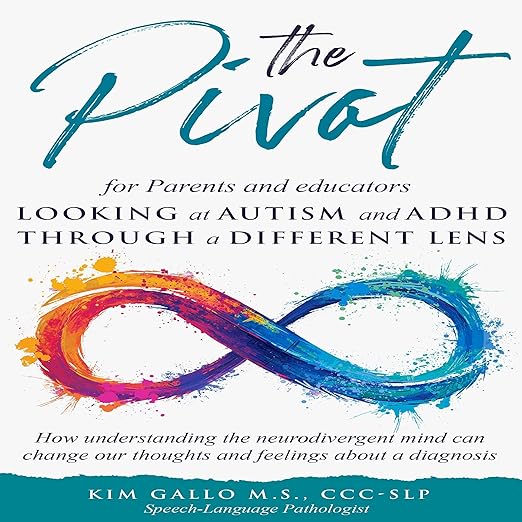
The practical challenge with books aimed at parents and educators navigating neurodivergence is the audience problem: what reads as revelatory for someone encountering the topic fresh can read as oversimplified to someone who’s been living it for years. Kim Gallo’s The Pivot lands squarely in the introductory space, and at just over four hours, it knows what it is and doesn’t pretend otherwise. I came to it shortly after listening to Russell Barkley’s much longer and more clinical Taking Charge of ADHD, which gave me a useful sense of where this book sits on the spectrum of available resources.
What distinguishes The Pivot from other entry-level guides is Gallo’s dual positioning: she’s a mental health professional who also has a child with autism and ADHD diagnoses. That combination gives the book a texture that purely clinical guides lack, because she can describe both the professional framework and the 3am emotional reality without the latter feeling like an afterthought or a humanizing anecdote appended to the real content.
The Language Shift as the Central Argument
Gallo’s core argument is that the language parents and educators use to think and talk about neurodivergence shapes what they expect, and therefore what they create. The book moves through the terminology, neurotypical versus neurodivergent, the different types of neurodivergence, how autism and ADHD manifest differently in different individuals, and then spends considerable time on what Gallo calls the pivot: the shift from a fixed, deficit-focused mindset to a growth-oriented one. The extended discussion of sensory input and processing, how children with neurodivergent profiles experience sensory environments, and what that means for behavior, is one of the more useful sections for educators who may not have encountered this framework before.
A reviewer who is a parent of a nonverbal child with autism noted that they found the book provided some new information while also challenging their existing understanding. That’s an honest description of what this book does: it’s not a comprehensive treatment, but it introduces frameworks that can reorient thinking. The reviewer also noted finding it intellectually challenging in some areas, meaning that some of its claims intersect with contested debates in the autism literature. Gallo doesn’t always flag those debates, which is a limitation for readers who go on to do more research and encounter different perspectives.
Self-Regulation and the Parent’s Own Mindset
One of the more useful threads in the book is the attention Gallo pays to the parent’s and educator’s own nervous system and mindset, not just the child’s. The sections on teaching self-regulation to children begin with the premise that adults modeling regulated, calm responses is foundational to any other technique. This isn’t a novel insight in the parenting literature, but Gallo connects it specifically to the neurodivergent context in ways that feel practical rather than generic. Her emphasis on reducing unnecessary stressors in the environment, rather than trying to condition children to tolerate them, reflects more current thinking in the field than some older guides do.
Adrian Newcastle’s narration is workmanlike and appropriate for the material. He reads the instructional content clearly without adding performance where none is needed, and the book’s relatively short runtime means that any narration fatigue is minimal.
Where to Place This Book in Your Reading
If you’re a parent who received a diagnosis last month and you’re trying to understand what it means, this is a useful first listen. It demystifies terminology, introduces the growth mindset framework as a practical tool, and provides enough context to make your next conversations with professionals more productive. If you’ve been navigating an autism or ADHD diagnosis for several years and you’re looking for deeper clinical strategies or research-based behavior management tools, you’ll exhaust this book quickly and need to move to something like Barkley’s work or specialized resources on executive function. Educators who have limited prior training in neurodivergence will likely find more new material here than experienced special education teachers will.
Frequently Asked Questions
Is this book appropriate for educators who have no prior training in autism or ADHD?
Yes, this is one of its most appropriate use cases. Gallo writes to demystify terminology and provide a conceptual framework that someone without clinical training can use. Experienced special education professionals may find the content familiar, but classroom teachers, school counselors, and administrators without specific neurodivergence training will find it useful.
Does the book cover both autism and ADHD together, or does it treat them as distinct topics?
Gallo covers both, acknowledging that they frequently co-occur and that the mindset shifts she advocates apply across both diagnoses. She also distinguishes between them where their manifestations differ, particularly around sensory processing and social communication. The pivot framework is presented as applicable to neurodivergence broadly.
How does this book compare to more clinical resources like Russell Barkley’s work on ADHD?
The Pivot is a mindset and orientation guide, not a clinical treatment manual. It’s shorter, more accessible, and more focused on reframing how you think about neurodivergence than on specific behavioral techniques or treatment protocols. Barkley’s work provides much deeper clinical content. These books serve different purposes and different moments in a parent’s learning curve.
Does Kim Gallo’s personal experience as an autism parent shape the book’s perspective in a noticeable way?
Yes, and it’s one of the book’s distinguishing features. Gallo moves between her professional perspective as a mental health counselor and her personal experience as a parent of a diagnosed child, which grounds the book in a way that purely clinical guides often aren’t. Reviewers have specifically noted that her dual position gives the book’s guidance a credibility and texture that they found valuable.