Quick Take
- Read by: Zura Johnson handles Elayne Angel's dense technical and medical content with measured clarity across a demanding sixteen-plus-hour runtime - she avoids the flatness that afflicts many reference-book narrations and keeps the material genuinely accessible.
- At its heart: body piercing safety, professional standards, healing and aftercare
- Vibe: Authoritative and thorough
- Short version: The most comprehensive body piercing reference available in audio format - genuinely useful for piercers, clients, and medical professionals, with a companion PDF making the visual technical sections actionable.
Fifty Thousand Piercings Back This Reference
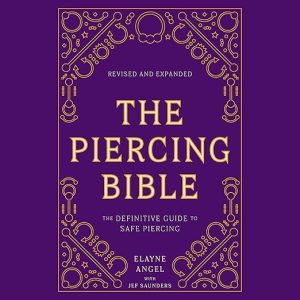
Elayne Angel has performed over 50,000 piercings since the 1980s. She pioneered the tongue piercing placement at a time when it was genuinely experimental, and she has spent decades developing and refining technique across ear, face, oral, and genital piercings - the full spectrum of what professional body modification involves. The Piercing Bible, Revised and Expanded, narrated by Zura Johnson, is the audiobook that makes four decades of that accumulated knowledge accessible to anyone who wants to understand what separates professional body piercing from the kind of work performed at a mall kiosk by someone without proper training. The book's premise is informed consent through education, and it operates at that level consistently across its sixteen hours and forty-six minutes: this is what a piercing involves, this is what it requires from the professional doing it, this is what it requires from you as the person getting it, and this is what it requires from anyone in a clinical or medical context who encounters a piercing-related complication.
The revised and expanded edition includes updated medical and technical content, new illustrations and jewelry photography accessible through the companion PDF included with the audiobook purchase, and fully refreshed information on sterility, sanitation, hygiene, jewelry materials, and aftercare. The original Piercing Bible was published in 2009 and became the definitive reference in its field; the revision updates the clinical content to reflect current professional standards and adds material reflecting the evolution of the industry over the intervening years. One reviewer with credentials in both nursing and piercing education described it as the most complete book ever written for people in the industry - praise worth taking seriously from someone professionally positioned to evaluate it.
Johnson Makes Autoclave Protocols Genuinely Learnable
The audiobook format works for this material more effectively than it might initially appear to, and the companion PDF is a significant part of the reason why. The PDF provides the diagrams, placement illustrations, jewelry photography, and glossary of terms that purely audio delivery could not convey. Angel and the production team have structured the content so that the audio carries the explanatory, contextual, and clinical reasoning while the PDF handles the visual reference - a sensible and practical division that means the audiobook does not attempt to describe a photograph when it can simply show you one. The two resources are designed to be used together, and listeners should plan to have the PDF open while listening to the technical sections.
Johnson's narration across the technical chapters is notably strong. Body piercing involves a vocabulary that non-practitioners will not know - jewelry gauges, specific anatomical placement terminology, autoclave protocols, the distinction between implant-grade titanium and lesser-quality metals - and Johnson delivers this material with pedagogical clarity that makes it genuinely learnable rather than merely pronounceable. She does not rush the sterility sections or flatten the aftercare troubleshooting chapters, which are among the most practically useful parts of the book for anyone currently managing a healing piercing. The measured pacing gives the listener time to absorb and process rather than simply track.
The range of coverage deserves emphasis because it is genuinely encyclopedic in scope. The book addresses ear, nose, face, oral, surface, and genital piercings; placement options for different body types; jewelry design, sizing, and material quality standards; how to evaluate a piercing professional before committing; sterility and infection prevention; the history of body piercing in modern and historical culture; and how to pursue apprenticeship as a career path. The organization allows a reader to navigate to the most relevant sections without needing to listen sequentially, which matters for a reference text of this length.
The practical value for clients - people who are not piercers but who are considering getting pierced - is underemphasized in most coverage of this book. The chapters on how to evaluate a studio, what questions to ask a piercer, how to identify appropriate jewelry for healing, and how to troubleshoot aftercare complications are among the most useful consumer education available in any format on this subject. A significant portion of the piercing complications that end up in clinical settings result from substandard studio work or incorrect aftercare, and Angel addresses both causes directly.
Apprenticeship Still Beats What Audio Can Teach
One reviewer noted clearly that this book will not teach you how to pierce - that requires hands-on apprenticeship under supervision. That statement is accurate and worth stating clearly for any aspiring professional who encounters this book. The Piercing Bible provides the theoretical, historical, and safety foundation for a piercing career; it cannot replace supervised practice and the tactile learning that professional technique requires. It is the essential reference, not the complete education.
The sixteen-hour-plus runtime also requires preparation. This is reference material rather than narrative, and sequential listening from start to finish demands a specific patience with dense technical content. Most listeners will benefit from treating this more like a course than a book - taking sections in focused chunks, returning to specific chapters as needed, using the companion PDF actively alongside relevant audio sections. A cover-to-cover continuous listen is probably not the most effective way to absorb this kind of material.
Three Audiences, One Comprehensive Piercing Reference
This audiobook serves three distinct audiences, and reviewers from all three groups have specifically and enthusiastically endorsed it. People considering their first or next piercing who want to understand the process, risks, placement considerations, and aftercare requirements before committing will find here the most comprehensive available pre-piercing education. Working piercers and apprentices who want a comprehensive reference to return to throughout their careers will find it authoritative and current. Medical and nursing professionals who encounter piercing-related complications and want the clinical context to handle them competently will find it directly applicable. Casual listeners looking for light background information rather than comprehensive education may find the depth and length more than they need - but those who want the real thing will find nothing more thorough in this format.
Is this audiobook useful for someone who just wants to get a piercing safely, or is it mainly for professionals?
It is explicitly useful for clients as well as professionals. Some of the most practically valuable sections cover how to evaluate a piercing studio, what questions to ask a piercer, how to choose appropriate jewelry for healing, and how to troubleshoot aftercare problems. You do not need industry knowledge to benefit substantially from those chapters.
How does Zura Johnson's narration handle the medical and anatomical terminology throughout this audiobook?
Johnson delivers the technical vocabulary with precision and consistency - she does not stumble over anatomy or equipment terminology, and her pacing through the denser sections gives listeners time to absorb rather than simply track the words. The narration is a genuine asset for a text this technically demanding.