Quick Take
- Narration: Cassandra Campbell reads Meadows’s journalistic prose with natural warmth and pacing; her voice handles the emotional weight of the case studies without tipping into melodrama.
- Themes: Integrative and complementary medicine at the frontier of chronic illness, the psychology of persistence and agency, gut health and dietary intervention in autoimmune disease
- Mood: Investigative and quietly hopeful, carried by real human stories rather than theory
- Verdict: Rigorously reported narrative medicine journalism that takes both conventional and complementary approaches seriously; the most honest book in this genre about what we do and do not know.
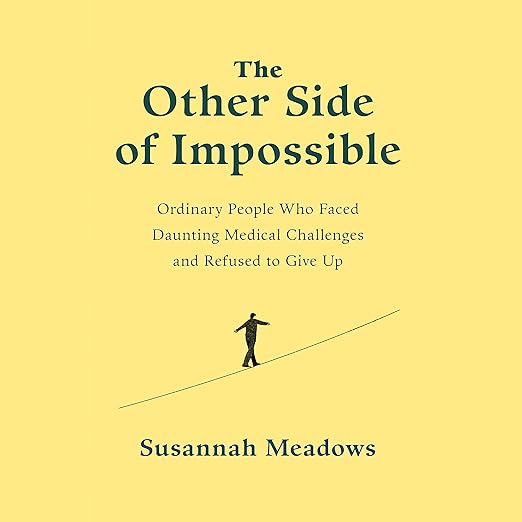
Susannah Meadows writes for the New York Times. That context matters for how The Other Side of Impossible positions itself in a crowded genre. This is not a testimonial for alternative medicine or a dismissal of conventional treatment. It is journalism, and Meadows applies journalistic standards to a question that most writers in this space either champion or debunk rather than actually investigate: What happens when people with serious, treatment-resistant conditions persist beyond what medicine has been able to offer them?
I came to this one familiar with the basic subject matter, having read extensively in the integrative medicine literature, and I found it more rigorous and more emotionally credible than I expected. Cassandra Campbell’s narration, which I have found reliable across a range of nonfiction titles, is well-suited to the material.
The Seven Families at the Center
The architecture of this book is its greatest strength. Rather than building a general argument and illustrating it with cherry-picked examples, Meadows follows seven families in enough detail that you understand both the complexity of their situations and the specific interventions they pursued. The cases span juvenile idiopathic arthritis, severe food allergies, epileptic seizures, MS, ADHD, rheumatoid arthritis, and behaviors on the autism spectrum. This range is deliberate: it prevents the book from becoming an argument for any single intervention or philosophy, because the families used different approaches and arrived at different outcomes.
Meadows’s own son Shepherd is one of the cases, which she is transparent about from the beginning. His juvenile idiopathic arthritis diagnosis, the pain it caused him, and the combination of conventional and complementary approaches that ultimately put his disease into remission is presented with the same scrutiny she applies to the other families. She does not inflate his recovery into a universal template.
The Gut Microbiome Research and Its Actual State
The sections on gut bacteria and their relationship to systemic disease are the most scientifically current part of the book, and Meadows handles them well. She accurately represents the gut microbiome research as genuinely exciting and rapidly developing while being honest that the clinical implications remain considerably less settled than the enthusiastic popular coverage would suggest. The dietary interventions pursued by several of the families, including gluten elimination and specific carbohydrate approaches, are presented as interventions that helped these specific individuals in these specific circumstances, not as universal protocols.
One reviewer’s disappointment about Meadows eventually reintroducing gluten and commercial dairy for her son is itself useful information. It illustrates that the book is honest about the ongoing, non-linear nature of these families’ journeys rather than presenting a clean before-and-after narrative. That honesty is both a journalistic virtue and, for some readers seeking definitive guidance, a frustration.
The Psychology of Healing
The final layer of the book is in some ways the most interesting: Meadows interviews researchers who study what makes some people continue pursuing solutions when others feel helpless. The psychological components of healing, the role of agency, persistence, and the refusal to accept fixed prognoses, turn out to be substantive factors rather than inspirational add-ons. The researchers she cites are working within mainstream psychology, not alternative medicine. This section prevents the book from collapsing into a simple message about the power of positive thinking while still making a serious argument about the psychological preconditions for the kind of persistence these families exhibited.
Cassandra Campbell and the Journalism Register
Campbell is one of the more reliable narrators working in serious nonfiction, and her reading of Meadows’s prose is a good example of why. Meadows writes with journalistic precision, clear sentences, careful qualification, and steady pacing, and Campbell does not emotionalize what the text has kept factual or flatten what the text has made warm. The case study sections in particular benefit from a narrator who can shift registers between analytical and human without drawing attention to the shift. At ten hours and twenty-eight minutes, this is a substantial listening commitment, and Campbell earns it.
Frequently Asked Questions
Does the book advocate for complementary medicine over conventional treatment, or does it present both fairly?
It presents both with journalistic fairness. Meadows is a New York Times journalist, and her approach is investigative rather than advocacy. All seven families in the book used combinations of conventional and complementary approaches, and the text is explicit that neither approach is presented as sufficient or superior on its own.
Is Meadows’s own son’s story presented objectively, or does it become a promotional framework for the whole book?
It is presented with the same scrutiny she applies to the other cases, including acknowledgment of ongoing complexity and reversals. The book does not treat his recovery as a universal template, and one reviewer’s criticism about dietary decisions Meadows made after his recovery illustrates that she remains honest about choices other readers might question.
How current is the gut microbiome and dietary intervention science discussed in the book?
The book presents the science accurately for its publication period, and the broad outlines of the research it covers, including the connection between intestinal microbiome health and systemic inflammatory disease, have continued to develop in the same direction. Some specific dietary interventions may have more evidence behind them now than when Meadows was writing.
Does Cassandra Campbell’s narration work for the emotional weight of the family case studies?
Yes. Campbell handles the shift between analytical journalism and human narrative effectively. The scenes involving children in pain are the most emotionally demanding, and she reads them with the kind of controlled warmth that serves the material without tipping into sentimentality, which would work against the book’s journalistic tone.