Quick Take
- Narration: Gabriel Brownstein narrates his own memoir with the careful, reflective cadence of a literary author, he knows where the emotional weight falls and delivers it without theatrics, which suits this story’s dignity precisely.
- Themes: Congenital heart disease, the history of cardiac surgery, mortality and medical innovation
- Mood: Warm and elegiac, darkened by genuine stakes, Brownstein writes about life at the edge of medicine’s reach with humor and precision
- Verdict: A rare combination of personal memoir and medical history that earns both registers completely, Brownstein’s self-narration deepens the intimacy of a story that is, at its core, about surviving long enough to tell it.
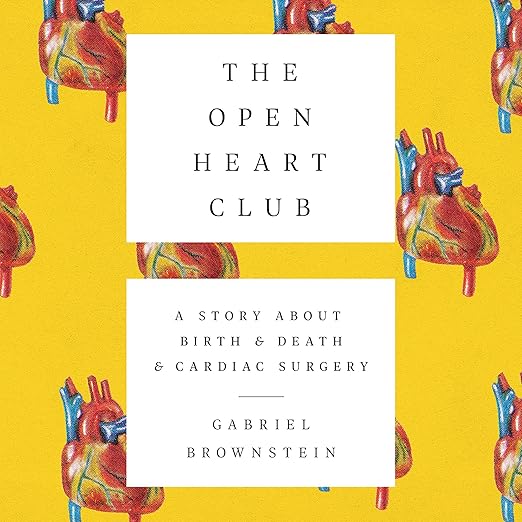
I was halfway through a long evening when I realized I had been listening to The Open Heart Club for two hours without once checking the time. That is the particular achievement of Gabriel Brownstein’s memoir: it moves with the momentum of good narrative nonfiction while carrying the weight of genuine medical history, and it does both without shortchanging either. By the time I reached the sections on the women who invented pediatric cardiology, I had notes I had not planned to take.
Brownstein was born in 1966 with tetralogy of Fallot, a congenital combination of four cardiac defects that, a generation earlier, would have been a death sentence. He received open-heart surgery at age five, at precisely the moment when cardiac surgeons were learning what open-heart surgery could accomplish. Since then, he has lived through wave after wave of cardiac innovation: each new intervention enabled by the previous one, his survival a kind of ongoing collaboration between his own body and the advancing edge of medicine.
A History Hiding Inside a Memoir
The most unexpected dimension of this book is the historical sweep. Brownstein does not simply tell his own story; he uses it as the connective tissue for a much larger narrative about how cardiac medicine came to exist. He traces anatomical understanding from seventeenth-century visionaries through the early twentieth century, then into the extraordinary mid-century period when the fundamentals of pediatric cardiology were being worked out in real time, on real children, with genuine uncertainty about what would survive the next intervention.
Reviewer H. Laack notes the striking statistic: heart defects affect 1 in every 110 babies, making them the most common life-threatening birth defects. Brownstein was one of those children at a time when the medical profession was still learning how to save them. That historical positioning, born in the exact window when the surgery he would need was becoming possible, gives the memoir a structural drama that extends beyond his personal experience.
The sections on the women who developed pediatric cardiology are particularly strong. Helen Taussig and her colleagues are not footnotes here; Brownstein gives them the biographical depth they deserve, tracing the resistance they faced, the patients they saved, and the intellectual innovation that made procedures like Brownstein’s eventual surgery possible. Reviewer Doris Friedensohn uses the word riveting in her review and apologizes for it, then uses it anyway because nothing else fits.
What the Author’s Voice Carries
Brownstein is a literary writer and a professor of creative writing, his prose is not the confessional looseness of a first-time memoirist. The humor that reviewers note is precise and well-timed: dark enough to acknowledge that he has lived much of his life in the hinterlands between sickness and health, but not so dark that it collapses into despair. When he narrates his own story, the literary intelligence is audible. He knows which details to linger on and which to move through quickly. He knows where the joke belongs and where silence is better.
Self-narration in memoir works when the author’s relationship to their material is genuinely irreplaceable, and this is one of those cases. A professional narrator could have delivered the text accurately. They could not have delivered the particular quality of attention a person brings to narrating the story of their own survival.
The Emotional Architecture of Twelve Hours
At just under thirteen hours, this is a generous runtime for a personal memoir, the historical sections earn the length by giving the personal story its full context. Reviewer Shelley N notes her husband, a medical professional, tells everyone in healthcare to read this. Reviewer Doris Friedensohn describes it as multi-dimensional. Both responses reflect the same quality: this is not a medical memoir in the narrow sense of one person’s suffering documented. It is a book about what it means to live inside a medical revolution, and about the people, patients, surgeons, researchers, who made that revolution possible.
The 85 ratings at 4.6 represent a modest but consistent signal of quality. Books about congenital heart disease occupy a narrow audience, which likely accounts for the relatively small review pool rather than any deficiency in the work itself.
Who Should Listen / Who Should Skip
Listen if you have any personal or professional connection to congenital heart disease, or if you simply want a serious memoir that uses one life as a lens for a larger history. Brownstein’s self-narration adds a layer of intimacy that serves this particular material exceptionally well.
Be aware that the medical history sections are detailed and sometimes technical, Brownstein does not simplify the science. Listeners who want purely personal narrative may find the historical scaffolding more demanding than they expected, though those sections are ultimately what elevate this book above standard medical memoir.
Frequently Asked Questions
Does Gabriel Brownstein narrate The Open Heart Club himself, and what does his self-narration add?
Yes. Brownstein, a literary author and writing professor, narrates with the precision and timing you would expect from someone who has spent years thinking carefully about language. His self-narration carries the intimacy of a person recounting their own survival, it is qualitatively different from professional narration in ways that serve this material specifically.
Is The Open Heart Club primarily a personal memoir or a history of cardiac medicine?
It is genuinely both. Brownstein’s life with tetralogy of Fallot provides the personal narrative thread, but he weaves into it a substantial history of cardiac medicine, from seventeenth-century anatomists through the women who founded pediatric cardiology to the surgical innovations that have kept him alive across five decades. Neither dimension shortchanges the other.
Who are the women who invented pediatric cardiology that Brownstein writes about?
Helen Taussig is the most prominent figure, she developed the Blalock-Taussig shunt and co-created the surgical procedures that opened the field of pediatric cardiology. Brownstein profiles her and her colleagues with biographical depth, documenting both their intellectual achievements and the institutional resistance they faced. These sections represent some of the book’s strongest historical writing.
Is The Open Heart Club appropriate for readers without medical backgrounds?
Yes. Brownstein writes as a literary author, not a clinician, and he explains medical concepts with clarity for general readers. The technical sections reward attention but do not require prior medical knowledge. His goal is comprehension and emotional resonance, not clinical instruction.