Quick Take
- Narration: Christina Moore reads with the warmth and authority of someone who has absorbed the material deeply, striking the right balance between clinical accuracy and maternal reassurance.
- Themes: Breastfeeding challenges and solutions, navigating conflicting advice, returning to work while nursing
- Mood: Encouraging and methodical, structured for reference as much as linear listening
- Verdict: Huggins’s seventh edition remains the reference standard for breastfeeding support, and Moore’s narration makes the audio version a genuinely useful companion for the first weeks after birth.
I have watched several close friends navigate the early weeks of breastfeeding over the years, and the pattern is consistent: the hospital visit is too short, the conflicting advice from nurses, lactation consultants, and well-meaning family members begins almost immediately, and the new mother is left trying to synthesize contradictory information while sleep-deprived and recovering from childbirth. This book has been addressing that specific problem for over thirty years. It is not a coincidence that it has sold more than a million copies.
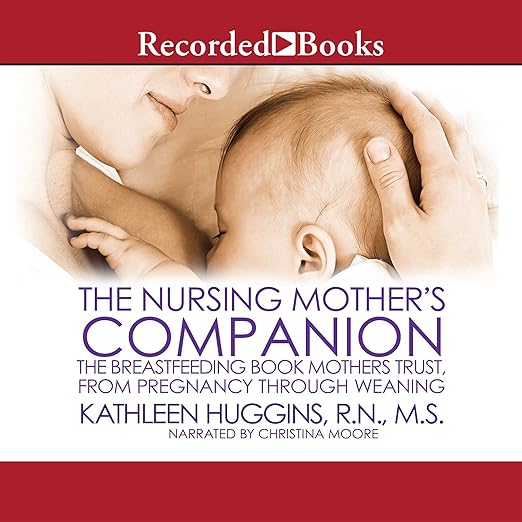
The Nursing Mother’s Companion has been the book most recommended by lactation consultants and the American Academy of Pediatrics in its category for decades. The seventh edition, updated to reflect current research and including new forewords by Jessica Martin-Weber of The Leaky Boob and Kelly Bonata of KellyMom, is the version most new parents will encounter. Kathleen Huggins wrote the original as a practicing nurse-midwife, and the book retains that clinical specificity across its many revisions. Christina Moore’s narration captures both the practical authority and the genuine warmth that have made this the benchmark text in its category.
A Structure Built for Hands-Free Reference
One reviewer who has had seven children described this book as different from other breastfeeding guides because it can be read cover to cover but also works as a problem-solving reference organized by infant age and challenge type. This structural quality matters significantly for the audio format. The book is organized so that a listener can locate information by the specific challenge they are encountering, whether that is latch difficulty in the first week, engorgement and mastitis, returning to work and maintaining supply, or introducing solids in the later months. Moore navigates these structural transitions clearly, making it possible to return to specific sections without losing the thread of the whole.
The coverage is genuinely comprehensive. Huggins addresses the mechanics of milk production and letdown, the identification and treatment of common problems including cracked nipples and low supply concerns, co-sleeping considerations including SIDS risk, breast pump comparisons, and the management of postpartum mood disorders including depression. This last topic is handled with particular care in the seventh edition, reflecting updated research on nutritional interventions alongside conventional treatment options.
Navigating the Information Overload Problem
The forewords by Martin-Weber and Bonata address a real problem directly: the internet has made the information environment around breastfeeding significantly worse, not better. There is more advice available, but the ratio of conflicting opinions to evidence-based guidance has increased. Both foreword writers position Huggins’s book as the authority that cuts through the noise, and that framing is accurate but worth qualifying. The book reflects the research consensus as of its most recent revision, which is not the same as all possible research and certainly not the same as the specific circumstances of an individual nursing relationship.
What Huggins provides is a foundation for informed judgment rather than a set of rules. She writes for adult readers who want to understand the reasoning behind recommendations rather than just receive instructions. That epistemological respect for the reader is evident throughout, and Moore’s narration honors it by reading with the voice of a knowledgeable guide rather than a prescriptive authority.
The Returning-to-Work Section as a Specific Strength
One of the areas where this edition is most practically valuable is the treatment of incorporating nursing into working life. This section covers scheduling, milk storage, pump selection, maintaining supply across different work situations, and the management of the transition from full-time nursing to a combined approach. A reviewer who purchased the book at seven months pregnant and read it cover-to-cover before birth noted feeling confident about the science before her baby arrived, which suggests the book works both as preparation and as reference. That dual function is harder to achieve than it sounds.
Who Should Listen and Who Should Skip
This is a reference audiobook for new and expectant mothers who plan to breastfeed, and for partners and family members who want to support them with accurate information. Healthcare providers who work with new mothers will find it useful for understanding what their patients are reading. The audio format works well for the first few months when a nursing mother may have her hands occupied and earbuds in rather than a book open. Those who prefer to search a physical index will find the print edition easier for targeted reference use.
Frequently Asked Questions
Does the seventh edition significantly update the earlier versions of The Nursing Mother’s Companion?
Yes. The seventh edition includes updated research on postpartum depression, SIDS and co-sleeping risk, nutritional supplements, and breast pump technology. The forewords by Martin-Weber and Bonata are new to this edition and address the changed information environment around breastfeeding since earlier versions were published.
How does the audio format work for a book that functions partly as a reference guide?
Christina Moore navigates the book’s structure clearly, and the chapter organization by infant age and challenge type makes it possible to return to specific sections. For the most targeted reference use, a print copy alongside the audio may be useful, but many listeners find the audio accessible enough for the early weeks when hands-free listening is valuable.
Does the book address breastfeeding challenges that arise for mothers who return to work?
Yes, this is one of the most developed sections of the seventh edition. It covers pump selection, scheduling, milk storage, maintaining supply across work situations, and managing the transition from exclusive nursing to combined approaches. The coverage reflects current workplace realities more directly than earlier editions.
Is this book appropriate for mothers who end up formula feeding by choice or necessity?
The book is designed specifically to support breastfeeding rather than to compare feeding methods. It is explicit about the benefits of breastfeeding and structured to help mothers who want to nurse succeed in doing so. Mothers who end up formula feeding will find most of the content specifically targeted at a breastfeeding relationship.