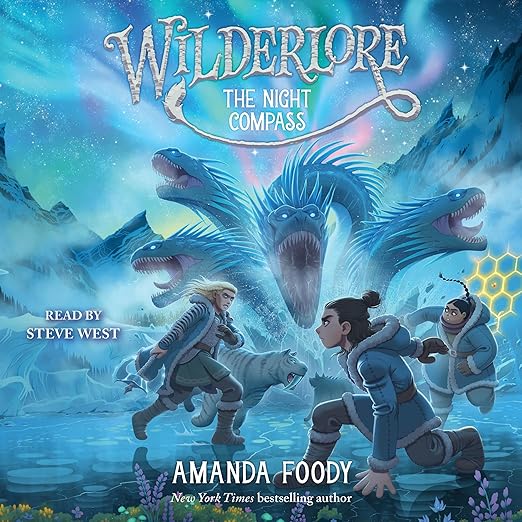
At a Glance
- Read by: Steve West has been the consistent anchor of the Wilderlore series from the start, and his handling of the Tundra's dangers and the evolving cast dynamics continues to serve the story with real craft in book four.
- At its heart: Loyalty under pressure, the cost of leadership, hidden knowledge and its consequences
- Vibe: Adventurous and emotionally resonant, with genuine stakes for characters readers already care about
- Short version: The Night Compass rewards the investment listeners have made in the Wilderlore series by deepening every relationship while raising the political and mythological stakes considerably.
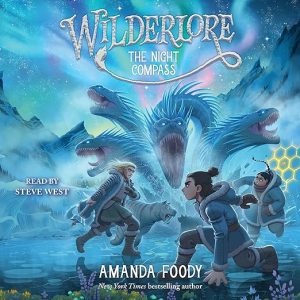
By the time Barclay and his companions reach the Tundra in The Night Compass audiobook, Amanda Foody has built enough trust with her readers to complicate everything she established in the first three volumes simultaneously. The fourth entry in the New York Times bestselling Wilderlore series does not play it safe, and that confidence in the audience is exactly what distinguishes a series that is genuinely developing from one that is simply extending its own premise. Navrashtya, the Legendary Beast missing for centuries from the Tundra, serves as both objective and mystery, and Foody's handling of why she went missing generates unease rather than just dramatic urgency. The question of where she is turns out to be less interesting than the question of why she disappeared in the first place.
The setup is cleanly stated by the story's terms: the election for Grand Keeper is approaching, the villain Audrian Keyes has returned claiming knowledge of Navrashtya's location, and a team of specialized Lore Keepers must find her first no matter what the Tundra costs them. What that summary does not capture is how much of the book's emotional weight rests on what Barclay can feel that no one else can, a strange Lore whose power might save the mission or doom it. Foody has been preparing that element across the earlier volumes with a patience that this fourth book finally rewards, and the payoff is more interesting than the setup suggested it would be.
First, the Big Picture
One reviewer who has been listening to the Wilderlore series alongside their child since book one, and who recommended The Night Compass before even finishing it, captures something important about how Foody's writing works across age groups. She builds characters that adults and children find genuine rather than instrumental, and she addresses complex themes including leadership, sacrifice, and the ethics of power without reducing them to legible moral lessons. By book four, the world has accumulated enough history that the political dimension feels earned rather than decorative, and the Grand Keeper election carries real weight because readers understand what that authority actually means in this world.
The friendship dynamics between Barclay and the other Lore Keepers receive particular and careful attention in this volume. One reviewer notes that Runa reveals another side of herself here, and that the growth in Barclay's relationships surprises even readers who felt they had seen everything these characters could offer. That is a meaningful structural achievement: genuine surprises in a fourth book require carefully laid groundwork across the preceding three, and Foody has been doing that work throughout the series without announcing it.
The ice-cap sequences generate the book's most vivid atmosphere. Foody describes the Tundra's "monstrous Beasts" and "brutal cold" with the specificity of a writer who has thought carefully about how extreme environments change behavior rather than merely using them as dramatic backdrop. The chilling mysteries that await the team in those uncharted regions go beyond physical danger to something stranger, and the transition from adventure to something closer to cosmic unease is handled without disrupting the story's narrative momentum.
Why Listen to The Night Compass
Steve West's narration has been an essential part of the Wilderlore listening experience since the first volume, and his performance in this fourth entry sustains the standard without any sign of fatigue. The physical dangers of the Tundra come through as genuine atmosphere rather than stage direction under his handling. At 15 hours and 28 minutes, this is the most substantial session commitment in the series so far, and West's ability to sustain listener investment across that duration is part of why families and individuals have kept returning to these audiobooks specifically rather than gravitating toward the print editions.
The audio format serves the action sequences with particular effectiveness. Foody writes physical confrontations with a clarity of spatial logic that translates to audio without requiring visual reference, and the disorientation of navigating uncharted ice-cap territory comes through in how West modulates the pace of his delivery during those sequences. He distinguishes cleanly between the quieter character scenes and the high-stakes action, which allows the emotional developments in each to land with appropriate weight rather than blending into an undifferentiated adventure tone.
A Few Reservations
The mystery of why Navrashtya disappeared centuries ago is more than a plot question to be answered when the team reaches her. It is a key to understanding the larger mythology Foody has been assembling across the series, and the answer has retroactive implications for how readers understand events in the earlier books. Pay particular attention to the early scenes where Barclay senses something the other Lore Keepers cannot. The novel is careful about when it explains that Lore and when it leaves it suggestive, and the pacing of those revelations is one of the book's most deliberately constructed elements.
The political dimension around the Grand Keeper election also deserves attention beyond its function as urgent background context. Foody has built a world where power and legitimacy are genuinely contested rather than cosmetically uncertain, and by book four, the implications of those contests for Barclay's future are difficult to compartmentalize from the adventure plot. The two threads are genuinely integrated rather than running in parallel.
Should You Listen to The Night Compass?
Read the first three Wilderlore books first. This is series fiction that builds explicitly on what came before, and starting here would mean arriving mid-development for a cast of characters whose relationships carry the book's emotional weight. For listeners already invested in the series, this is a satisfying and ambitious entry that earns every one of its 15 hours. Parents looking for complex middle-grade fantasy that holds adult attention alongside a child's will find Foody continues to deliver on both fronts without condescending to either audience. The emotional stakes here are real rather than performed, and the resolution, which several reviewers describe as deeply satisfying, honors the investment the series has asked its audience to make.