- Read by: Steve Menasche carries Kass's optimistic and conversational prose with clean authority, keeping the eight-hour runtime from feeling like a sustained pitch.
- At its heart: AI as collaborative partner, career future-proofing, human creativity in the AI era
- Vibe: Optimistic, energizing, and historically grounded
- Short version: Zack Kass's AI case for optimism is better grounded in historical analogy and practical strategy than most of the genre, with narration that keeps the material from drifting into boosterism.
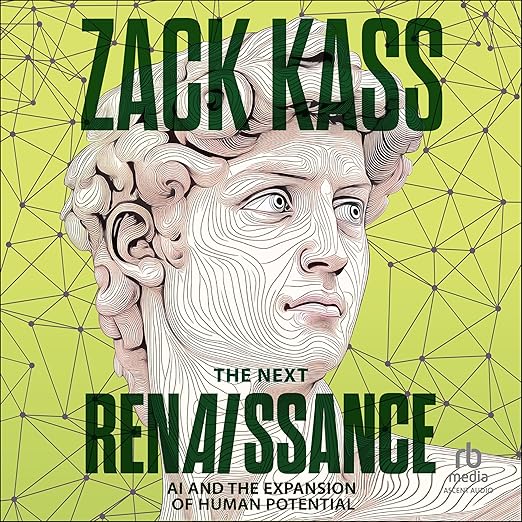
Zack Kass's The Next Renaissance, narrated by Steve Menasche in this audiobook, positions artificial intelligence not as a threat to human creativity but as the mechanism by which a new creative and intellectual flourishing becomes possible. Kass, an AI advisor with firsthand industry experience at the highest levels, makes the historical comparison explicit from the outset: just as the original Renaissance dissolved the boundary between scientific, artistic, and humanistic practice, the current AI shift will dissolve the artificial separation between what humans can imagine and what they can execute. That is an ambitious frame, and Kass spends eight hours making the case for it.
Menasche's narration is clean and confident, well-matched to a book that moves between historical argument, practical career strategy, and speculation about near-term technological change. He reads with the authority the material requires without tipping into the evangelical register that AI optimism writing sometimes defaults to. The pacing is steady across the full runtime, which is a genuine asset in a book that covers as much ground as this one does.
One Reviewer Found an Underline on Every Page
The book's core argument is that AI will function as a collaborative partner rather than a replacement for human intelligence, and that the primary obstacle to benefiting from that partnership is psychological rather than technical. Kass documents the pattern he has observed: the people and institutions that resist AI adoption are not doing so because the technology doesn't work, but because the integration of a new cognitive tool requires revising assumptions about expertise, authorship, and the value of human effort. The historical parallel he draws here is specific and well-deployed, the Renaissance did not make artists obsolete by giving them new materials and methods; it expanded what was possible and elevated the practitioners who adapted earliest.
What distinguishes this from the genre's average is the practical specificity of Kass's career guidance. The sections on "future-proofing your career by emphasizing uniquely human skills" do not traffic in the usual vague reassurance that "creativity" and "empathy" will protect workers from automation. Kass names specific capacities, identifies why they are structurally difficult for AI to replicate in their full social and contextual form, and describes what it looks like to develop them deliberately. One reviewer noted that they had "an underline on every page," which reflects the density of actionable insight relative to the book's length.
The chapter on overcoming psychological and societal barriers to AI adoption is where Kass's firsthand advisory experience is most evident. He has watched organizations with significant resources fail to capture AI's benefits not because the technology was unavailable but because the internal narrative about what AI adoption meant for their people was never adequately addressed. The practical strategies he offers for navigating that transition, addressing the status implications of AI use alongside the technical implementation, are grounded in observed failure patterns rather than theoretical ideal states. For readers in leadership roles navigating AI integration, this is some of the most immediately applicable material in the book.
Menasche Moves Between Registers With No Seams Showing
Menasche's narration earns the eight-hour commitment by keeping the argument's energy consistent across chapters that shift between very different registers. The historical chapters, which trace parallels between the fifteenth-century Renaissance and the current AI shift, require a different vocal texture than the career strategy sections, which are essentially practical instruction. The speculative sections, where Kass describes how AI will transform specific domains of knowledge, require yet another register. Menasche moves between them without the seams showing, which is a mark of narration competence that only becomes visible when it is absent.
The audio format suits this book's conversational intellectual style. Kass writes the way a skilled advisor speaks: he signals his structure, returns to his core analogies, and builds toward his recommendations cumulatively rather than revealing them all at once. Hearing that progression delivered at Menasche's measured pace allows the logic to accumulate in the way the author intended, rather than being compressed by speed-reading or skimmed for bullet points.
Skeptics Won't Find the Toughest Counter-Arguments Here
Listeners who are already deeply skeptical of AI optimism as a genre will find this book persuasive in parts but unlikely to fully convert them. Kass is honest about the challenges and psychological barriers to AI adoption, but his fundamental orientation is optimistic, and the book does not spend significant energy on the most serious counter-arguments, labor displacement at scale, concentration of AI capability in a small number of institutions, or the governance challenges of systems that learn and change faster than regulatory frameworks can track. These are acknowledged but not dwelt on.
The book was written at a particular moment in AI's development, and some of the specific examples of AI capability will date more quickly than the underlying argument. The historical and structural claims Kass makes are more durable than the specific tool comparisons, and the former are where the book's lasting value lies. Those who read extensively in the AI futures space will find some overlap with arguments made elsewhere, though the Renaissance framing and the specificity of Kass's industry experience give this its own distinct angle.
A Genuinely Enjoyable Companion for the Full Commitment
This audiobook suits professionals across industries who want an optimistic but substantive case for engaging with AI rather than resisting it, leaders and managers responsible for navigating AI integration in their organizations, and anyone who wants historical grounding for understanding technological transitions rather than pure futurism. It works particularly well for listeners in the early stages of thinking through what AI means for their career specifically, because the career strategy sections are concrete enough to generate immediate next steps. Those who have already read extensively in the AI governance or critical AI space will find this a useful counterpoint but may want more engagement with the challenges than Kass provides. Menasche's eight-hour narration is a genuinely enjoyable companion for the full commitment.
Good to Know
At eight hours, does this audiobook sustain its argument without becoming repetitive?
Reviewers consistently describe the pacing as engaging across the full runtime, with multiple practical sections that prevent the book from resting too long on any single idea. The chapter structure moves between historical argument, practical guidance, and speculative analysis, which varies the texture enough to sustain the commitment.
Is this audiobook still relevant given how quickly AI technology changes?
The historical argument and career strategy sections are durable and do not depend on any specific AI capability that might be superseded. The specific tool examples will date, but the structural case Kass makes about human-AI collaboration and the psychology of adoption is not tied to any particular platform or model.