Quick Take
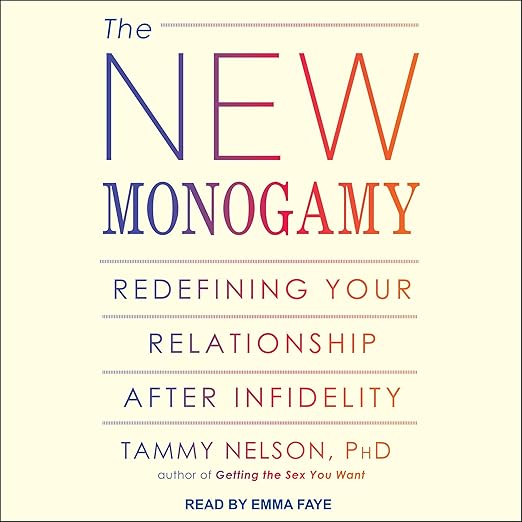
- Narration: Emma Faye’s reading is measured and clear, appropriate for a therapeutic workbook format, and the imago dialogue sections benefit from the steady pace she brings.
- Themes: Infidelity recovery, redefining relationship agreements, rebuilding erotic and emotional trust
- Mood: Serious and therapeutic, with a surprising degree of pragmatic compassion for both partners
- Verdict: For couples in genuine post-infidelity recovery who want a structured approach, this delivers. Readers should know the open relationship section is coming at the midpoint and why it’s there.
I listened to the first half of this on a morning when I had no particular emotional stake in the subject, and found myself considerably more engaged than I expected. Tammy Nelson’s premise is deceptively simple: most couples assume they share a monogamy agreement without ever having articulated what that agreement actually contains. When infidelity happens, what breaks is not just trust but a set of implicit assumptions that were never made explicit, which means rebuilding the relationship requires first making the agreement visible and then renegotiating it consciously. That’s a more generative frame than the one most infidelity literature offers.
The book is designed to be worked through, not just listened to. It moves in sequence: establishing trust after the affair comes first, then imago dialogues, a structured communication technique drawn from Harville Hendrix’s relational therapy work, that help each partner surface what they actually want. Then comes the harder work of the erotic recovery, addressing the specific sexual rupture that infidelity creates and that couples often navigate less directly than the emotional dimension.
The Imago Framework and Why It Works Here
Nelson’s use of imago dialogue as a structural spine for the post-infidelity conversation is well-chosen. The technique was designed to help couples communicate about charged emotional content without the conversation collapsing into re-litigation of grievances, and that’s exactly the problem infidelity creates. The specific questions she poses about desire, expectation, fear, and the shape of what each partner actually wants are more precise and more honest than what most couples generate on their own. A couples therapist reviewing the book noted using the techniques and concepts directly in clinical work, which is the most reliable signal of practical value I know.
The dialogues translate reasonably well to audio, though this is a case where having the print alongside would strengthen the workbook function. Some of the guided exercises are harder to engage with in motion. If you’re listening while commuting, you’ll miss the reflective dimension entirely.
The Open Relationship Section and the Polarized Response
About halfway through, Nelson introduces the possibility that some couples, in redefining their monogamy agreement, may choose to create what she calls a transparent non-monogamy structure. One reviewer, 28 years into a marriage that ended in infidelity, described this as the moment the book lost them. That’s a real response to a real passage, and worth naming directly. Nelson’s argument is not that infidelity should lead to open relationships, but that every couple’s renegotiated agreement should be explicitly made and individually tailored, and for some couples, some form of non-monogamy is what they actually agree to. For readers with strong convictions about what constitutes a valid marriage, this section will land poorly regardless of how it’s framed. Knowing it’s there before you arrive at it is more useful than being surprised by it.
For couples who approach the book with genuine openness about what might be possible, the section is less disruptive than it sounds. Nelson doesn’t moralize in either direction, and she continues to provide structured tools for whatever agreement the couple ultimately makes.
The Erotic Recovery Chapters
These are the section of the book that most infidelity literature avoids. Nelson addresses the specific sexual dimension of post-affair recovery: the way desire gets destabilized, the way some partners want sex more after an affair and others want it less, the way the betrayed partner’s sexual self-concept is often damaged in ways that aren’t immediately obvious. Her guidance here draws on her work as a certified sex therapist and goes to places that more general relationship books don’t follow. For couples who’ve found that their therapist addresses the emotional dimension of recovery but steps back from the physical, this section is particularly valuable.
Who Should Listen
Couples actively in post-infidelity recovery who are working with a therapist or committed to working through this on their own. Solo listeners trying to understand what happened in a past relationship may also find value in the framework. This is not a book for couples in happy relationships who want to proactively improve communication, nor is it a useful entry point for someone trying to determine whether their relationship has issues worth addressing. The focus is specific: recovery from a specific wound.
Frequently Asked Questions
Does the book take a position on whether couples should stay together after infidelity?
No. Nelson’s framework is explicitly about helping each couple determine what their own renegotiated agreement looks like, which may or may not involve staying together. She’s not invested in a particular outcome for the relationship, which makes the book more useful as a therapeutic tool than titles that assume reconciliation as the goal.
The imago dialogue technique requires both partners to engage. Is this a book you can use alone if your partner won’t participate?
You can gain meaningful insight from the framework and the questions even without a participating partner, but the core exercises are designed for two people. Solo listeners will find the conceptual framing and erotic recovery sections valuable; the dialogue work specifically requires a partner who’s willing to engage.
How does Nelson handle the situation where the person who had the affair isn’t remorseful?
The book assumes some basic willingness from both partners to engage in recovery. It doesn’t have a strong framework for a scenario where the unfaithful partner is not committed to repair. If remorse or commitment is genuinely absent, the structured dialogue approach requires a different starting point than this book provides.
Is the open marriage discussion at the midpoint substantial, or is it a brief section I can skip?
It’s a meaningful section, not a footnote. Nelson spends real time on transparent non-monogamy as one possible outcome of the renegotiated agreement. Readers who find that content incompatible with their values will know it’s coming and can engage or skip accordingly, but it’s not possible to characterize it as peripheral.