In Brief
- Narration: Dave Berke narrates his own audiobook with the controlled authority of someone who has briefed generals and instructed pilots; his delivery is direct and unhurried, and it suits the material entirely.
- Themes: Leadership as universal responsibility, humility as a leadership tool, military principles applied to civilian life
- Mood: Direct and motivating, grounded in earned experience rather than inspiration
- Verdict: The third Extreme Ownership Series audiobook is the most personally grounded entry, built on Berke's specific trajectory from TOPGUN instructor to boardroom consultant in a way that gives the leadership principles unusual concreteness.
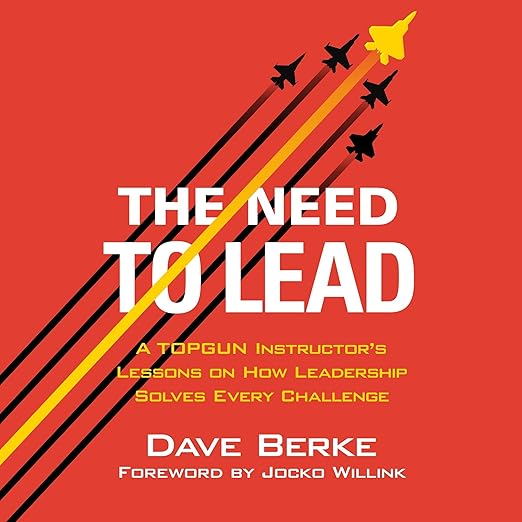
Dave Berke narrates his own audiobook The Need to Lead, the third installment in the Extreme Ownership Series from Echelon Front, and the self-narration is not incidental to how the audiobook works. Berke is a retired Marine Corps officer, TOPGUN instructor, and ground combat leader who now serves as Chief Development Officer at Echelon Front, the leadership consultancy co-founded by Jocko Willink and Leif Babin following the success of their own bestselling books in the series. Having Berke read his own material means listening to the exact voice that delivered these concepts in cockpit briefings and combat leadership situations before translating them to the boardroom, and that continuity is audible throughout the 7 hours and 55 minutes of the recording.
The audiobook's central premise is expansive: everyone at every level is a leader, regardless of rank, title, or function. Leadership is not a role or a designation but a capacity available to every person in an organization, a marriage, a family, or a friendship. Every problem is a leadership problem, and leadership is a learnable skill rather than an innate trait. Those four propositions organize the audiobook's argument and Berke develops each through stories from TOPGUN training, combat deployments, and corporate consulting work that give the abstractions specific and often humbling shape.
Leif Babin Singles Out Berke's Humility
The audiobook's most distinctive quality is Berke's transparency about his own failures. Leif Babin, writing a review of the book, specifically cited Berke's humility as the quality that most effectively transmits the leadership lessons. The stories Berke tells about his own mistakes, the times he failed his team in the cockpit or the field, are delivered without self-exculpation. He does not frame his failures as learning opportunities in the corporate-motivation-speaker sense; he describes what he got wrong and what it cost, and the audiobook is more useful for that directness than a collection of success stories would be.
One reviewer required the audiobook as reading for their entire team, which is consistent with how the Extreme Ownership series has been used by organizations since the original Willink/Babin books. The Need to Lead extends the series framework to a slightly different question: not just how to lead when you have formal authority, but how to lead from any position and in any domain of your life. The TOPGUN framing is not gratuitous; Berke draws genuine parallels between the specific culture of elite military aviation and the mechanisms of civilian organizational performance.
The audiobook's TOPGUN material is the most vivid and the most immediately persuasive in how it illustrates the leadership principles. Berke describes specific moments of failure in the cockpit with the specificity of someone who has debriefed those moments many times, in institutional settings designed to extract every lesson from every error. That debrief culture, the systematic, non-defensive examination of what went wrong and why, is itself one of the leadership tools Berke argues should be transplanted to civilian organizations, and the audiobook makes the case for it convincingly through the examples he uses from his own career.
Berke's Cadence Sounds Like a Veteran Instructor
This is an audiobook that benefits from Berke's self-narration in a specific way: the pacing is deliberate. He does not rush. The stories he tells have a cadence that feels like a veteran instructor who knows which pauses to hold, and that quality makes the audiobook easier to absorb than a faster or more energetic delivery would be. Business leadership audiobooks often suffer from narration that treats every sentence as equally important; Berke's version has the modulation of someone who has distinguished between what matters and what is context for years under high-stakes conditions.
At just under 8 hours, The Need to Lead is also a manageable commitment. The argument is focused and the sections build logically on each other, so listeners who engage with it in sustained blocks will find the cumulative effect of the principles more valuable than a fragmented listen. The audiobook is published by Macmillan Audio, and the production quality reflects that; the recording is clean and consistent throughout.
Family Leadership Gets the Same Seriousness as Combat
The section on leadership as a skill rather than a trait is where the audiobook distinguishes itself most clearly from the motivational-adjacent end of the leadership genre. Berke's argument that good leaders are made through specific practices, not through inherent personality qualities, has practical implications for how listeners can approach their own development, and his examples from TOPGUN training, where the explicit institutional mission is to manufacture superior combat performance through rigorous instruction, give that argument a concrete backing.
The chapters on leadership in family and personal relationships are handled with the same seriousness as the professional material, which is either the book's most interesting extension or the one that will divide listeners. Berke does not treat the combat and boardroom content as the real material and the personal content as an afterthought; he argues that the same principles govern all of it. Whether that reading of leadership resonates or feels like an overclaim will depend on what the listener brings to the audiobook.
Skip if You're Skeptical of Military Analogies
Existing followers of the Extreme Ownership series will find this audiobook a natural and substantive addition; it extends the framework to questions the Willink/Babin books did not address directly and delivers them through a different personal history that enriches the series rather than repeating it. Listeners new to the Echelon Front approach can start here without prior context; the audiobook does not depend on familiarity with the previous entries. Skip it if you are skeptical of military-to-business analogies as a genre; that framework is structural here and is not separable from the content.
A Few Questions About The Need to Lead
Do I need to listen to Extreme Ownership or The Dichotomy of Leadership before starting the The Need to Lead audiobook?
No. The Need to Lead is the third audiobook in the Extreme Ownership Series but functions as an independent argument. Berke develops his framework from the ground up and does not require listeners to have heard Jocko Willink and Leif Babin's contributions to the series. Prior familiarity enriches the listening but is not a prerequisite.
How does the The Need to Lead audiobook compare to other military-to-leadership crossover titles in the genre?
Berke's audiobook is more personally grounded than most in the genre because the combat and aviation stories are his own, not borrowed examples. The TOPGUN context gives specific institutional weight to claims about performance culture that more generic military analogies cannot match. The audiobook also extends the leadership argument to personal and family domains more explicitly than most competitors in the space.
Is this audiobook useful for listeners who are not in formal management or leadership roles?
The central argument is that every person at every level is a leader, which means Berke explicitly addresses listeners who do not have formal authority. The audiobook is designed to be useful for the most junior employee as much as the CEO, and the personal domain chapters extend that argument beyond the professional context entirely.
How does Dave Berke's narration compare to the performance of professional audiobook narrators in the leadership genre?
Berke's narration is deliberate and unhurried rather than energized in the way professional narrators in the business category often perform. His cadence comes from years of briefing and instructing under high-stakes conditions, which gives the audiobook a specific authority that a hired narrator working from the same text could not replicate. Listeners accustomed to more theatrical business audiobook narration should calibrate their expectations.