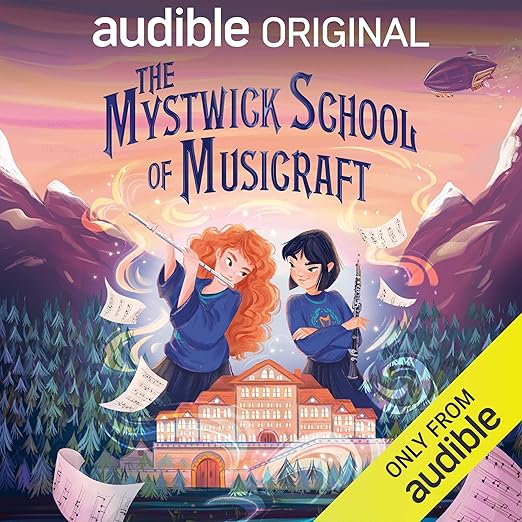
Quick Take
- Narration: Suzy Jackson’s award-winning performance gives Amelia Jones both stubborn determination and genuine vulnerability; the NJSO Youth Orchestra musical compositions woven into the listening experience are not a gimmick but a structural element.
- Themes: Belonging and the impostor syndrome of gifted children, music as emotional truth-telling, the tension between rule-following and authentic expression
- Mood: Warm and propulsive, with musical interludes that deepen rather than interrupt
- Verdict: One of the genuinely audio-native middle-grade productions available today, designed from the start to exist as sound rather than adapted from print.
I was halfway through a rainy Wednesday afternoon when I started The Mystwick School of Musicraft, intending to sample it briefly before moving on to something else. Four hours later, the rain had stopped and I had not moved. This is the kind of audiobook that justifies the specific patience required by the format: Jessica Khoury’s story is good on the page, but as sound, with Suzy Jackson’s narration and the NJSO Youth Orchestras’ original compositions woven through it, it becomes something that the print version of the same story simply isn’t. The music is not decoration. It is argument.
The premise positions the book in a specific tradition of magical school stories. Amelia Jones has one dream, admission to the Mystwick School of Musicraft, and she botches her audition. She gets a second chance through what the school frames as charity rather than merit, which immediately establishes the central tension: Amelia has to prove herself in an institution that has already decided she doesn’t belong, while the institution itself may be wrong about what belonging requires. That’s a familiar setup in the Nevermoor and School for Good and Evil tradition, and Khoury uses it to explore something more interesting than most comparable titles: the difference between technical musical ability and musical truth.
The NJSO Youth Orchestras and What Integrated Music Does to Narrative
The most significant thing about the Mystwick audiobook is the decision to commission original compositions from the New Jersey Symphony Orchestra Youth Orchestras and integrate them as actual story content rather than ambient background. When Amelia plays a particular piece, you hear it. When she fails, the music fails with her. When she finally finds her own musical voice, the composition changes in ways that carry specific emotional information that Khoury’s prose is describing simultaneously.
This is an ambitious production choice and it pays off. The compositions are age-appropriate in complexity but genuinely well-crafted, not simplified in the condescending way children’s orchestral writing sometimes is. The integration with Jackson’s narration is well-paced enough that the musical passages feel like earned punctuation rather than padding. At eight hours and eighteen minutes, there’s room for the music to breathe, and the production uses that room wisely.
The audiobook is available in Dolby Atmos on Audible, and the spatial audio adds a dimension to the performance sequences that rewards listening with good headphones. Amelia’s instrument moving through space has a quality that deepens the storytelling without requiring active attention to the technical achievement.
Suzy Jackson’s Amelia and the Performance of Not Being Good Enough Yet
Award-winning narrators for middle-grade fiction earn their reputation primarily through their ability to inhabit a protagonist whose defining quality is being in the middle of something. Amelia Jones is not at the beginning of her journey, full of innocent confidence, and not at the end, having achieved mastery. She is in the exact place where she has enough skill to understand her own limitations but not enough to correct them. Jackson plays this with a quality I’d describe as determined inadequacy: Amelia’s voice carries the weight of knowing she isn’t good enough yet and the unwillingness to accept that this is permanent.
The teacher who dislikes her, Professor Mouton, is rendered with just enough specificity to be recognizable as a type without becoming a caricature. The roommate who wants to see her expelled, Bex, benefits from Jackson’s ability to distinguish voices across a range of emotional registers, from openly contemptuous to grudgingly respectful as the story develops. The friendship dynamics that emerge over the course of the narrative are handled with enough restraint that you feel the emotional shifts rather than being told about them.
What the Kirkus Review Called Toe-Tapping and What It Actually Is
The Kirkus review quoted on the cover calls this toe-tapping fantasy that mixes music and mystery, which is accurate as far as it goes. What it misses is the book’s genuine emotional ambition. The supernatural threat to Mystwick that Amelia must address is the least interesting part of the story; what makes the book worth the listen is the internal question Khoury is pursuing: can you be taught music, or can you only be helped to hear what’s already true about you? Amelia’s journey answers this question in a way that is specific to her character rather than generic to the genre, and Jackson’s performance is the instrument through which that answer arrives.
The plot twist mentioned in listener reviews is well-constructed, built from elements introduced in the book’s first half rather than arriving from outside the story’s logic. It recontextualizes a significant relationship in a way that makes the narrative’s themes explicit without feeling forced.
Who Should Listen and Who Should Skip
Mystwick is designed for middle-grade listeners between eight and twelve, and the emotional complexity of its central character’s journey makes it particularly well-suited to children who have experienced the specific anxiety of caring intensely about something and not being sure they’re good enough for it. Children who have some relationship with music, whether through lessons, choir, or casual interest, will find additional resonance in the compositions and the school’s magical system. Adults who enjoyed Nevermoor, The School for Good and Evil, or comparable series will find Mystwick a satisfying peer title with the specific addition of an audio-native musical dimension those books don’t have.
Frequently Asked Questions
Is the Mystwick audiobook meaningfully different from the print version, or is it essentially the same story with narration added?
The audiobook is genuinely different from the print version. The NJSO Youth Orchestras’ compositions are integrated as story content, meaning certain sequences that the print reader imagines are actually performed for the audio listener. The story itself is the same, but the experience is structurally distinct.
Is there a second book in the Mystwick School series, and does this audiobook end in a way that requires a sequel?
The book is listed as Mystwick School Book 1, indicating a series is intended. The ending resolves the primary narrative conflict while leaving elements open for continuation. Listeners who finish wanting more should check on Book 2’s availability.
Does the Dolby Atmos production require specific headphones to appreciate, or does it work on standard earbuds?
The production works on standard earbuds, and the narration and music are the primary draw regardless of spatial audio capability. Dolby Atmos-compatible headphones add a dimension to the performance sequences, but they are not required to get the full emotional experience.
Is Mystwick appropriate for children who found the Harry Potter books too intense or dark?
Mystwick is lighter in tone than mid-series Harry Potter. The stakes are real but the darkness is managed carefully, and the emotional content is more centered on belonging and friendship anxiety than on violence or loss. It’s a strong recommendation for readers who want magical school stories without the escalating darkness of the HP later books.