Quick Take
- Narration: Andrew Peterson’s self-narration grows more assured with each Wingfeather volume; by book three he is fully inhabiting the saga’s emotional register, and the scenes of family crisis in this installment are among his best recorded work.
- Themes: Otherness and belonging, the fear communities have of what they don’t understand, identity under pressure
- Mood: Emotionally intense with bursts of humor, grounded more in community and consequence than in pursuit and flight
- Verdict: The Wingfeather Saga’s most emotionally complex volume, shifting the action to a new community and using Kalmar’s transformation to ask hard questions about what it means to belong.
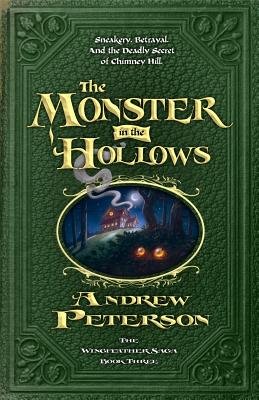
The Wingfeather Saga changes shape with its third book, and that change is its greatest risk. After two volumes of constant flight, of the Igiby family running from the Fangs of Dang across a dangerous and inventive world, The Monster in the Hollows slows down and settles into a community. The action shifts to the Green Hollows, a place of relative safety, and the threat this time is not an army but a much more intimate kind of danger: the fear that one of the Igiby children has become the monster the title suggests.
The synopsis supplied with this listing describes only the physical book object rather than its contents, so I am working from the book’s broader reputation and from what the reviews supply. A parent who read all four books described this as so good that even that felt like an understatement. A teenage reader described it as very enthralling with a great family dynamic and realistic emotional content. And a reviewer noted that it introduces different kinds of literature from sea dragons to slithery snake men and even touches on child abuse, which is worth noting for parents thinking about age-appropriateness.
The Community of the Green Hollows
Moving the action to an established community with its own culture, prejudices, and internal politics is one of the more demanding structural choices a fantasy author can make. Peterson has to build the Green Hollows as a believable place with enough density to generate real conflict, while also keeping the momentum that has driven the first two books. By most accounts he succeeds. The community serves as a mirror for the saga’s core themes: belonging and otherness, the gap between what someone is and how they are perceived, and the specific cruelty that communities direct toward what they fear.
Andrew Peterson’s self-narration is well-suited to this material. The Green Hollows requires him to voice a wider range of community members than the flight-driven earlier books, and his authorial intimacy with the world pays dividends in how he differentiates the supporting cast. The nine-hour runtime is more reflective than propulsive compared to book two, but the emotional density compensates for the reduced pace.
Kalmar’s Transformation and What It Costs the Family
The central dramatic engine of this book is the situation of one of the Igiby children, who has been transformed in ways that make the community of the Green Hollows view them as dangerous. The series has always been interested in what it costs to carry an identity that frightens other people, and this predicament is the most sustained exploration of that theme in the saga. Peterson does not resolve it quickly or comfortably.
The reviewer who noted that some parts may not be suitable for younger kids, and referenced elements touching on child abuse, is pointing to material that the series has been building toward. Peterson is writing about trauma, about what happens to people who have been used as instruments by those who should protect them, and the Wingfeather Saga’s willingness to address that honestly is part of what distinguishes it from lighter fantasy. That same willingness requires parents to make thoughtful decisions about when to introduce it.
A Tradition Worth Following
A parent reviewer who ordered all four books at once and described the series as reminiscent of The Chronicles of Narnia is accurately placing it in a tradition. Peterson is writing Christian-inflected epic fantasy in the Inklings tradition, and readers who love Lewis will find the moral architecture familiar and satisfying. The series earns its spiritual points through story rather than substitution, which makes it work for readers regardless of faith background.
The Monster in the Hollows is the third of four books, and arriving here without the first two would leave a listener comprehensively lost. Committed Wingfeather Saga readers will find this the most demanding volume in the series and arguably the most rewarding. For families who are newer to the series, beginning with book one and listening alongside the children is worth considering, especially as the content in this installment reaches into territory that is more emotionally complex than most middle-grade fantasy attempts.
Frequently Asked Questions
The synopsis listed doesn’t describe this book at all. What is The Monster in the Hollows actually about?
The listed synopsis is a product description error describing only the physical book object. The Monster in the Hollows is the third Wingfeather Saga book, following the Igiby family to the Green Hollows, where one of the children faces suspicion and fear from the community because of a transformation that makes them appear monstrous.
Does the series get darker in book three, and is it still appropriate for middle-grade readers?
Yes, it is notably more emotionally complex than the first two books, and reviewers have flagged that some content, including elements touching on child abuse and the psychological aftermath of trauma, may not be suitable for younger readers in the eight to ten range. Ages eleven and up are generally better equipped for this installment.
How does Peterson’s narration change between the more action-driven second book and this more community-focused third book?
Peterson’s pacing is more reflective in book three, which suits the shift from flight narrative to community drama. He has more character types to differentiate as the cast expands to include the Green Hollows community, and his comfort with the material has visibly grown across the series.
Is this series comparable to The Chronicles of Narnia as some reviewers suggest?
In spirit and tradition, yes. Peterson is writing in the Christian-inflected Inklings tradition that includes Lewis and Tolkien. The moral architecture has that lineage, but the saga earns its spiritual points through story rather than allegory, which makes it work for readers regardless of faith background.