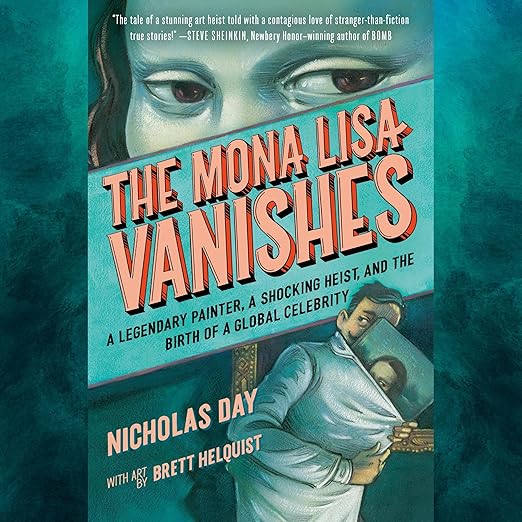
Quick Take
- Narration: Carlotta Brentan brings genuine urgency to the heist sequences and warmth to the Leonardo passages, navigating the dual timeline with clarity and confidence.
- Themes: Art theft and notoriety, Renaissance genius and its contradictions, the making of a cultural icon
- Mood: Propulsive and curious, like reading a thriller in a museum after hours
- Verdict: Nicholas Day’s middle-grade nonfiction is precisely the kind of book that turns reluctant readers into history devotees, and Brentan’s narration honors that ambition fully.
I was folding laundry on a Sunday afternoon when I put this one on, expecting something pleasant and educational that I could half-listen to. By the time Vincenzo Peruggia had slipped out of the Louvre with the world’s most famous painting tucked under his coat, I had stopped folding entirely. That almost never happens with middle-grade nonfiction.
The Mona Lisa Vanishes is the kind of book that knows exactly what it wants to do and executes with uncommon precision. Nicholas Day has written a work of narrative nonfiction that reads at the pace of a heist novel, and Carlotta Brentan’s narration is fully in on the game. She gives the Paris of 1911 a particular electricity, moving through the story’s competing timelines with the kind of controlled energy that keeps younger listeners anchored without talking down to them.
The Theft That Made a Portrait Immortal
Day’s central argument is genuinely surprising: that the Mona Lisa was not especially famous before it was stolen. The theft itself, on that hot August morning when a panicked guard burst into the director’s office shouting “La Joconde, c’est partie,” transformed a respected if understated Renaissance portrait into the most recognized image in the world. The book builds this case with accumulating evidence and sharp wit, tracing how the media frenzy, the public grief, and the parade of false suspects including the young Pablo Picasso elevated the painting to near-mythological status. It is a story about fame as much as theft, and Day handles both strands with equal confidence.
One reviewer quoted the line: “The Mona Lisa being stolen was impossible, but impossible things were happening every day, sometimes before breakfast.” That’s a fair sample of Day’s prose register throughout. He writes with a wry intelligence that respects young readers enough to give them real ideas to wrestle with. The nod to Lewis Carroll is not accidental; there’s a sense throughout that Day is building something both playful and rigorous, a book aware of its own literary inheritance.
Leonardo Before the Louvre
The book’s structural gamble is to pull the camera back much further than the 1911 theft, reaching all the way into Leonardo da Vinci’s own life to explain why the painting exists at all and why it should not, technically, have survived. This is where Brentan’s narration earns its keep. She shifts register when the narrative moves into the Renaissance passages, slowing slightly, letting the strangeness of Leonardo’s world accumulate. The claim that the painting should never have existed is not rhetorical flourish; Day unpacks it across several chapters, tracking the commissions that fell through, the patron who never received the portrait, the decades it spent traveling with Leonardo rather than hanging on any wall. For listeners who come to this book expecting a straightforward crime story, these passages are a genuine surprise.
Turn-of-the-Century Paris as a Character
Day excels at urban atmosphere. His Paris is vivid and specific: the backstreets, the newspapers, the criminal underworld, the art market operating in moral gray zones. The international gang theory, the American millionaire theory, the Picasso theory each gets its moment, and Day resists the urge to resolve the suspense prematurely. The book teaches middle-grade readers something valuable about how historical investigation actually works, through the accumulation of partial evidence, competing interpretations, and moments of genuine uncertainty. That’s a sophisticated epistemological lesson delivered inside a thriller structure, and the balance rarely tips awkward.
Who Should Listen and Who Should Skip
This is an ideal listen for ages nine through thirteen with any interest in art, history, crime, or Paris. It also works beautifully for classroom and family listening; the dual timeline and clear chapter structure make it easy to pause and discuss. One reviewer used it for an intergenerational book club stretching across continents, which tells you something about its range. Adults who enjoy popular history written with genuine narrative drive will find it holds up well at any age. Listeners seeking only the heist story may find the Renaissance sequences a detour, though most will come around to appreciating how the two timelines illuminate each other.
Frequently Asked Questions
Does the audiobook work well without the book’s illustrations, which reviewers describe as exquisite?
Carlotta Brentan’s narration stands on its own, and Day’s prose is descriptive enough to carry the visual material aurally. That said, listeners who can access the illustrated print edition alongside the audio will get the fullest experience, particularly for the Leonardo passages.
How does the book handle the dual timeline between 1911 Paris and Leonardo’s Renaissance Italy?
Day uses clear structural transitions between the two timelines, and Brentan’s narration marks the shifts through subtle changes in pacing and tone. Most listeners nine and up will follow the structure without difficulty.
Is the identity of the thief revealed, or does the book leave it as an open mystery?
The historical record does eventually point to a real person, and Day follows that record honestly while keeping the investigative suspense alive through most of the book. The resolution is historically grounded, not invented.
Is this appropriate for listeners who know nothing about art history or Leonardo da Vinci?
Absolutely. Day builds all necessary context from the ground up, assuming no prior knowledge. The book is specifically designed to be a first encounter with both the theft and with Leonardo’s life and work.