Quick Take
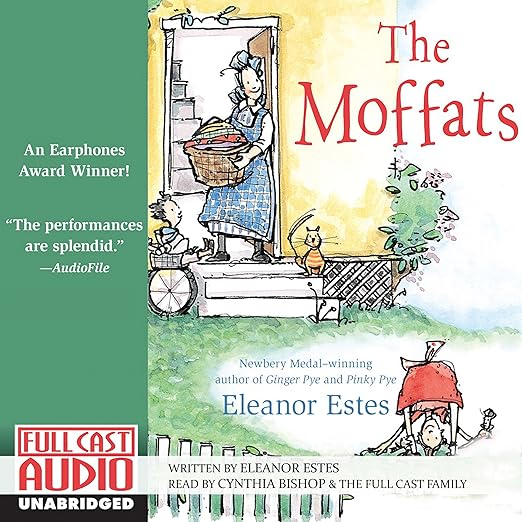
- Narration: Cynthia Bishop leads a full cast that the production itself describes as falling in love with the material, the warmth is audible throughout the recording.
- Themes: Working-class family resilience, childhood as its own complete world, episodic small joys
- Mood: Gentle, nostalgic, and genuinely funny in the way of things that are old and still work
- Verdict: A full-cast adaptation of Eleanor Estes’ eighty-year classic that earns its intergenerational reputation, ideal for families who want something warm and unhurried.
My mother pressed a copy of The Moffats into my hands when I was nine and told me it was the book that taught her what family actually looked like in fiction. I found it sweet but slightly slow at the time. I came back to it at thirty-two and understood what she meant. When I encountered this full-cast recording, I was curious whether the production would honor the specific quality that made the books last, their warmth, their gentleness, their refusal to manufacture drama out of situations that are simply the texture of living.
Eleanor Estes published The Moffats in 1941, and it has been in print for over eighty years because it does something quietly difficult: it tells the stories of a poor, fatherless family in a small Connecticut town without sentimentalizing their poverty or dramatizing their hardship. The four Moffat children, Sylvia, Joey, Janey, and Rufus, navigate their episodic adventures as children for whom the interior logic of childhood is the primary reality. Their mother is present and loving and stretched in equal measure. The yellow house they are about to lose is not a metaphor for anything, it is simply their home, and that specificity is what gives the book its emotional weight.
What a Full Cast Does to Classic Fiction
The Moffats is described as a full-cast recording, and the production quality reflects genuine care for the material. Full-cast productions of classic children’s fiction can go wrong in several directions, overcasting, uneven performances, sound design that competes with the text, but this recording, according to the production notes, featured a cast that fell in love with the book during the process. That affection is audible. The performances do not strain for effect. They inhabit a world that already exists on the page and trust the material to do its work.
Cynthia Bishop leads the cast, and her anchor performance provides the through-line that keeps the episodic structure coherent. The vignette format of the original, each chapter focusing on a different child’s adventure, works well in audio because the ensemble can shift focus without losing the warmth of the whole. Reviewer Jetes808 describes revisiting the Moffat books as an adult as enthralling in a way they were not as a child, which is one of the signatures of fiction that has actual depth beneath its apparent simplicity.
Eighty Years of Childhood Staying the Same
The Moffats is set in the early twentieth century, and children encountering it for the first time today are separated from its setting by a hundred years and from its publication by eighty. None of this appears to matter. Reviewer Finch describes passing the book down through multiple generations, from mother to them, now to a niece, and the consistency of the response across decades is striking. Joey’s anxiety about a specific social situation, Janey’s small miscalculations, Rufus’s perspective on everything being enormous and slightly bewildering, these read as contemporary because they are accounts of childhood experience rather than accounts of a specific era.
This is one of the quieter arguments for why classic children’s fiction persists: the emotional specificity of childhood does not date in the way adult psychology does. The things that make children anxious, joyful, and confused are more consistent across time than adult social arrangements.
Warmth and Its Particular Demands
The production’s own description mentions that listeners may occasionally be wiping away a tear between laughs, and that is accurate to the source material. Estes’ humor is gentle rather than sharp, it does not subvert expectations or build toward comedic payoffs so much as it finds the absurdity already present in small moments. This is a different register from the Wimpy Kid books or Wayside School, and listeners calibrated to faster, more joke-driven children’s humor may find The Moffats too slow. That slowness is also its distinctive quality. The book is unhurried in the way that childhood is unhurried in retrospect, which is not how childhood actually feels at the time, but how it looks from far enough away.
Who Should Listen and Who Should Skip
The Moffats is the right audiobook for families who want something that can be listened to across multiple generations simultaneously without anyone feeling talked down to, for children ages seven through twelve who can tolerate an episodic structure without a single building plot, and for parents who want to introduce classic children’s fiction without the more demanding prose of, say, Little Women.
Children who need consistent momentum or who are calibrated to contemporary children’s humor will find The Moffats too quiet. This is a book that rewards a particular kind of attention, slow, patient, and willing to live inside a moment for its own sake.
Frequently Asked Questions
Is The Moffats still accessible to children today, given how old it is and the historical setting?
Yes, more than you would expect. The emotional core, the children’s adventures, their anxieties, their family dynamics, reads as contemporary because Estes is writing about childhood experience rather than period detail. The historical setting is present but light. Multiple reviewers report passing the book down through generations.
How does the full-cast production differ from a single-narrator audiobook of The Moffats?
The full-cast format gives each of the four Moffat siblings a distinct voice, which makes the chapter-by-chapter shift in perspective cleaner and more immediate. The ensemble warmth also reflects the book’s own warmth back. A single narrator would create a more literary, unified experience; the full cast creates something closer to a performed reading.
Is this appropriate for a read-together experience, or is it better for independent listening?
Both work well. The episodic structure makes it easy to pause and return without losing a thread. The warmth and gentle humor suit read-together listening with younger children, while older children can follow it independently without difficulty.
How does The Moffats compare tonally to more contemporary children’s humor like Wayside School or Diary of a Wimpy Kid?
The tonal difference is significant. Sachar and Kinney are faster, sharper, and more joke-driven. Estes is warmer, slower, and more interested in texture than in punchlines. Listeners who enjoy both styles will find The Moffats a different but complementary experience, it asks for patience that the other titles do not.