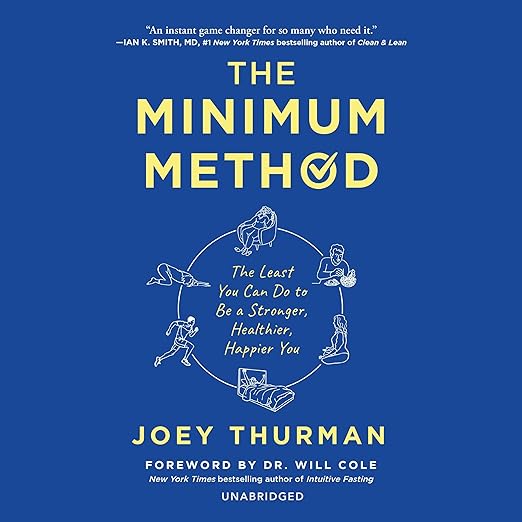
Quick Take
- Narration: Joey Thurman narrates his own work with genuine energy and self-aware humor that makes his apology for past fitness industry excesses land credibly, the self-narration is the right call here.
- Themes: Efficiency over intensity, behavioral sustainability, dismantling fitness industry mythology
- Mood: Energetic and refreshingly unpious, like advice from a trainer who actually regrets the advice he used to give
- Verdict: An accessible and genuinely useful fitness philosophy that is strongest when Thurman interrogates his own industry rather than when it turns prescriptive.
I downloaded this one expecting a familiar formula: a celebrity trainer with a contrarian-sounding title that turns out to deliver the same high-effort prescription with a softer coating. That is not what this is. I was about twenty minutes in, listening while I was making dinner, when Thurman did something I did not anticipate: he apologized. Not performatively, but specifically, for his years of promoting the idea that extreme workouts were the only path to a transformed body. That moment of accountability sets the register for everything that follows.
Joey Thurman is a Chicago-based nutrition expert and trainer whose clientele includes people in entertainment, and he brings to this book the credibility of someone who has watched the fitness industry sell a harmful myth for profit and who has been, by his own admission, part of that selling. The Minimum Method is structured around the argument that efficiency, not extremity, is what most people actually need.
The Industry Critique That Earns Its Place
The first substantive section of the book deals with what Thurman calls the shortcomings of mainstream fitness culture, and this is where his self-narration pays dividends. Reading this material in his own voice, with the cadence and occasional wry pause of someone who knows exactly what he is talking about, gives the critique a weight it would not carry delivered by a professional narrator at arm’s length. Reviewer Lucas Chaltry noted that the book resonated on several levels, and that is partly because Thurman is not just offering a program, he is offering a reorientation of how you think about your body and your time.
The concept of exercise snacks, short functional movement breaks incorporated into an ordinary day, is one of the book’s most practical contributions. Thurman does not invent the concept, but he contextualizes it well and links it to actual research on cardiovascular benefit and metabolic effect. He is careful not to oversell: you will not get the physique of a competitive athlete from exercise snacks. But you will get a meaningful improvement in cardiovascular health and energy levels without reorganizing your schedule around a gym.
Sleep as a First-Class Health Variable
One of the more quietly persuasive sections of the audiobook concerns sleep, which Thurman treats as seriously as nutrition and exercise rather than as a bonus chapter. The sleep hygiene practices he describes are specific and actionable, and he connects them to hormonal regulation in a way that does not feel reductive. For listeners who have tried to address their weight or energy through diet and exercise alone and hit a wall, this section offers a plausible explanation and a different lever to pull.
The narration handles this section particularly well. Thurman’s delivery is unhurried here, which matches the subject matter, and he resists the tendency toward performative enthusiasm that can make self-narrated wellness audiobooks exhausting to listen to for any length of time.
When the Program Turns Prescriptive
The weakest stretch of the audiobook comes when Thurman shifts from philosophy to specific nutritional guidance. He is careful to avoid the extremist diet messaging he critiques elsewhere, but some of the nutritional advice is fairly generic, and reviewer Megan Easley noted that while she was the target audience, the content did not always surprise her. The book’s strength is in the reframe, not the recipe. Thurman is more interesting as a critic of fitness culture than as a prescriber of specific macros.
That said, the overall structure works well in audio form over nearly eight hours. The pacing is consistent, the self-deprecating moments land, and the running argument against perfectionism gives the book a coherence that a lot of fitness audiobooks, which tend to feel like padded listicles, do not achieve.
Who Should Listen and Who Should Skip
If you have tried ambitious fitness programs, achieved temporary results, and then lost them in the predictable three-to-six-month window, this book is worth your time. It is also a strong pick for anyone who has never found their way into a sustained exercise practice and needs something that meets them where they are rather than where they should aspire to be. Skip it if you are already training consistently and looking for periodization science or advanced nutritional strategy.
Frequently Asked Questions
Does Joey Thurman’s self-narration make this a better or worse listening experience compared to a professional narrator?
Better, in this case. The book’s credibility rests partly on Thurman’s willingness to critique his own past work in the fitness industry, and that critique lands more honestly in his own voice. His delivery is personable without being exhausting.
Is The Minimum Method aimed at people who are completely sedentary or at people already active but overtrained?
Both, though it is most specifically aimed at the first group. Thurman explicitly designs the program for people who have never found a sustainable fitness practice, with exercise snacks and sleep hygiene as foundational tools. Active people may find the philosophy section more useful than the program itself.
How long is the actual program component versus the philosophy and context-setting?
The program guidelines are woven throughout the book rather than separated into a standalone section. At just under eight hours, the ratio skews toward explanation and context rather than step-by-step instruction, which suits the audiobook format well.
Does Thurman address specific dietary approaches like intermittent fasting or low-carb eating?
He touches on various approaches but avoids endorsing any single protocol. His nutritional guidance emphasizes simplicity and sustainability over dogma, consistent with the book’s core argument against extreme methods.