Quick Take
- Narration: Subhadra Newton delivers Langer’s research with calm authority, a measured pace that suits the reflective, science-forward material without ever becoming clinical.
- Themes: Mind-body unity, the power of perception, questioning medical orthodoxy
- Mood: Thoughtful and quietly radical
- Verdict: Listeners who want their assumptions about illness and aging challenged by actual experimental data will find this one of the more intellectually bracing health books in recent memory.
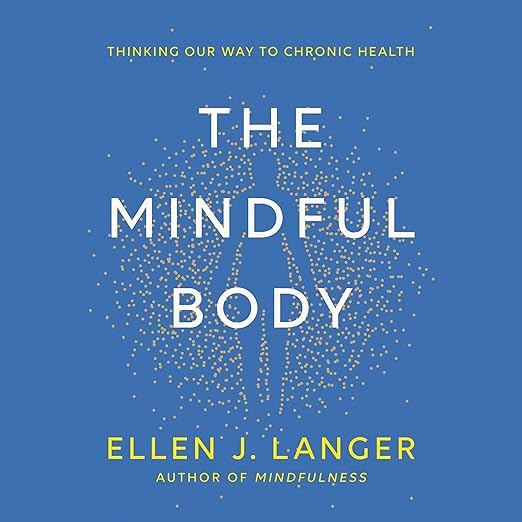
I came to this one on a Tuesday afternoon when I was about three weeks into a nagging back problem that doctors had essentially shrugged at. Something about the title snagged me, not the wellness-book promise of it, but the word “mindful” attached to something as concrete as a body. Ellen Langer is not a wellness influencer. She is a Harvard social psychologist with decades of controlled experiments behind her, and from the first chapter, that distinction matters enormously.
What Langer is arguing in The Mindful Body is not the vague self-help claim that positive thinking makes you healthier. Her claim is stranger and more radical than that: that the separation we draw between mind and body is itself a conceptual error, one that quietly shapes how illness progresses and how readily it retreats. The science she marshals in support of this is genuinely surprising. Hotel chambermaids who were told their daily work counted as exercise lost weight without changing any behavior. Patients whose wounds healed faster when clocks were set to a faster pace. Subjects who reversed markers of aging after a week spent in an environment designed to evoke their younger selves. These are not anecdotes, they are the results of Langer’s own research program, presented with enough methodological detail to take seriously.
When the Research Outpaces the Conventional Wisdom
The most subversive thread in this book is Langer’s argument about diagnostic labels. She gives the example of prediabetes: a person whose blood sugar sits just fractionally below the clinical threshold for diabetes is told they are “normal.” A person whose reading sits just fractionally above is handed a diagnosis that, Langer’s research suggests, may itself accelerate the disease trajectory. The label changes the patient’s relationship to their own body. This is not a fringe hypothesis, it builds on decades of work on how context shapes perception and how perception shapes physiology. Hearing this laid out over nine hours, with case after case building the argument, produces a cumulative effect that I found genuinely unsettling in the best possible way.
One reviewer noted that Langer’s point “is taken too far at times,” and I think that’s a fair observation. There are moments when the book risks overclaiming, when the gap between a compelling laboratory result and a broad prescription for how all people should relate to all illness feels wider than Langer acknowledges. But even when you push back, the core argument holds. The question of how much our mental models of disease shape disease itself is one medicine has been slow to take seriously, and Langer has spent forty years forcing the issue.
The Narration’s Quiet Precision
Subhadra Newton reads this with a composure that suits Langer’s prose well. The writing is not pyrotechnic, it proceeds methodically, building from study to study, and Newton honors that rhythm rather than trying to inject drama. At seven hours, the runtime is lean enough that the book never outstays its welcome, though listeners hoping for a practical protocol to follow will find the book more conceptually rich than prescriptive. This is a book about rethinking, not a twelve-week program.
Where It Lands in the Larger Longevity Conversation
If you’ve spent time with David Sinclair’s Lifespan or Mark Hyman’s work, The Mindful Body occupies a different but complementary lane. Sinclair and Hyman focus on the biochemistry of aging, the molecules, the supplements, the interventions. Langer’s contribution is the prior question: what does your relationship to the concept of aging do to you before any of those interventions arrive? She doesn’t dismiss biological approaches; she contextualizes them within a framework where belief, attention, and environmental cues are themselves active variables. That’s a reframing worth sitting with, and in audio format, where the ideas have room to breathe between commutes and evening walks, it lands with particular force.
Who Should Listen and Who Should Pass
If you want a practical exercise plan or a supplement protocol, this is not your book. If you want a rigorous, occasionally mind-bending argument that the way we think about health is itself a health variable, one that mainstream medicine still mostly ignores, then this is one of the more important listens in the wellness space. Those who bristle at any challenge to conventional medical frameworks will find reasons to resist; those willing to hold the argument open will find themselves replaying specific experiments in their heads for weeks afterward.
Frequently Asked Questions
Is The Mindful Body based on real scientific research or is it more of a philosophy book?
It is grounded in Langer’s own experimental research, decades of controlled studies conducted at Harvard. The hotel chambermaid weight-loss study, the faster-healing wounds in rooms with accelerated clocks, and the counterclockwise study where subjects showed biological markers of youth after a week in a period environment are all from Langer’s lab. The book is more rigorous than most popular health titles, though it does draw broader conclusions that some researchers dispute.
Does Ellen Langer argue that you can cure serious illness just by changing your mindset?
Not quite, and the distinction matters. Langer argues that mental models and contextual cues are active variables in health outcomes, not that belief alone can override all biological processes. Her position is that medicine has systematically underestimated the mind’s role, not that it is omnipotent. The book is careful about this, even if it sometimes pushes the implications further than the evidence strictly supports.
How does The Mindful Body compare to other longevity audiobooks like Lifespan or Outlive?
It occupies a different register entirely. Sinclair and Attia focus on the cellular and biochemical mechanisms of aging, with specific intervention recommendations. Langer’s book asks the prior philosophical question: how does the way you conceptualize your body affect what happens to it? The two approaches complement each other rather than compete, and listeners interested in longevity science will find Langer’s angle adds a dimension that biochemistry-focused books leave largely unexplored.
At 7 hours, does the audiobook feel complete or does it leave major arguments unfinished?
The runtime is lean but purposeful. Langer’s argument builds steadily and reaches a coherent conclusion, this isn’t a case where you feel truncated at the end. Some listeners may want more practical guidance on applying the ideas to daily life, but the book’s primary goal is conceptual reorientation rather than protocol delivery, and at seven hours it achieves that without padding.