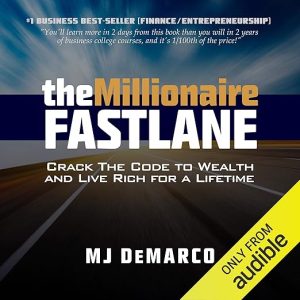
- Narration: MJ DeMarco narrates his own polemic, which suits a book whose key terms he coined, and removes any buffer between the argument and you.
- Themes: entrepreneurship over salaried saving, scalable income, the critique of conventional retirement planning, wealth as a system rather than a wage
- Mood: Combative and evangelical, closer to a rally than a seminar
- Verdict: Worth thirteen hours for the reframe, as long as you can tolerate being lectured at volume.
Personal finance books rarely open by mocking the plan their reader is already following. This audiobook does exactly that, and it does it before you have settled in. MJ DeMarco lays out the conventional script in quotation marks, "Graduate from college, get a good job, save 10% of your paycheck, buy a used car, cancel the movie channels", carries it all the way to retiring rich at sixty-five, then names the whole arrangement "The Slowlane" and calls it "an impotent financial gamble that dubiously promises wealth in a wheelchair".
Sustaining that voice for twelve hours and forty-six minutes is a commitment, and DeMarco narrates the book himself, which changes the arithmetic. A polemic built on invented vocabulary lives or dies on emphasis. Where the stress lands on the word Slowlane decides whether it registers as a neutral label or an accusation, and the author is the only person who knows for certain which he meant.
A Sailboat of Hope, Engineered to Feel Humiliating
Underneath the showmanship sits an actual argument, and it is worth separating the two. Reviewer Rashid, writing from the United Kingdom, states it more plainly than the marketing does: DeMarco "presents a compelling roadmap towards rapid wealth creation, emphasising entrepreneurship, value creation, and leveraging opportunities". Strip the highway metaphor and you get a thesis about scale. Income that depends on your presence has a ceiling set by hours in a day; income built into a system does not. Everything DeMarco says about jobs, 401(k) plans and mutual funds follows from that single distinction. Once you accept the premise, his contempt for the alternative becomes internally consistent rather than merely rude, which is the most useful thing I can tell a listener who is about to spend a working week inside his company.
Pretending the rhetoric is accidental would be dishonest criticism, so let me be plain about it. Sentences like "your financial future will blow carelessly asunder on a sailboat of hope" are engineered to make the cautious path feel humiliating. Whether you find that bracing or manipulative will decide your relationship with the whole listen. I found the technique effective and slightly airless, in the way a very good closing argument is. Paul Gallagher, on a third pass through the book, described it as "a veritable goldmine of actionable PRINCIPLES for creating wealth", capitals included, which gives a fair sense of the temperature the book runs at and the temperature its admirers match.
Nobody but DeMarco Could Sell These Neologisms
Reach is the first argument in its favor. The five reader reviews on this listing come from the United States, the United Kingdom, Sweden and France, which is unusual for a book published this far outside the mainstream and suggests the frustration DeMarco is speaking to travels well. Andrii Serhiienko, writing from Sweden, gives the most honest endorsement in the set. The review promises no secrets and says instead that the book "might open your eyes to many false beliefs", after which "it starts something itching in your head". Irritation as a mechanism of change is a modest claim, and a credible one.
Durability is the second. Two of these five reviews were posted in 2011 and 2012, years before this audio edition arrived in August 2015, and the two most recent landed in 2025. Scott Bradley, the earliest reviewer here, reported having "already recommended it to 30+ of my closest entrepreneurial friends". More than fourteen years later cornille, writing from France, called it a "Really useful book with a lot of concrete insights on the thought process that leads to wealth". Business advice that survives that long is either genuinely structural or exceptionally well marketed, and this one gets to argue for the first.
Self-narration is the right call here for a reason specific to this book. DeMarco is not reporting research he gathered; he is prosecuting a case he invented the vocabulary for. Slowlane, Fastlane, the wealth accelerator, the sailboat of hope, all of it is his coinage, and a hired reader would face the odd task of selling someone else's neologisms with conviction. The trade-off cuts the other way too. An author performing his own certainty for nearly thirteen hours leaves a listener very little room to disagree politely.
Eight Silent Scores Are Dragging the Average Down
Anyone wanting a checklist should recalibrate now. Paul Gallagher relays DeMarco's own warning that this is not a "HOW to get rich" book with "paint by the numbers" instructions, and that is accurate. The value on offer is a reframing of where wealth comes from, not a sequence of steps you can start on Monday. Listeners who need concrete implementation will finish energized and unsure what to actually do, which is a familiar and frustrating aftertaste in this category.
Scoreboard arithmetic deserves a second look as well. A 4.7 average sits on top of just thirteen ratings, while every written response visible here awarded five stars. Those two facts cannot both describe the same crowd. Eight scores nobody can read are dragging the figure down, and the sample you can read tells you nothing whatever about them. Add the age of the argument, which treats the job market, the housing market and the stock market roughly as they looked before 2011, and a listener has to do their own updating as they go. I did a fair amount of it while listening, which is not a complaint so much as a description of the work involved.
Skip It if You Invest Steadily and Sleep Well
Would-be founders who already suspect the save-and-wait advice is not for them will find this the most energizing twelve hours in the category, and DeMarco's core distinction about scale is genuinely useful regardless of what you think of his manner. It also suits anyone who enjoys an argument conducted at full volume, and anyone who wants their assumptions dented rather than confirmed. My own view is that the framework survives the delivery, and that the delivery is what makes the framework memorable, which is an uncomfortable thing to concede about a book this pleased with itself.
Steer clear if you invest steadily and sleep well doing it, because the book treats that choice with open contempt and you will spend thirteen hours being told your plan is a dream-stealing dogma. Skip it too if hard-sell prose grates on you, since the author's own voice removes the small buffer a neutral reader would provide. And if you want a plan rather than a diagnosis, buy something else first and come back to this one afterward for the motivation, which is the part it supplies better than anybody.