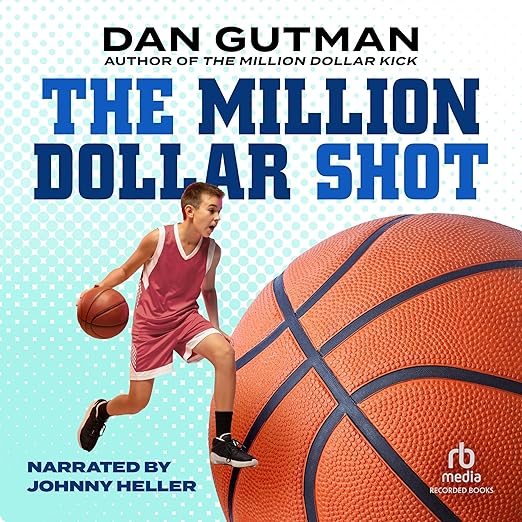
Quick Take
- Narration: Johnny Heller brings genuine comic timing to the basketball sequences and enough warmth to the friendship between Eddie and Annie that the emotional stakes feel real.
- Themes: Working-class aspiration, the intersection of athletic talent and creative ability, unlikely partnership
- Mood: Warm, funny, and fast-moving
- Verdict: A compact and satisfying listen that works particularly well for children who claim not to like reading, because the story never gives them a reason to stop.
I finished The Million Dollar Shot on a Tuesday morning, sitting in a parking lot, because I had ten minutes left and could not bring myself to stop it. That is less common than it should be with children’s sports audiobooks, which often mistake energy for momentum. Dan Gutman’s book earns its momentum honestly: he sets up a situation that sounds absurd and then commits to it completely, and Johnny Heller’s narration honors that commitment from the first chapter.
Eddie Ball, whose nickname Air is both inevitable and slightly mean, wants to win a poetry contest to earn a chance to shoot a free throw for a million dollars at halftime of the NBA Finals. He knows he can make the shot. The problem is the poem. Enter Annie Stokely, his best friend, who is as good at basketball as Eddie is and substantially better at writing. The setup sounds like a vehicle for a simple lesson about teamwork, but Gutman has more going on beneath the surface.
What the Poetry Contest Actually Costs
Eddie and Annie are not competing from a position of comfort. Both live in a trailer park, and the million dollars is not abstract money in this story. It represents a possible exit from a situation that neither of them chose. That context does not turn the book into a misery narrative, but it gives the comic moments ballast. When the stakes of the poetry contest feel genuinely high, it is because the financial reality is treated with respect rather than sentimentality.
The book is aimed at children roughly eight to twelve, and Gutman does not simplify this reality into something painless. The kids understand their situation. They have specific plans for what the money would mean. This is not a story where the lesson is that money is not important. It is a story where the lesson is that competence and friendship can get you places that talent alone cannot, and where the economic pressure is part of what makes the friendship matter.
Heller’s Timing as the Narration’s Strongest Asset
The synopsis itself notes that Heller’s narration hits nothing but net in this engaging tale, which is the kind of promotional language I usually treat with skepticism. In this case it is accurate. Heller understands that Gutman’s prose has a rhythm, short declarative sentences broken by longer stretches of internal Eddie-logic, and he plays that rhythm with genuine skill. The basketball sequences have pace without becoming breathless. The moments of Eddie’s anxiety about the poem have just enough drag in them to feel authentic without slowing the story.
Multiple reviewers mention using this book as a shared reading experience with children who resist reading independently, and the audio format supports that use particularly well. One parent describes a system where she and her eight-year-old read the same book, then discuss what they thought would happen next. The Million Dollar Shot is ideal for that kind of co-listening: it raises questions about outcomes without telegraphing them, and children and adults will disagree productively about what Eddie should do in the final sequences.
A Book That Knows Exactly What It Is
At under two hours, this does not overextend itself. Gutman has been doing this long enough to know that a children’s sports novel’s greatest enemy is its own middle section, and he has written a book without a dragging middle. The Finkle Foods contest, the complication of whether Annie’s help makes the poem dishonest, the question of whether Eddie can actually make the shot under pressure, these three threads wind around each other efficiently and resolve in a sequence that is satisfying without being predictable.
The author comparison in the synopsis to Babe and Me and The Kid Who Ran for President is accurate in one specific sense: Gutman writes books that children who claim not to like books finish anyway. That is not a small talent, and the audio format brings out its best qualities.
Frequently Asked Questions
Does a child need to be a basketball fan to enjoy The Million Dollar Shot?
The basketball sequences are specific enough to feel authentic, but the central tension is about the poetry contest and the friendship between Eddie and Annie. Children who enjoy underdog stories and unlikely partnerships will find the book accessible even without sports enthusiasm.
Is this book part of a series, or does it stand alone?
The Million Dollar Shot stands alone. Dan Gutman has written other sports novels, including the Baseball Card Adventure series, but Eddie and Annie do not appear in a continuing series. No prior reading is required.
How does Johnny Heller differentiate Eddie’s voice from Annie’s in the narration?
Heller differentiates Eddie’s more impulsive, action-first voice from Annie’s more considered approach without overstating the contrast. The performances are naturalistic rather than exaggerated, which serves a book that depends on believable friendship chemistry.
Is the book appropriate for children who are sensitive to economic themes?
The trailer park setting and the financial motivation are present but handled with lightness and respect. There is no suffering-for-effect in the storytelling. Children focused on the sports and mystery aspects will engage at that level without distress.