Quick Take
- Narration: Barry Abrams handles a hole-by-hole structure that could easily feel repetitive and keeps it genuinely engaging. A technically demanding narration job done well across nearly ten hours.
- Themes: Augusta’s mystique, golf greatness and failure under pressure, the Masters as American institution
- Mood: Reverent, historically detailed, and warmly nostalgic
- Verdict: The most thorough audio treatment of Augusta National’s history available. Indispensable for Masters devotees and engaging for serious golf listeners broadly.
There is a particular week in April when even people who do not follow golf regularly find themselves watching the Masters. The azaleas, the green jackets, Amen Corner, the particular geometry of Augusta National: all of it has been packaged into one of sport’s most successful brand narratives. What David Sowell’s book attempts, in its third edition, is to go beneath the brand and into the course itself, hole by hole, story by story, disaster by disaster. I listened to the first few chapters on an evening in spring, which felt exactly right.
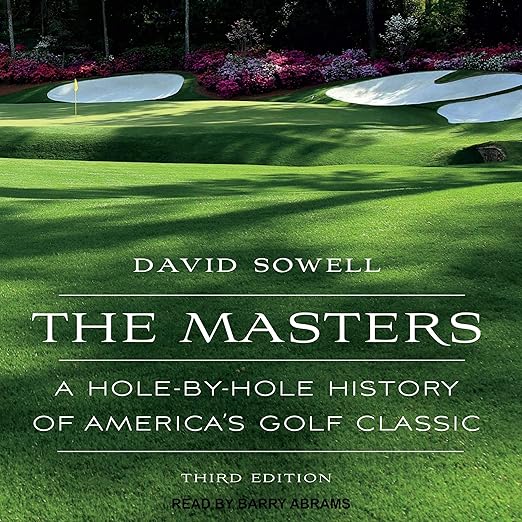
Barry Abrams narrates for Tantor Audio in this nine-hour-and-forty-eight-minute production, released in 2019 as the third edition of a book that first appeared years earlier. The hole-by-hole structure is genuinely unusual for a sports audiobook. Each chapter lives at a specific location on Augusta National and accumulates the most dramatic events that took place there across the tournament’s full history. Sowell updated this edition to include Jordan Spieth, Rory McIlroy, Patrick Reed, Bubba Watson, and Sergio Garcia alongside Bobby Jones, Gene Sarazen, Arnold Palmer, Jack Nicklaus, Tiger Woods, and Phil Mickelson.
Our Take on The Masters
The structural choice works better in audio than it might seem on paper. Abrams’s narration gives each hole a distinct chapter identity, and because the episodes within each chapter span decades, the listener develops a sense of Augusta National as a physical space with its own character and history rather than simply as a backdrop for a linear narrative. Amen Corner, holes eleven, twelve, and thirteen, receives treatment proportionate to its drama. The short twelfth hole, historically the most pitiless on the course, accumulates enough stories of brilliance and disaster to justify an extended chapter on its own. One reviewer described the book as a rich historical view of the course where success breeds legends and where failure can haunt even the most brilliant golfer’s career. That is the hole-by-hole approach at its best.
Why Listen to The Masters
The range of figures covered is genuinely comprehensive across more than eight decades of tournament history. Bobby Jones and Gene Sarazen through Arnold Palmer and Jack Nicklaus through Tiger Woods and Phil Mickelson through the current generation: Sowell treats each era with enough historical context that listeners unfamiliar with earlier Masters champions will understand why specific moments mattered. One reviewer described buying it for a 95-year-old retired golfer who now uses a wheelchair and finding that the book brought golf back to him vividly. That multigenerational accessibility is one of the book’s genuine strengths. This is not a book that treats pre-Tiger history as prologue or preamble.
What to Watch For in The Masters
The hole-by-hole structure, which is the book’s defining characteristic, can feel constraining if you are looking for a continuous narrative about a specific player or championship year. The stories within each chapter span different decades and different players, which means the emotional continuity that drives a conventional biographical or single-season narrative is not the experience here. This is more like a well-organized reference brought to life in audio than a propulsive account building toward a climax. Listeners who engage with it as a browsable, episodic experience will get more from it than those who approach it expecting a conventional sports narrative. The third edition’s updates also mean that the book’s most recent historical coverage cuts off before the most current generation of Masters champions.
Who Should Listen to The Masters
Masters devotees and serious golf history enthusiasts are the natural audience, and the third edition’s updates make it current enough to include the golfers who defined the tournament’s second decade of the twenty-first century. The book also works for listeners who want to understand why the Masters occupies the cultural position it does: Sowell’s reverence for Augusta National is evident throughout, but he is not uncritical about the tournament’s historical complications. Golf listeners who found Moe and Me rewarding for its human depth will find The Masters more panoramic and less personal, but equally thorough within its chosen domain. Non-golfers who are curious about why Augusta National commands such unusual attention even from people who have never watched a full round of golf will find Sowell’s approach genuinely illuminating.
Frequently Asked Questions
Does The Masters cover the full history of the tournament or focus on recent decades?
The third edition covers the full tournament history from Bobby Jones and Gene Sarazen through the current generation including Jordan Spieth, Patrick Reed, and Sergio Garcia. Each hole’s chapter draws on episodes from across the tournament’s entire lifespan, giving equal historical weight to all eras.
Is the hole-by-hole structure confusing to follow as an audiobook?
Barry Abrams’s narration keeps the structure clear. Each chapter is anchored to a specific hole, and the transitions between episodes within chapters are handled cleanly. The format works better in audio than it might seem on paper, because Abrams gives each hole a consistent narrative identity that the listener can orient to.
Does the audiobook cover famous disasters at Augusta alongside the great shots?
Yes. Disasters receive equal treatment to greatness, which is part of what makes the hole-by-hole approach effective. Augusta National’s most punishing holes accumulate as many stories of failure as triumph, and Sowell covers both with equal care and historical detail.
Is The Masters suitable for listeners who are not already deeply familiar with golf history?
It helps to have some familiarity with the names involved, Palmer, Nicklaus, Woods, Mickelson, but Sowell provides enough context within each chapter that casual golf observers can follow the significance of what he is describing. Deep expertise is not required to find the book engaging and informative.