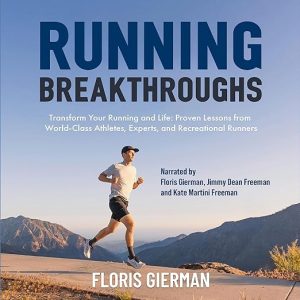
Slow down to speed up is the least intuitive instruction in endurance sport, and this audiobook is built on it from end to end. Floris Gierman spends eight hours and forty-seven minutes arguing that most runners are training too hard to improve, and reads the argument himself. Every written response on the record went up before the release date printed on it, inside a six-day window at the end of October 2025, which is worth knowing before you weigh the reception. The material itself is broader than the title suggests, and the case it makes is less about racing than about staying in the sport long enough for racing to matter.
Is Running Breakthroughs: Transform Your Running and Life Worth Your Time?
Heart rate training is the technical spine, and the description is specific about the rest: running longer without gasping for air, injury prevention and recovery, plus mindset, breathwork, journaling and meditation treated as performance inputs rather than as extras. Insights from Eliud Kipchoge, Kilian Jornet and Courtney Dauwalter are promised alongside stories from recreational runners who broke through plateaus, and that mix is the book's method as much as its content. Elite practice is used to license an unglamorous instruction, and the instruction is patience. Anyone who has watched a training log fall apart knows the problem is rarely a lack of ambition, which is the assumption this book quietly refuses.
A five-star filed on October 28, 2025 comes from a self-described new runner who had believed running needed to be painful and fast to count, and who describes the book dismantling that idea early, then making a case for slowness, patience and consistency as the actual mechanism of improvement. That response is the clearest evidence of what the material does when it lands on someone with no prior loyalty to a method. It also praises the simplicity of the writing and says no athletic background is needed to follow it, which matters for a subject that usually arrives buried under zone charts and lactate thresholds.
One of the two responses filed on October 24, 2025 describes the book as inspiring and pragmatic at once, blending elite athletes, experts and everyday runners, and mixing practical methodology with anecdotes that carry the lesson while staying readable. That balance is the reason to choose this over a training manual. A pure methodology book gives you zones and thresholds; this one spends real time on why runners abandon an approach in week three, which is the part that determines whether anything changes at all. The elite names are doing rhetorical work rather than technical work, and it is fair to notice that, but the rhetoric is the point when the ask is behavioral.
Four audiences are named on purpose: beginners afraid of burnout, experienced runners stuck against a plateau, masters athletes wanting durability, and coaches looking for tools to hand on. Few books manage four audiences without diluting all of them, and what holds these together is a single claim: consistency beats intensity, and enjoyment is what makes consistency possible rather than a reward for achieving it. The October 25, 2025 response puts the same idea in the register the book prefers, calling it more than a running book and pointing at rest, nutrition and mindset as the places the argument actually bites.
Before You Commit to Running Breakthroughs: Transform Your Running and Life
A five-star posted on October 23, 2025 praises the absence of shortcuts and hype and the sense of talking to a friend who understands the subject, and that compliment doubles as the warning. A method built on slowing down asks for months before it pays anything back, and nothing in the description offers a faster route. If you want a dated plan with prescribed sessions, note that the copy sells strategies, methods and mindset rather than a calendar. The accompanying PDF promised on the listing will carry whatever charts exist, so a listener who wants numbers should plan on having a screen nearby rather than expecting the audio to deliver them.
Floris Gierman is credited as narrator as well as author, and the imprint on the record carries his name too, so the writing, the reading and the publishing all sit inside one operation. That is normal for a coach with an audience and it is not a fault in itself, but it does mean nobody outside the project shaped the recording. Set that beside the timing of the visible sample, all of it filed in the week before the release date by people who mostly already knew the work, and the honest read is that the reception on display is a launch cohort rather than a cross-section. The author's podcast, his YouTube channel and his community all get named inside that sample, which tells you where it came from.
Should You Listen to Running Breakthroughs: Transform Your Running and Life?
The other October 24 response is the one to read if you are undecided. It describes never having liked running because it never felt good, never managing any consistency, always finding a reason to stop, until an encounter with Gierman's community six years earlier changed the relationship entirely. That is a long-range testimonial rather than a reaction to a new book, and it tells you what this material is for: not a personal best next month, but a way of running that survives a decade. The same response frames the book as a holistic resource for beginners and experts alike, which is a large claim, though the four audiences named in the copy support it.
Take it if you are rebuilding after injury, stuck at the same times for two seasons, or old enough that intensity now costs more than it returns. It suits coaches as well, since the copy pitches directly at that use and the anecdote-heavy structure gives you material to pass on. Runners who already train by heart rate and have made peace with easy days will recognize most of the architecture, and should ask whether eight and a half hours of reinforcement is what they need right now. Anyone chasing a marathon time six weeks out is shopping in the wrong aisle, and the book would be the first to say so.
Questions Listeners Ask
Is this audiobook a training plan or a book of principles?
Principles, with methods attached. The description sells heart rate approaches, injury prevention strategies and mindset work rather than a week-by-week calendar, so a runner wanting prescribed sessions for a specific race date will need to build that scaffolding themselves from what the book supplies.
Does the audiobook cover recovery and nutrition, or only running?
It reaches well past mileage. The copy lists breathwork, journaling, meditation, injury prevention and recovery alongside training methods, and frames wellbeing as an input to performance rather than a reward for it. Nutrition surfaces in the reception more than in the description's own list.
Is it useful for masters athletes or older runners?
That group is named directly in the copy, which promises age-proof strategies for lasting performance. Given that the central argument is running easier for longer stretches, the approach suits anyone whose recovery has slowed and who can no longer absorb repeated hard sessions week after week.