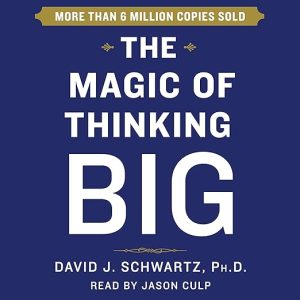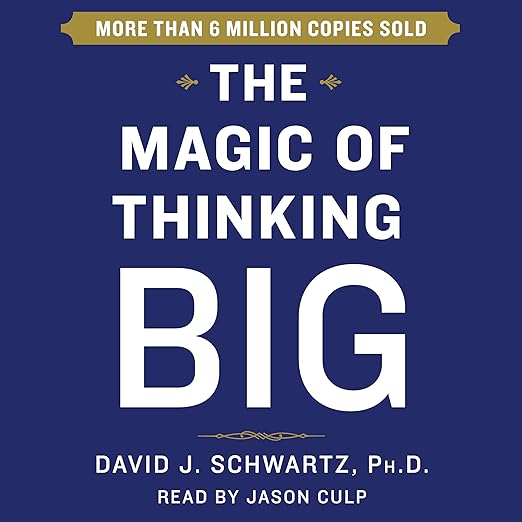
Six million copies sold worldwide is the number this audiobook's synopsis leads with, and David Schwartz's The Magic of Thinking Big has apparently needed all six million to become the fixture it now is in business-shelf self-help. What's notable here is the format itself: this unabridged edition marks the book's first appearance as a complete audio recording, decades after it first became a bestselling phenomenon in print. Jason Culp narrates, and the material he's working with is decidedly old-school in structure, built less around case studies than around a single repeated conviction, that success is a habit of thinking rather than a matter of raw talent.
Culp Doesn't Oversell With Forced Enthusiasm
Schwartz's core argument hasn't changed with the decades: real success, in his framing, isn't about ‘innate talent’ but about deliberately practicing certain patterns of thought and behavior until they become automatic. That's a deceptively simple claim to build an entire audiobook around, and it holds up because Schwartz keeps circling back to concrete behavior rather than abstract mindset talk, how you carry yourself in a meeting, how you frame a setback, how you talk yourself into or out of an opportunity. Culp's narration matches that directness. He doesn't oversell the material with forced enthusiasm, which this kind of vintage self-help can tip into easily, and instead lets Schwartz's own confident, declarative sentences do the persuading.
One listener, reviewing under the name O. Halabieh, put it plainly: the book doesn't just inspire ‘big’ thinking, it ‘takes it one step further to inspire action to make it happen.’ That distinction between inspiration and action is really the whole case for this title over its many imitators. A lot of motivational audio content stops at the feeling. Schwartz, and by extension Culp's reading of him, keeps returning to specific, repeatable behaviors, which is why a book first published well before the modern self-help boom still gets cited as foundational by people working in the genre today.
Some context helps explain the staying power the synopsis touts. Schwartz first published this book in 1959, decades before self-help became the crowded, research-citation-heavy publishing category it is today. That vintage matters for how the book reads now: it predates the therapy-inflected language and study citations that define most contemporary motivational writing, relying instead on plainspoken assertion and repetition to make its case. Listeners used to newer business audiobooks stacked with research references may notice the difference immediately. What Schwartz offers instead is closer to a confident mentor's advice than a research brief, delivered with the kind of certainty that either lands as refreshingly direct or, for a more skeptical listener, asks for more trust than the book earns with evidence alone.
A Book People Return to at Different Stages
The reviews attached to this book tell a consistent story about how this book actually gets consumed, which is slowly, and often more than once. One listener describes this as a second read, having first come to it in 1999, shortly after joining a direct-sales company and shortly before joining the Air Force, and still finding it, decades on, among the best self-help books read in that time. Another reviewer bought the book in 2013, let it sit unread for years, then finally worked through it after committing to a modest daily habit, ten pages at a time. Both stories point to the same thing: this is a book people return to at different life stages rather than one they consume once and shelve.
That staying power matters for an audio-first listener trying to decide whether an unabridged edition of a decades-old title is worth the roughly nine and a half hours. The answer, based on both the sales figures and the reviewer testimony here, is that Schwartz's advice ages unusually well precisely because it stays at the level of behavior and habit rather than tactics tied to a specific era's job market or technology. Culp's steady, unhurried pacing gives that material room to land as instruction rather than hype, which matters for a book meant to be absorbed gradually rather than binged.
The synopsis specifically pitches this unabridged edition as ‘perfect for gift giving,’ a detail worth taking seriously rather than skipping past as marketing language. A physical or ebook copy of a sixty-plus-year-old bestseller can feel like homework to someone new to the genre; a well-narrated audiobook lowers that barrier meaningfully, since nobody has to commit to finishing a physical book sitting on a shelf. For listeners choosing a first self-help title for themselves, or picking one to recommend to someone else navigating a rough patch, an unabridged audio edition of a book this widely credited with shaping the genre is a reasonably safe, low-risk starting point.
Reads More Like a Mentor's Advice Than Research
This is a genuinely old book, and it reads like one in places. Schwartz wrote in an era of a single-earner household and a much more linear career ladder than most listeners navigate now, and the examples that illustrate his points, promotions, salary negotiations, community standing, occasionally show their age even as the underlying psychological advice holds up. Listeners expecting citations, studies, or the data-driven framing that defines a lot of contemporary business audio should recalibrate: this is a book of conviction and repetition, not research.
It's also worth knowing that the persuasive style leans heavily on repetition of its own central idea across chapters, restating the thinking-big premise from new angles rather than introducing a wide range of distinct frameworks. Listeners who want a tightly plotted, chapter-by-chapter system with checklists and worksheets may find the structure looser than expected. The result reads more like a sustained pep talk grounded in specific behavioral advice than a structured curriculum, which is exactly what has kept this book in print and, now, finally, in listeners' ears in full.
Suits Listeners Doing Something Else, Like a Commute
Readers encountering a classic-era self-help title for the first time have a legitimate, low-risk entry point here, since the book's reputation rests on decades of exactly this kind of first encounter. Anyone whose exposure to motivational business writing starts and ends with newer, data-heavy titles will notice the difference immediately, and probably benefit from it: Schwartz's insistence on habit over talent is a genuinely useful corrective to more clinical modern frameworks. The reviewer who returned to the book a second time, years apart, across a career change, is a good model for how this material is meant to be used, revisited rather than raced through.
The unabridged audio format specifically suits listeners doing something else at the same time, a commute, a workout, since Schwartz's prose is built for that kind of half-attentive, cumulative absorption rather than close analytical reading. It's a poor fit, though, for anyone who has already read the print edition recently and wants substantially new material rather than a faithful audio companion to the same six-million-copy text. This is the same book, delivered clearly and without embellishment, not a revised or expanded edition dressed up for audio.
At a Glance
- Narrator: Jason Culp delivers Schwartz's declarative, repetition-heavy prose with steady confidence rather than forced hype, which suits vintage self-help better than an overly energetic reading would.
- Subjects: Habit over talent, thinking big as a practiced behavior, action following inspiration
- Tone: Steady, encouraging, old-school confident
- Bottom line: A genuine classic that finally has an unabridged audio edition worth the roughly nine and a half hours, best suited to listeners open to a decades-old, repetition-driven style.