Village Drowning has outlawed books, and it has specifically outlawed girls reading them. Families are fined for breaking laws that were never written. Children are chased through the streets. Before a single monster appears in this audiobook, Paul Durham has built a place where the ordinary machinery of authority is already the problem, and that ordering of the threats is the smartest structural decision in the whole thing. The Bog Noblins, when they arrive, are almost a relief by comparison.
First, the Big Picture
Rye O'Chanter is eleven and has seen enough of Drowning's strangeness to stop treating it as normal. A terrifying encounter convinces her that the Bog Noblins, monstrous and supposedly extinct, have come back. The complication is that only one group ever managed to defeat them, and the Luck Uglies were driven into exile long ago. Nobody is left to protect the village, which leaves an eleven-year-old working through a maze of secrets, rules and lies to find out what was actually true about the legend.
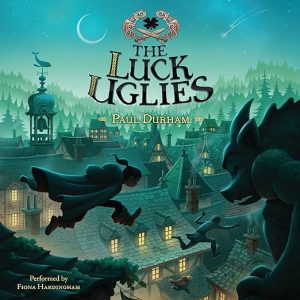
A five-star response from June 2014 pinpoints how well the opening works, describing Rye debating the risks of jumping from roof to roof and then being frightened into the jump by a gargoyle that moves. What that reader appreciated most is a real craft choice: Rye is 'not an athlete, in fact she's a bit clumsy, especially on rooftops.' Her strength is stubbornness on behalf of people she loves, not competence, which keeps the danger honest for eight and a half hours.
Its final turn is what makes the book more than a monster chase. Rye's investigation into her village's outlaw legend leads to the conclusion that it may take a villain to save them from the monsters, which is a genuinely uncomfortable idea to hand a middle-grade reader and one Durham refuses to soften. The Luck Uglies are not misunderstood heroes waiting to be vindicated. They are frightening, and the book needs them to stay frightening.
Tonal balance is the reason this one has held up. A five-star response from November 2023, nearly a decade after release, calls it 'both swashbuckling whimsy and also dark, grim adventure,' and adds that the lead, 'while perhaps acting a bit beyond her age, is compelling.' That reader claims to have read hundreds of books and written one, and reports this one sticking. A title that still draws that kind of response nine years on is doing something durable.
Publisher comparison points here are unusually informative. Positioning this between Chris Colfer's Land of Stories and Kelly Barnhill's The Girl Who Drank the Moon puts it between broad, playful fairy-tale adventure and something quieter and considerably stranger. Most middle-grade marketing reaches for one register or the other. Claiming both is a risk, and the reason it lands is that Durham genuinely alternates: a rooftop chase, then a passage about outlawed books and what a village does to the people who keep them.
It is also a debut, which the awards list makes easy to forget. An ALA Notable Book, a New York Public Library Title for Reading and Sharing, the Cybil Award for Middle Grade Speculative Fiction and a Sunshine State Young Readers Award is a heavy first-book haul, and it explains the confidence of the worldbuilding. Drowning has a texture, a history and a working set of superstitions rather than the thin backdrop a first novel usually manages.
Before You Commit to The Luck Uglies
Patience is what the opening asks for. A five-star response from April 2015 is unusually candid about this, reporting no hook at all in the first chapter and a shift somewhere around chapter three, after which putting the book down became difficult. On audio that is roughly the first hour of eight and a half. If you are sampling to decide, sample past the beginning, because the review pool suggests the beginning is not where this book makes its case.
Weigh the darkness against your listener. Banned books, children hunted through streets, a village governed by invented rules and a monster population returning from supposed extinction is a heavier premise than the cover art suggests, and the grimness in it is deliberate rather than incidental. Nothing here is gratuitous, but a sensitive eight-year-old and a bored eleven-year-old will have very different evenings with it.
Note also that every award on the listing was won by the printed book, and the honors predate this recording. They tell you the writing is strong; they say nothing about the production. Nor does the page state a listening age, leaving the eight-and-a-half-hour runtime and the Fairy Tales and Folk Tales tag to do that work by implication. And this is book one of a series, so the ending resolves its immediate crisis while leaving the larger business of the Luck Uglies open.
Who It's For
Adults should not skip this on genre grounds. A four-star response from August 2015, from a self-described sixty-eight-year-old grandmother, describes it as a break from a summer of wartime history and standard romance, and the list of what did it is a good summary of the appeal: 'Medieval Times, ghostly alleys, weird characters, secrets and Bog Noblins.' The middle-grade label describes reading level, not emotional range.
For its intended audience, this suits a listener around nine to twelve who has outgrown gentle fantasy and wants something with actual teeth. It also works well as family listening, since the moral argument at its center rewards a conversation afterward. Eight and a half hours divides comfortably into a couple of weeks of car journeys, and the chapter-scale cliffhangers are built for exactly that.
Hold off if your listener is younger than the range or prone to nightmares, since the Bog Noblins are described as monstrous and treated seriously. Hold off too if you want a story that closes completely, because this opens a series and behaves like it. What you get instead is a first book that trusts children with genuine unease and an outlaw who never gets sanded down into a nice man, which is why it is still finding readers.
- Narration: Fiona Hardingham is credited across eight and a half hours holding a village full of outlaws, monsters and one eleven-year-old point of view.
- Themes: Banned books and petty tyranny, outlaws as protectors, folklore turned real, friendship under suspicion
- Mood: Swashbuckling with genuine menace underneath
- Verdict: A middle-grade debut that respects its readers enough to be frightening, and worth an adult's time as well.
Frequently Asked Questions
What age is this audiobook actually pitched at?
The writing is middle grade, so roughly nine to twelve, with the lead herself aged eleven. The listing gives no age guidance of its own. Confident younger readers manage it, but the outlawed-books premise and the monster threat are handled seriously enough that a cautious parent should sample a chapter first.
Is this audiobook the start of a series, and does it end on a cliffhanger?
It is book one of the Luck Uglies. The immediate crisis facing Village Drowning resolves within these eight and a half hours, while the larger questions about the outlaws themselves and Rye's place among them stay open by design. Expect a complete adventure inside an unfinished larger story.
What are the Bog Noblins?
Monsters the village believed extinct, and the reason the Luck Uglies existed in the first place, since that outlawed group was the only force that ever defeated them. Rye becomes convinced they have returned after a frightening encounter, and the book keeps them genuinely threatening rather than comic.
Do the Land of Stories and Girl Who Drank the Moon comparisons hold up?
They mark the two poles rather than the middle. Expect the adventure pacing and humor of the first alongside the eerier folkloric texture of the second, alternating rather than blended. A listener who loved only one of those two books will find stretches here that feel like the wrong one.