Quick Take
- Narration: Christopher Gebauer captures Alec’s bookworm interiority with a dry, self-aware delivery that makes the accidental community of the Losers Club feel like something Alec didn’t plan for but genuinely needed.
- Themes: Reading as identity and refuge, accidental belonging, the difference between solitude and loneliness
- Mood: Funny and warm, with Clements’s characteristic light touch on the harder emotional material
- Verdict: Andrew Clements at his most affectionate, building a school story around a kid who loves books and discovering that real life is messier and more interesting than he expected.
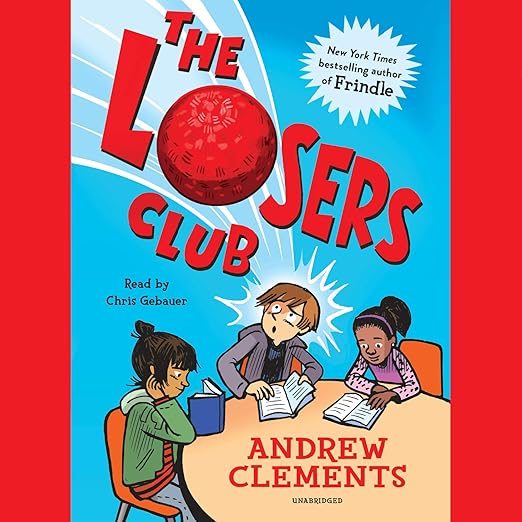
I finished The Losers Club on a Tuesday morning when I was supposed to be doing something else entirely. That’s the Clements effect: his books have a deceptive ease that disguises how carefully they’re constructed. The Losers Club is ostensibly a school story about a sixth-grader who loves reading so much that he starts a club specifically to protect his reading time. What it actually is turns out to be a small, precise novel about the difference between solitude and loneliness, and about what it means to be seen by people you didn’t expect to notice you.
Alec is a reader. Not a casual reader: a kid who cannot put a good book down, who has gotten into trouble with his principal for reading during class, who starts a club called the Losers Club specifically because he expects no one to want to join something with that name. He intends to be the only member. The novel is about the systematic, amusing failure of that plan, as first one kid, then another, then his ex-friend turned bully, and then a girl he might be starting to like, all find their way to Alec’s reluctant club. Real life, Clements observes, turns out to be just as interesting as a book.
Christopher Gebauer and the Art of Playing It Straight
The School Library Journal starred review called the book engaging and funny, and Gebauer’s narration lands both qualities without forcing either. He plays Alec with a kind of bone-dry awareness: this is a kid who notices everything and comments on most of it internally, and Gebauer’s delivery makes that internal monologue feel natural rather than performed. When Alec is baffled by the appearance of unexpected club members, Gebauer gives the bafflement a timing that’s genuinely comic without mugging for laughs.
The harder material, the ex-friend who has become a bully, the vulnerability of starting to like someone, the quiet ache of feeling like you don’t quite belong anywhere, gets a lighter touch. Clements is not a writer who sends children through suffering; he is a writer who acknowledges difficulty and then shows children finding their way through it with their dignity intact. Gebauer understands this register and stays in it consistently across five and a half hours.
The Book-Within-the-Book and Why It Works
One of the pleasures of The Losers Club is that Alec’s reading life is not decorative. His books are named. His reading responses are specific. Clements includes shout-outs to other writers throughout, as the New York Times review noted, and the book ends with a recommended reading list. This is a novel that takes the act of reading seriously enough to be specific about it, which is rarer in middle-grade fiction than it should be. For children who already identify as readers, that specificity is affirming. For children who don’t yet see themselves as readers, it might offer an opening.
Reviewer MC described thinking the book was going to be about a kid and his loser friends and being surprised by what it actually was. That misdirection is built into the title and premise, and it’s part of the novel’s generosity: it meets the reader at a simple, funny premise and then quietly becomes something more.
Awards and Classroom Relevance
The Losers Club has collected an impressive slate of regional children’s reading awards: Rhode Island Children’s Book Award, Garden State Children’s Book Award, and nominations across a dozen state reading programs. The School Library Journal gave it a starred review with a recommendation as a first purchase for all middle grade collections and as a solid read-aloud choice for classrooms. Reviewer PILAR noted a grandson who said it was entertaining, easy to follow, and a different theme from other books he’d read. The word different is interesting coming from a child who has already read six Andrew Clements books: it means Clements found a way to do something new within his own established territory.
Who Should Listen / Who Should Skip
Listen to this if your child is in the 8 to 12 range and loves reading but struggles to find books that make their identity as a reader feel reflected back at them. The Losers Club is one of the more direct celebrations of bookish children in middle-grade fiction. It also works for children who are reluctant readers but enjoy funny school stories: the premise and Gebauer’s delivery are accessible entry points.
This is not a book for readers who want fantasy, action, or high stakes. It is a realistic school story with gentle conflict. Its pleasures are character, humor, and the small victories of connection rather than adventure.
Frequently Asked Questions
Does The Losers Club work if my child hasn’t read other Andrew Clements books like Frindle?
Completely. It’s a standalone novel with no prior knowledge required. The synopsis references Clements as the author of Frindle, but The Losers Club is independent of that book in every way. It works as a first Clements experience.
Is Christopher Gebauer’s narration suitable for the age group this book targets?
Yes. Gebauer plays Alec with a dry, internally-aware delivery that suits a sixth-grade protagonist who’s slightly bemused by his own life. The performance is engaging for both child listeners and adults listening alongside them.
The title suggests the book might involve bullying, so how intense does that material get?
The ex-friend who has become a bully is a presence in the novel, but Clements handles the dynamic with his characteristic light touch. This is not a book about bullying trauma. It’s a book about how relationships change and sometimes reconnect in unexpected ways. The conflict is realistic and age-appropriate without being distressing.
The Losers Club has won multiple state reading awards. What does that mean for classroom use?
Multiple state reading award wins indicate that the book has been reviewed and recommended by children’s librarians and educators across different regions. The School Library Journal starred review specifically recommended it as a first purchase for all middle grade collections and as a solid read-aloud choice for classrooms. It’s classroom-vetted.