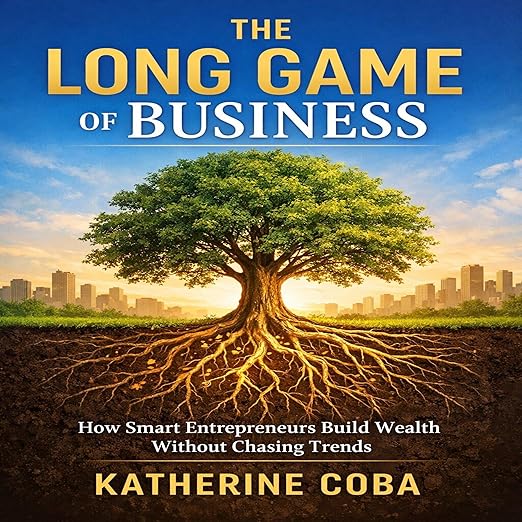
Eighty-six minutes is not much runway to argue against an entire culture of overnight-success stories, but that is exactly what this audiobook sets out to do. Katherine Coba's central warning is that new ventures rarely collapse for lack of good ideas; they stall out because their owners keep reaching for quick wins instead of putting in years of unglamorous groundwork that actually compounds, and narrator Scott LeCote reads the case for patience with the kind of unhurried, measured delivery that never once rushes toward a punchline or a hard sell.
LeCote's Calm Pace Models the Book's Own Argument
That calm pacing turns out to be the right choice for this specific material. The Long Game of Business is built entirely around the idea that patience compounds and shortcuts erode, so a narrator who sounds like he is racing to the next chapter would undercut the book's own argument. LeCote's steady rhythm essentially models the behavior Coba is asking listeners to adopt, which is a subtler kind of narration craft than dramatic range or character voices, but it fits this genre of practical, systems-minded business writing well.
LeCote's pacing choices are easy to overlook precisely because they are so unobtrusive, and that is the point. A narrator eager to sell energy and urgency would fight against a book whose entire thesis is that urgency is the enemy of sustainable growth. Instead, sentences land with room to breathe, transitions between ideas are given a beat to settle, and the overall effect resembles a mentor thinking out loud rather than a motivational speaker building toward a crescendo.
Patience Itself Becomes a Competitive Advantage
Coba's insistence on staying focused amid distractions gets particular emphasis, and it lands as more than a throwaway line given how much of the current business-advice landscape actively works against that discipline, with algorithm-driven platforms rewarding constant pivoting and trend-chasing over the patient, repetitive work she is defending. Positioning patience itself as a competitive advantage, rather than merely a virtue, is the sharper and more useful version of an argument that could easily have stayed abstract.
Coba's own framing is refreshingly unglamorous. Rather than promising a viral breakout or an overnight transformation, she walks through how small, boring, repeatable improvements stack into what she calls real wealth, contrasted throughout against the trend-chasing behavior she considers the actual reason most new ventures stall out. The audiobook is structured around building businesses that strengthen with time rather than simply moving faster, and around turning modest daily progress into compounding long-term results.
It Reads Like a Foreman's Checklist for Patience
Money management gets serious attention too, not just mindset. Coba spends real time on staying financially disciplined, developing skills that keep generating income well beyond any single gig or client, and building systems sturdy enough to keep you moving even on the days motivation disappears entirely. None of this is packaged as a secret formula. It reads more like a foreman's checklist for people who already know, in theory, that patience matters but need a concrete blueprint for practicing it.
Coba's background is not detailed extensively in the synopsis itself, but the voice throughout reads as someone who has actually run something long enough to watch the shortcuts fail. The recurring emphasis on systems, the kind of repeatable processes that keep a business moving even when the owner's motivation dips, suggests operational experience rather than purely theoretical strategy borrowed from other books in the genre.
At just under an hour and a half, this sits closer to an extended briefing than a comprehensive business course, and listeners should calibrate expectations accordingly. No deep dive into tax law, chapter-length case study of a single company's rise, or granular spreadsheet-level detail on financial modeling is on offer here. What Coba offers instead is a compact framework, delivered with enough real-world grounding that it reads as lived experience rather than recycled motivational language.
No listener reviews or star ratings beyond a perfect five out of five across twenty-two ratings accompany this title yet, which makes it harder to gauge how the material lands once someone actually tries to apply it. A perfect average from a modest sample is a promising early signal, but it is still a small one, and anyone hoping to verify the strategies against a wider base of independent listener feedback will not find much to lean on here.
A Small Sample Still Reads as a Promising Signal
A natural audience overlap sits here with the broader financial independence and slow-wealth-building movement, even though Coba frames her argument specifically around business ownership rather than personal investing. Listeners already sympathetic to that general worldview, valuing compounding over speculation, will likely find her business-specific application of the same underlying philosophy a natural extension of ideas they already hold about money more broadly.
A perfect rating from a small sample deserves a slightly more skeptical read than the number alone suggests, and it is worth noting that twenty-two ratings with zero written reviews leaves real uncertainty about who exactly is rating this and why. That said, a consistently perfect average, rather than a high average with some scattered lower scores, at least suggests nobody who finished it walked away actively disappointed, even if the depth of engagement behind each rating remains unclear.
The absence of named case studies or specific company examples is worth flagging as a real stylistic choice rather than an oversight. Coba builds her argument around principles and patterns rather than a single celebrated founder's story, which keeps the material broadly applicable across different industries but means listeners hoping for concrete, named examples of the long game paying off will need to look elsewhere for that kind of narrative proof.
A Short Runtime That's Genuinely Double-Edged
The short runtime is genuinely double-edged. On one hand, it respects a busy entrepreneur's time and can be finished in a single commute or gym session, then revisited as a refresher whenever motivation wobbles. On the other, anyone hunting for the kind of exhaustive, chapter-by-chapter operating manual that some business audiobooks provide will find this closer to a distilled thesis than a full playbook, light on the granular how-to a reader might need to actually execute each idea.
First-time founders wrestling with the temptation to chase every viral tactic or quick-profit trend stand to get the most immediate value here, especially anyone building a side hustle who keeps second-guessing whether slow, steady progress is actually working. Side-hustlers testing whether their current pace can eventually become a full income will likely find the framing validating rather than revelatory.
Anyone already deep into detailed financial modeling, tax strategy, or scaling operations beyond the startup phase will likely find the content too foundational, better suited to someone building the discipline and mindset first than to an operator already managing complex systems, and listeners craving concrete case studies with names, numbers, and outcomes may find Coba's approach more principle-driven than story-driven throughout.
Is this audiobook long enough to replace a full business course?
No. At roughly ninety minutes, it works better as a compact framework and mindset reset than as an exhaustive operating manual, without deep tax, legal, or financial-modeling detail.
Does Scott LeCote's narration suit this kind of practical business audiobook?
Yes. His steady, unhurried pacing fits a book built entirely around patience and compounding progress, letting the material breathe rather than pushing it toward a hard-sell energy.
Are there listener reviews to check before choosing this audiobook?
Not yet. The perfect five-star average comes from a small sample of twenty-two ratings with no written reviews attached, so there is limited independent feedback on how the strategies play out in practice.
Who gets the most out of this audiobook, beginners or experienced entrepreneurs?
Early-stage founders and side-hustlers wrestling with trend-chasing temptation are the clearest fit. Operators already running complex, scaled businesses will likely find the content more foundational than advanced.