Quick Take
- Narration: Gez Medinger narrates his own work, and the decision is correct. His voice carries the authority of a fellow patient who also did the research, not of someone reading from a distance.
- Themes: Post-viral illness, chronic fatigue and immune dysfunction, navigating systemic medical uncertainty
- Mood: Clear-eyed and practical, with the hard-won calm of someone who has been living the problem
- Verdict: The most complete, clinically grounded audio resource currently available for Long COVID patients and the people who care for them.
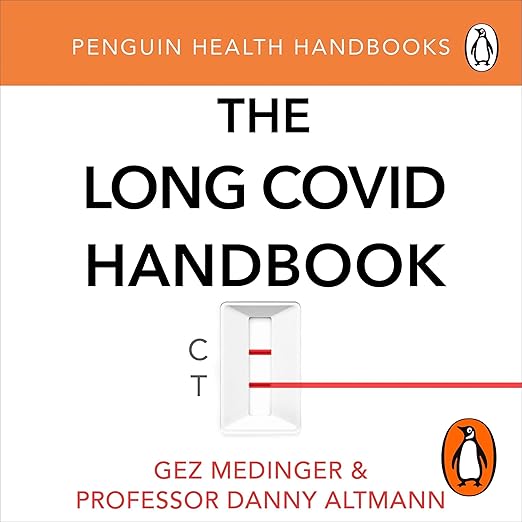
I have a close friend who has been navigating Long COVID for nearly two years. She described to me, early in her illness, the specific vertigo of trying to research a condition in real time: new studies contradicting last month’s studies, Reddit threads mixing patient testimony with unvetted treatment claims, doctors who were willing but uninformed. She told me she had read most of the available books on the subject by the time she found this one, and that this was the first resource that made her feel like the ground had been mapped. That is a precise description of what Gez Medinger and Professor Danny Altmann have built here.
Medinger is a documentary filmmaker who developed Long COVID in 2020 and, rather than waiting for the medical system to catch up, spent years interviewing researchers, immunologists, and patients while also being a patient himself. Professor Danny Altmann is one of the world’s leading immunologists, based at Imperial College London. Their collaboration produces something that neither could have written alone: Altmann supplies the cutting-edge science, Medinger supplies the patient perspective and the translator’s instinct for what actually helps someone living with 200 symptoms and insufficient answers. The PDF companion, which Audible notes is available alongside the audio, provides visual materials that support the scientific sections.
Two Hundred Symptoms, and Why That Number Matters
The book opens with something clarifying: Long COVID is not one thing. The 200 symptoms documented by researchers span neurological, respiratory, cardiovascular, gastrointestinal, and immunological systems in patterns that differ substantially between patients. The fatigue some patients experience looks different from the post-exertional malaise others report, which looks different again from the brain fog clusters or the cardiac involvement. Medinger and Altmann do not simplify this. They map it. That mapping, more than any single treatment recommendation, is what makes the book genuinely useful. It gives patients a vocabulary for their own experience and a framework for understanding why two people with Long COVID can present so differently.
What the Immunology Actually Shows
Altmann’s influence is clearest in the chapters reviewing what Long COVID is, immunologically speaking. The book covers the major hypotheses: viral persistence, autoimmune activation, microbiome disruption, and reactivation of latent viruses. Medinger translates these carefully, distinguishing between what has been demonstrated in peer-reviewed studies and what remains speculative. One reviewer specifically praised the book for being easy, concise, and up-to-date, noting that online research typically produces confusion rather than clarity. Another reviewer who had been ill for nineteen months describes it as a lifeline, crediting Medinger with providing information, solace, and hope across the arc of their illness. That dual function, scientific guide and source of morale, is rare in medical writing.
Practical Guidance That Treats Patients as Adults
The treatment and management sections are the most practically oriented part of the book. Medinger and Altmann review which interventions have evidence behind them, which are promising but unproven, and which should be avoided. They are honest about the limitations of the current evidence base without using that uncertainty as a reason to withhold guidance. The pacing and energy management framework, drawn from research on ME/CFS and adapted for Long COVID, is covered in enough detail to be actionable. The mental health dimensions of living with a poorly understood chronic illness receive their own dedicated coverage, which matters more than any given treatment protocol for many patients.
Why Self-Narration Was the Right Choice
At seven hours and fifty-three minutes, the audiobook runs at a pace that is genuinely accessible for patients managing cognitive load. Medinger reads clearly and without the performance quality that some self-narrators accidentally impose on nonfiction. He sounds like someone explaining something important to you, not like someone doing a reading. That register is exactly right for material this personal and this technical simultaneously.
Who Should Listen, Who Should Skip
Listen if you have Long COVID, suspect you do, or care for someone who does. This is the clearest, most current patient-facing resource available in audio format. Listen if you are a clinician who wants to understand what your Long COVID patients are navigating and what the current research landscape looks like from their side.
Skip if you are looking for a simple recovery protocol or a reassuring narrative. Medinger and Altmann are honest that Long COVID is serious, that recovery timelines are unpredictable, and that the medical system is still catching up. The book is hopeful but not false about the difficulty of what it is describing.
Frequently Asked Questions
Is The Long COVID Handbook up to date with the most recent research?
At publication it drew on cutting-edge immunological research, and Professor Danny Altmann’s co-authorship guarantees scientific rigor. Because Long COVID research is moving quickly, it is worth supplementing with recent peer-reviewed literature, but the book’s foundational science framework remains relevant.
Does the audio version include the companion PDF?
Yes. Audible notes that the accompanying PDF is available in your Audible Library alongside the audio. It contains supporting materials including references and visual aids that supplement the scientific sections. It is worth having accessible, particularly for the immunological content.
Is this book useful for someone recently diagnosed, or is it more for long-term patients?
Both audiences are served. For recently diagnosed patients, the early chapters on what Long COVID is, why it presents so variably, and what the evidence shows about mechanisms provide essential grounding. For long-term patients, the treatment, management, and mental health chapters offer the most directly actionable guidance.
Gez Medinger is a filmmaker and patient rather than a doctor. Does that affect the book’s credibility?
The co-authorship with Professor Danny Altmann, a leading immunologist at Imperial College London, anchors the scientific content at a high level. Medinger’s patient perspective is explicitly one of the book’s strengths rather than a limitation. Reviewers with significant personal illness experience have found it credible and useful.