Quick Take
- Narration: Christian Neale brings a steady, warm storytelling presence to Baum’s mythological prose, unhurried enough to let the 1902 cadences breathe without feeling stiff.
- Themes: Origins of generosity, mortal life among immortal beings, the meaning of giving
- Mood: Quietly mythological, warm, and reflective
- Verdict: An unexpectedly rich holiday listen for families who want something with genuine literary heritage rather than another contemporary Christmas confection.
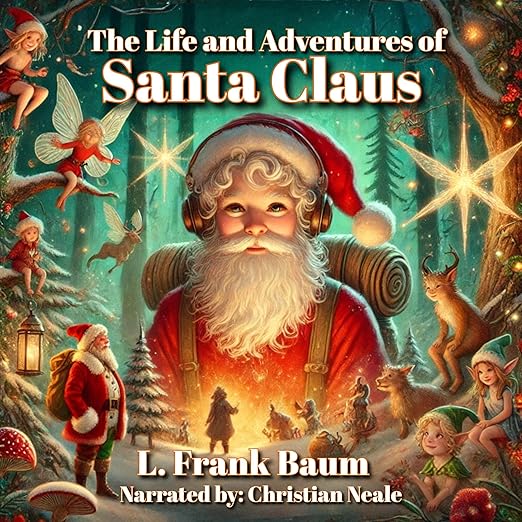
Most people know L. Frank Baum only through Dorothy and Oz. I came to The Life and Adventures of Santa Claus years ago through a footnote in a book about American fantasy literature, and I remember feeling surprised by how different it was from anything I expected. This isn’t the jolly commercial Santa of department store mythology or the modern elf-workshop narratives that fill holiday audiobook catalogs. Baum’s Santa is a foundling raised by a wood nymph in the immortal Forest of Burzee, who grows up among magical creatures and slowly, through his own moral intuition, decides to dedicate his life to making children happy. It is, in its own way, a philosophical origin myth, and it reads with all the stateliness of one.
Published in 1902, the same period that produced the Oz books, this story sits at the intersection of Baum’s two great preoccupations: the enchanted American wilderness and the question of what makes a good life. Reviewer Tyr makes the point well, noting that Baum’s other work often circled back toward his magical cosmology and that Santa Claus is no exception. The Forest of Burzee, where the wood nymph Necile raises young Claus, belongs to the same imaginative territory as Oz, governed by immortal beings, operating by its own internal logic, touched by genuine wonder.
The Mythological Architecture Baum Built
What distinguishes this book from other Santa origin stories is the seriousness with which Baum treats the mythology he’s constructing. He doesn’t shorthand the world. There are immortal councils, formal debates about whether Claus should be granted immortality at the end of his mortal life, and battles between forces of good and darkness that take the form of a War of the Ryls. The Awgwas, malevolent creatures who work against Claus’s mission, are genuinely menacing for a Victorian-era children’s fantasy. Baum earns the Santa legend by making the road to it feel earned rather than inevitable. Claus doesn’t discover toy-giving because he’s magically predestined to, he invents it, one wooden cat at a time, in response to the specific sadness he observes in mortal children.
This attention to mechanism and motivation is what separates the book from holiday kitsch, and it’s what Christian Neale’s narration serves well. Neale reads with measured warmth, he doesn’t try to inject modern pep into Baum’s formal prose, and that restraint is exactly right. The language of 1902 American fantasy has a particular cadence: slightly elevated, courtly in its imagery, unhurried in its syntax. Rushing it would flatten the mythology. Neale understands that the story wants to feel like something being passed down rather than something being performed.
Where It Gets Complicated for Modern Listeners
I want to be honest about what this audiobook is not. It is not a fast-paced adventure. It is not primarily funny. It has the structure of mythology rather than novel, episodic, panoramic, interested in consequence over conflict. Young listeners accustomed to the propulsion of contemporary middle-grade fiction may find the first third slow; the story doesn’t generate momentum in the way Baum’s Oz books do. This is the main caveat for families considering it as a bedtime listen with fidgety children. For a child who has already developed a taste for older prose, someone who has gotten through classic E. Nesbit or early C.S. Lewis without complaint, this will feel natural. For a seven-year-old expecting something in the register of a holiday chapter book, it may require some parental framing upfront.
The series label “Smart Hippo Holiday Books” in the metadata suggests this edition has been positioned for a broad holiday audience. Baum’s original text is the draw here; the packaging is secondary.
A Different Kind of Christmas Tradition
Families who return to this audiobook year after year tend to do so for the reason one reviewer described it: “cute, even for adults.” That undersells it slightly, but the sentiment is right. There is something in the book that functions differently for grown listeners than for children. Adults hear the question of whether Claus will be granted immortality as a meditation on mortality and legacy, whether a life spent in generosity earns some form of continuation. Children hear Santa learning to make sleds. Both experiences are available simultaneously, which is the mark of a text that deserves its longevity.
At three hours and 43 minutes, this is a comfortable single-session listen or a three-evening advent audiobook, which suits its seasonal purpose perfectly.
Who Should Listen, Who Should Skip
The ideal listener here is a family with children aged eight and up who have some tolerance for older prose rhythms, or an adult listener who wants an unusual and genuinely literary holiday audiobook experience. It pairs beautifully with the Oz books for Baum completists. Anyone who has always wondered why the Santa mythology has that particular shape, the reindeer, the workshop, the midnight gift-giving, will find Baum’s inventions satisfying even when they diverge from later tradition.
This is not the right choice for listeners who need their holiday audiobook to be brisk and contemporary. The deliberate pace is a feature of the mythological register, not a flaw, but it does require the right listener.
Frequently Asked Questions
Is this the original L. Frank Baum text, and how does Baum’s writing style compare to the Oz books for children already familiar with those?
Yes, this is Baum’s original 1902 text. The writing style is more formal and mythological than the Oz books, closer to Norse or Celtic myth in structure than to the adventure-story pacing of The Wonderful Wizard of Oz. Children who loved Oz will find the same imaginative world-building here but should expect a more contemplative, less action-driven story.
Is Christian Neale’s narration a good match for Baum’s formal 1902 prose?
Yes. Neale reads with measured warmth and doesn’t modernize the cadence. He understands that the story needs to feel like an old legend being retold rather than a contemporary children’s audiobook, and his pace honors that. He is particularly effective in the mythological council scenes where the immortal beings debate Claus’s fate.
Does the book contain the Awgwas battle sequence, and is that section too intense for young children?
Yes, the battle between the immortal forces protecting Claus and the Awgwas who oppose him is present. Baum frames it with the distance of myth rather than graphic violence, so it reads as heroic fantasy rather than frightening. Most children aged seven and up will handle it without difficulty, though the sequence is more intense in tone than the gentler origin sections.
How different is Baum’s Santa from the modern commercial version, and will children recognize the character?
Baum’s Santa is recognizable, he makes toys, delivers them at night, uses reindeer, but the mythology is far richer and stranger than the department-store version. His Santa is a mortal who earned his relationship with the immortal world, not a magical being who always existed. Children may find the strangeness delightful or disorienting depending on how firmly the commercial image is entrenched. The book works best as an addition to a child’s Santa mythology rather than a replacement for it.