Quick Take
- Narration: Fred Berman handles Andrew Clements’ school-story register cleanly, balancing Hart’s cockiness and gradual growth without overplaying either end.
- Themes: Leadership versus popularity, responsibility, what it actually means to care about something
- Mood: Light-footed and relatable, with a small emotional gut-punch near the end
- Verdict: Another precise, unpreachy school story from Clements that earns its emotional payoff without telegraphing it.
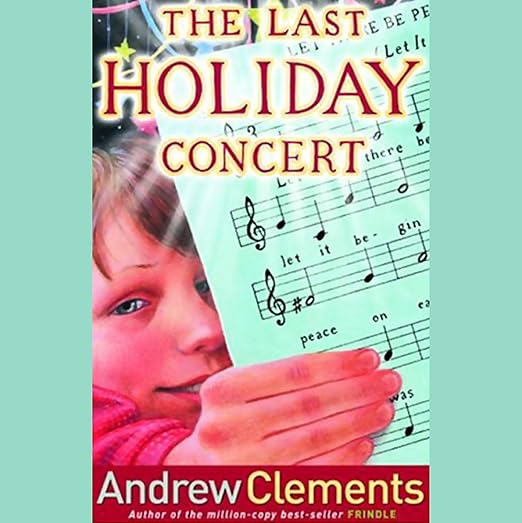
I came to Andrew Clements later than most readers do, which means I approached The Last Holiday Concert as an adult who had already read Frindle and been quietly impressed by how little it talked down to its audience. This one arrived on a Sunday morning commute, and I was three chapters in before I realized I had stopped thinking about anything else. Clements has a particular gift that I think gets undersold in the way his books are categorized as classroom favorites. Yes, they work in classrooms. But what makes them work is the same thing that makes good adult literary fiction work: the central conflict is genuinely unresolved for long enough that you don’t know how it will land.
Hart Evans is the most popular fifth grader at his school, and he knows it. The accidental rubber-band incident in choir class, launched at his teacher Mr. Meinert during a moment of zone-out, sets in motion a punishment that is one of the more elegant plot mechanisms in middle-grade fiction: Mr. Meinert, facing the end of his job due to budget cuts, appoints Hart as interim choir director. Hart, who has coasted on social capital his whole school life, must now actually lead something, with actual consequences if he fails.
The Rubber Band and What It Unlocks
Clements writes school scenes that feel like they were observed from inside a real fifth-grade classroom rather than reconstructed from memory at a comfortable distance. The dynamic between Hart and Mr. Meinert in the aftermath of the incident is the best kind of teacher-student fiction because neither character is made to be wholly right or wrong. Mr. Meinert’s punishment is clever and disproportionate in its cleverness; Hart’s resentment of it is entirely understandable even as we see exactly what the teacher is trying to accomplish. The reader holds both positions simultaneously, and Clements never breaks that equilibrium by editorializing.
Fred Berman’s narration serves this well. He finds the right version of Hart’s voice, just confident enough to be believable as the most popular kid in class, not so confident as to be immediately unlikable. The gradual shift in Hart’s relationship to the choir, from an embarrassment to something he actually gives a damn about, needs to happen at a pace that doesn’t feel rushed or sentimental. Berman tracks that arc without overcorrecting.
The Holiday Concert That Isn’t Quite About the Holidays
One reviewer noted something important: the book talks about all religions, not just Christmas. That’s an accurate description of a conscious authorial choice. Mr. Meinert’s choir program and the concert Hart eventually has to produce are designed to be inclusive in a way that would have been quietly unusual for the era of publication in 2004 and that still stands up as thoughtful rather than tokenistic. The holiday concert is the structural deadline of the story, but the actual subject of the book is what happens to a kid who has never had to care about anything because his social position made caring unnecessary.
The ending has a sting in it that several reviewers describe as emotionally complex for what presents itself as a simple school story. Clements respects his readers enough to let the resolution cost something. That’s rarer than it should be in children’s fiction of this type, and it’s the reason this book, like Frindle, lingers.
Who Should Listen and Who Should Skip
Children in grades 3-6 who have already connected with Frindle or other Clements titles will find this a natural next listen. Parents looking for school-story audiobooks that handle themes of leadership and responsibility without turning into moral parables will appreciate how lightly Clements wears his themes. The 3-hour runtime makes this a solid choice for a long car trip or a week of bedtime listening at 20-25 minutes per session. Listeners who want exclusively lighthearted holiday-themed content should know the book is more emotionally complex than its holiday concert premise suggests. Anyone who thought Frindle was too simple will find this one sharper.
Frequently Asked Questions
Do you need to have read Frindle or other Andrew Clements books before listening to The Last Holiday Concert?
No, this is a completely standalone story with no connection to other Clements titles. Each of his school novels stands alone. The Frindle comparison in reviews is about tone and approach, not shared characters or plot.
Fred Berman narrates a lot of middle-grade audiobooks. How does his performance here fit the material?
Berman is well-matched to the Clements material. His voice has the right register for 10-11 year old protagonists, and he handles the class dynamics clearly without exaggerating any of the characters. His Hart is believably popular without being a caricature.
Is the ending happy or sad? Some reviews hint at something emotionally complex.
The ending is bittersweet rather than purely happy or purely sad. It resolves the concert storyline satisfyingly but involves a development regarding Mr. Meinert that adds emotional weight. It’s appropriate for the age group but does ask more of the listener than a simple happy ending would.
How does the book handle the different religious holidays given that it’s set around a holiday concert?
Clements makes a point of writing a holiday concert that represents multiple traditions rather than defaulting to Christmas. The inclusivity is woven into the story rather than announced, and it reflects Mr. Meinert’s character as much as it does any authorial agenda.