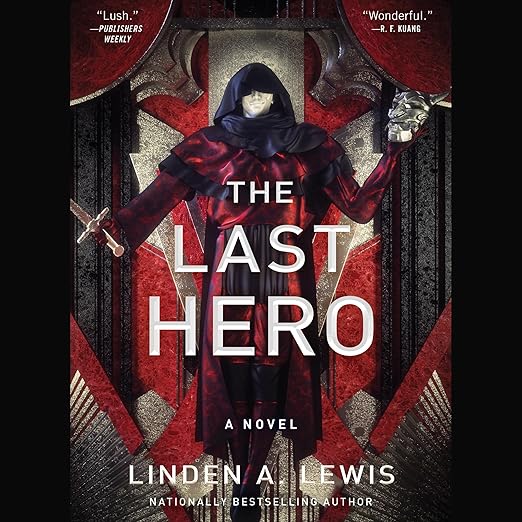
Quick Take
- Narration: Ali Andre Ali handles a large cast of distinct characters across a sprawling space opera, the performance is technically accomplished and holds the complexity of the trilogy’s conclusion together across 23 hours.
- Themes: Religious authority and liberation, queer identity in dystopian systems, grief and chosen family
- Mood: Intense and emotionally layered, with the weight of a series reaching its reckoning
- Verdict: A worthy and emotionally demanding conclusion to one of the more original queer space operas in recent SF, best experienced after reading books one and two in close succession.
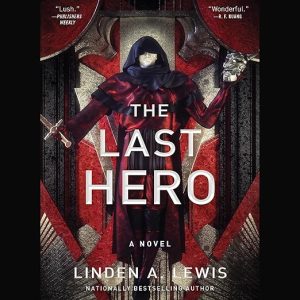
I finished The Last Hero on a Saturday morning when the house was still quiet. I had been rationing the final hours of Linden A. Lewis’s First Sister trilogy for about a week, unwilling to let it end. That kind of deliberate slowing-down is something I only do with books I know I will miss, the ones that have built a world I am not ready to leave behind.
This is the third and final volume in a trilogy that began with The First Sister, and it is nearly impossible to discuss without the context of what came before. Lewis has constructed something ambitious: a solar-system-spanning civilization divided between two opposing powers, the Geans and the Icarii, with a religious sisterhood that controls women’s voices and bodies serving as one of the central axes of oppression. Queer identity runs through the narrative not as a subplot but as a structural element, characters like Hiro val Akira, who uses they/them pronouns and operates as a former Dagger without a Rapier, exist at the intersection of gender, violence, and institutional power in ways that feel genuinely thought through.
Our Take on The Last Hero
The novel picks up multiple threads simultaneously. Astrid, free of the Sisterhood but now called the Unchained by her followers and the Heretic by her enemies, is using her insider knowledge to raid abbeys and Cathedrals while piecing together the mystery of her own erased past. Hiro is moving through the streets of Cytherea on a path of grief and vengeance aimed at their father, Souji val Akira, who stands in judgment over the entire human future. Luce, transformed by the Genekey virus, navigates the schism forming among the Asters on Ceres. Lewis weaves these storylines toward a convergence that manages to feel both inevitable and genuinely surprising.
One reviewer described having read the series across years and finding The Last Hero something of a slog at first, before coming to believe that all of it had purpose. That is an honest and useful note. This is a book that rewards patience and punishes gaps in memory, one reviewer openly advised against reading the trilogy with long breaks between volumes.
Why Listen to The Last Hero
Ali Andre Ali’s narration is a significant part of why this trilogy works in audio. Twenty-three hours of multiple POVs across a complex political landscape requires a performer who can differentiate characters consistently while maintaining narrative momentum. Ali accomplishes this. The emotional register shifts that the story demands, from grief to fury to something like transcendence, are handled with restraint and care rather than melodrama. For new-to-SF listeners, as one reviewer described themselves, the series served as a perfect entry point, largely because the narration makes it easy to track who is who.
NPR described the trilogy as a sprawling, queer space opera, which is accurate but undersells the precision of Lewis’s construction. This is not a series that uses queerness as decoration, it is a series that examines how institutions erase, control, and commodify identity, and the queer characters are doing the most interesting work in resisting those structures.
What to Watch For in The Last Hero
The pacing of the final volume is demanding. Lewis is resolving a great deal of plot, and some readers have found certain stretches slower than they expected from a concluding installment. The Synthetics subplot, involving whether even the greatest human intellect can outwit artificial intelligence, adds complexity at a point in the story when some listeners are already at capacity. It pays off, but it asks for trust.
One reviewer who described themselves as undone by the ending, and who offered to grab readers by the shoulders to insist they read the series immediately, represents the ceiling of what this book does to the right audience. The floor, for readers who come in cold without the earlier volumes, is considerable disorientation.
Who Should Listen to The Last Hero
This audiobook is for readers who have already listened to or read The First Sister and The Second Rebel. Anyone who arrives here without that foundation will be lost within the first hour. For series readers in good standing, this is a conclusion that takes its responsibilities seriously, it does not shortchange the emotional stakes that two prior volumes established. Listeners who are drawn to science fiction that uses the genre’s tools to examine real-world hierarchies of gender, religion, and bodily autonomy will find this trilogy among the most substantive in recent memory.
Frequently Asked Questions
Can I listen to The Last Hero without having read the previous two books?
No. The Last Hero is the third volume in the First Sister trilogy and assumes complete familiarity with the characters, factions, and events of the prior two books. Starting here would result in significant confusion.
How does Ali Andre Ali handle the multiple POV characters across 23 hours?
Very well. Ali differentiates the major perspectives, Astrid, Hiro, Luce, and others, with consistent vocal choices that help listeners track whose chapter they are in. The performance is one of the reasons audio works particularly well for this series.
Is the queer representation in The Last Hero central to the story or treated as background?
It is central. Characters like Hiro val Akira use they/them pronouns and their gender identity is directly tied to the political and institutional conflicts of the story. Lewis is not using queerness as flavor, it is structurally embedded in the world’s power systems and in the characters’ resistance to those systems.
Does The Last Hero provide a satisfying conclusion to the trilogy?
For readers who have stayed with the series, yes, though it requires patience in places, and some characters’ arcs conclude in ways that are bittersweet rather than triumphant. Several reviewers described feeling emotionally wrecked in the best possible way.