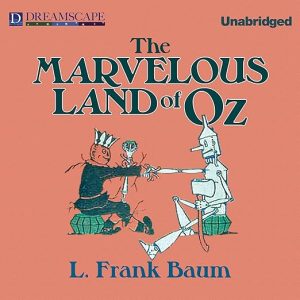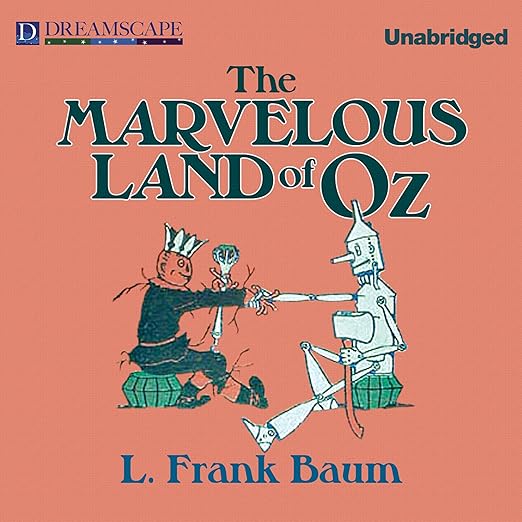
I came to The Land of Oz in a roundabout way, my niece had been rereading the Oz books and kept asking me questions about the series I couldn't answer, which sent me back to the original and then, almost immediately, to this first sequel. I was not prepared for how different it would feel from The Wonderful Wizard of Oz, and not in a way that diminishes it. L. Frank Baum essentially wrote a new kind of story in the same world, and the result is more politically strange, more structurally inventive, and in some ways more interesting than the book it follows.
The absence of Dorothy is the first signal that Baum isn't simply repeating himself. The Land of Oz follows Tip, a boy escaping the sorceress Mombi, and his journey to the Emerald City acquires companions, Jack Pumpkinhead, brought to life from straw and a carved pumpkin, and the Wooden Sawhorse, who are among Baum's more genuinely inventive creations. When they arrive to find an army of girls has overthrown King Scarecrow, the book tips into something closer to political fable than adventure story, and the resolution, which one young reviewer found astonishing enough to record in her review, is the kind of structural twist that genuinely earns its surprise.
The identity revelation at the book's end is one of the more remarkable moments in early American children's literature, and it holds up better than most Victorian-era plot twists because Baum seeds it carefully. The question of who rightfully should rule Oz turns out to be a question about who Tip has always been, and the answer challenges assumptions about gender, identity, and legitimacy that were genuinely radical for a 1904 publication. A third-grade reviewer in India expressed her surprise concisely: "I was so surprised to know that tip was princess ozma." She's in good company.
Tara Sands' narration handles the book's tonal range well. Oz requires a narrator who can move between comic invention and genuine adventure without losing either register, and Sands finds that balance. Jack Pumpkinhead is one of the funnier characters in the series, his literal-mindedness produces the kind of gently absurdist comedy that Baum was good at, and Sands gives him a voice that is comedic without being dismissive. Glinda and Mombi are differentiated with appropriate gravity.
What Makes The Land of Oz Worth Hearing
For family listening specifically, this audiobook is close to ideal. The five-hour runtime makes it manageable across a few sessions, and the story's structure, a journey with accumulating companions, a political problem to solve, and a climactic revelation, follows the logic of children's adventure fiction in ways that feel genuinely satisfying rather than formulaic. One reviewer who read the first book with his five-year-old found this one a different but equally rewarding experience, noting fewer preconceptions from the MGM film adaptation to navigate.
The Oz books as a series are richer and stranger than the MGM film has conditioned most readers to expect. The Land of Oz is an excellent demonstration of that strangeness. The Woggle-Bug, introduced here, is one of Baum's better inventions, a highly educated insect whose pomposity generates running comedy throughout the second half of the book. The political logic of the girls' army overthrowing Scarecrow is treated with a lightness that masks how genuinely subversive it is.
Things to Know Before Starting The Land of Oz
This is the second book in the Oz series, not the first, and while it functions as a largely self-contained adventure, listeners who have not read The Wonderful Wizard of Oz first will miss some of the affection generated by meeting Scarecrow, Tin Man, and Glinda again in new circumstances. The emotional weight of the reunion scenes depends on prior investment in those characters. The book works as a standalone, but it works better as a sequel.
The low-rated review that appeared in this listing, complaining of "jagged pages and dots on the pages," refers to a physical book edition, it has no relevance to the audiobook, which has no such issues. The Dreamscape Media production is clean and professionally mastered.
Who L. Frank Baum Is Writing For
This is excellent for family listening, for children between roughly five and twelve, and for adult readers interested in the Oz series beyond its most famous entry. It's also worth noting for those who are specifically interested in the history of American children's literature, the identity revelation at the book's close is a genuinely notable moment in that tradition. Listeners who came to Oz entirely through the 1939 film and want something more grounded in that specific aesthetic may find the book's Baum-original strangeness surprising; those who embrace that strangeness will find the series one of the more rewarding extended worlds in classic American fiction.
- Narration: Tara Sands delivers a performance calibrated for family listening, warm, clearly differentiated between characters, and energetic enough to hold a child's attention without condescending to an adult's.
- Themes: identity and hidden origins, unlikely found families, the politics of who gets to rule
- Mood: Whimsical and adventurous, with a surprisingly subversive undercurrent
- Verdict: A sequel that earns its own identity while rewarding fans of the original, and Tara Sands' narration makes it a pleasure for family listening.
Does The Land of Oz need to be read after The Wonderful Wizard of Oz, or can it stand alone?
It largely stands alone as an adventure story, but the emotional payoff of encounters with Scarecrow, Tin Man, and Glinda depends on familiarity with the first book. The identity revelation at the end will be more resonant for listeners who know the Oz world already.
What age range is Tara Sands' narration suited for?
Sands calibrates her performance for family listening, clear, warm, and character-differentiated without being condescending. It works for children from roughly five upward, and adult listeners find it engaging rather than juvenile.