Quick Take
- Narration: Kirby Heyborne brings reliably warm middle-grade energy to Billy’s story, balancing the comedy of literary characters colliding with genuine emotional undercurrent in the family subplot.
- Themes: The power of imagination, literary characters as living forces, family separation and resilience
- Mood: Playful and inventive, like a summer adventure that keeps pulling in unexpected guests
- Verdict: Grabenstein’s celebration of reading is packed with madcap literary collision and genuine warmth, and Heyborne’s narration makes it one of the better audio choices for book-loving 8-to-12-year-olds.
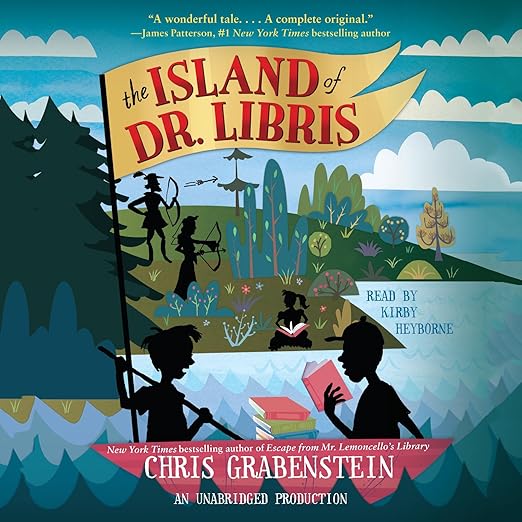
I listened to the opening chapters of this one on a Thursday afternoon, planning to sample a few minutes and move on. Two hours later I was still going. There is something almost unfairly enjoyable about Chris Grabenstein’s approach to book-loving children’s fiction: it respects the readers enough to expect that they have already met some of these literary characters, while making the encounters funny and thrilling enough that it barely matters if they have not.
Billy arrives at a lakeside cabin owned by the mysterious Dr. Libris for the summer, and things get strange immediately. There is a private bookcase. There are security cameras everywhere. And from the island in the middle of the lake, sounds come drifting over the water: sword clashes, bowstrings releasing, the occasional tremor underfoot. The books Billy reads are apparently staging themselves on that island, which is either a remarkable experiment in imagination science or a significant liability insurance problem for Dr. Libris.
The Literary Mashup and Its Internal Logic
Grabenstein pulls characters from classic and contemporary literature and lets them collide on the island with genuine comedic timing. The Wall Street Journal’s description of gleefully plundering great works of literature is accurate and affectionate. What keeps the mashup from feeling arbitrary is that Grabenstein gives the collision an internal logic: the characters behave as they would within their own stories, which means that bringing certain heroic figures into proximity produces specific kinds of chaos rather than random chaos. The rules of the island establish what is possible and what the limits are, which gives Billy a problem to solve rather than just a spectacle to observe.
James Patterson, who co-authored the I Funny series with Grabenstein, calls this book a complete original. What is genuinely original is the specific combination: the summer isolation, the island theater, the parental subplot running alongside the fantasy, and the warmth of the whole enterprise. The New York Times notes Grabenstein’s breezy narrative voice and jaunty wit, and those qualities translate exceptionally well to audio, where Heyborne can deliver the comedy directly into the listener’s ear.
Kirby Heyborne’s Contribution
Heyborne is among the most reliable narrators working in middle grade fiction, and his performance here confirms why educators and parents keep returning to his work. Billy is a specific kind of boy: anxious about his parents’ deteriorating marriage, lonely in the cabin, intellectually curious but uncertain of himself. Heyborne tracks all of those qualities simultaneously. He does not flatten Billy into generic adventure-story-protagonist mode; the emotional subtext about the family is present even during the most exciting island sequences.
The literary character voices are handled with enough differentiation to be legible without becoming a vocal imitation competition. Heyborne knows that the comedy depends on the characters sounding somewhat like themselves, not on performing famous voices that distract from the story. He makes that judgment consistently well throughout the 5-hour runtime.
The Subplot That Earns the Resolution
What separates Island of Dr. Libris from a pure literary adventure lark is the parental subplot. Billy is at the cabin because his parents are separating, and his mother has sent him ahead while she and his father work out what their family is going to look like. The island’s magic is partly wish fulfillment, partly distraction, and partly a way of processing what is happening at home. Grabenstein earns the emotional resolution in the final chapters because he has kept that thread present throughout the adventure. One reviewer flags the ending as slightly sappy, which is a fair observation: the emotional bow is tied quite firmly. But for the target age range, a firmly tied bow is usually the right call.
The New York Times notes Grabenstein’s winning generosity and sweetness, and that characterization is precise. This is a book that likes children and likes books and is not embarrassed about either of those things. It is celebratory rather than ironic about reading, and it trusts its audience to share that celebration.
Who Should Listen, Who Should Skip
Best suited for: readers aged 8 through 12 who already love books and enjoy seeing literary characters treated with affectionate irreverence, children dealing with family transitions who might find the parental subplot resonant, and teachers looking for a read-aloud that rewards recognition of classic literature without requiring it.
Probably not the right fit for: listeners who want sustained dark tension or who find broadly comedic middle grade too cheerful for their current mood. The tone is light, the humor is gentle, and the resolution is optimistic. Readers who prefer grittier fare may find Island of Dr. Libris too sunny.
Frequently Asked Questions
Do I need to recognize the specific literary characters on the island to enjoy this book?
No. Grabenstein writes the characters with enough context that unfamiliar readers will understand who they are and why the collision is funny. Listeners who have already met these characters in their own stories will get additional comedic resonance from seeing their specific attributes collide, but the humor and adventure work without that prior knowledge.
Is the family separation subplot handled appropriately for listeners in the 8-to-9 age range?
Yes. Grabenstein handles the parental subplot with sensitivity and does not subject Billy or the reader to explicit conflict or blame. The emotional reality of the separation is present and acknowledged, but it is processed through the book’s adventurous events rather than dramatized directly. Most children in that age range who have experienced family transitions will recognize the emotional texture without finding it distressing.
How does this compare to Grabenstein’s Escape from Mr. Lemoncello’s Library for listeners who loved that book?
They share a celebration-of-books premise and Grabenstein’s signature warmth, but Island of Dr. Libris has a more overtly fantastical premise since the literary characters are literally animated. Lemoncello is more puzzle-driven and closer to a heist structure; Island of Dr. Libris is more emotionally centered. Both work well in audio, and fans of one are likely to enjoy the other.
Is Kirby Heyborne’s narration appropriate for this book’s literacy-celebration theme?
Yes. Heyborne’s warmth and emotional tracking suit a book about a boy learning to love stories and trust his own imagination. His handling of the literary character voices is differentiated without being distracting, which is the right calibration for material where the comedy depends on the characters sounding like themselves rather than like vocal impressions.