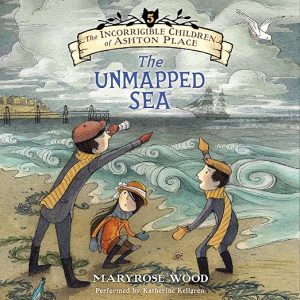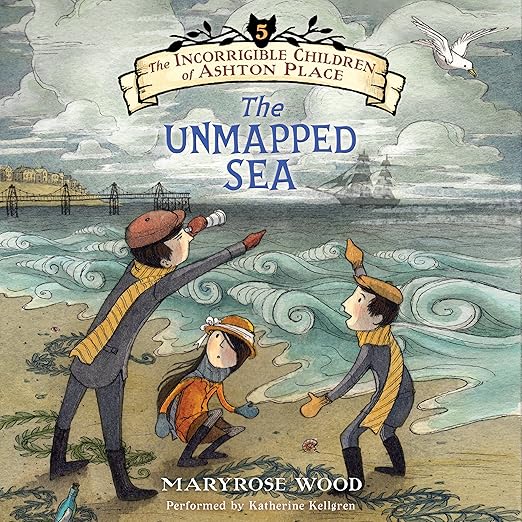
I came to this series late, catching up on the first four volumes over a winter before allowing myself Book V, which I saved for a long weekend when I knew I could give it proper attention. I finished it on a Sunday afternoon in one extended sitting, genuinely unable to put it down once the Brighton section gathered speed. For a children's audiobook, Maryrose Wood's fifth installment in the Incorrigible Children of Ashton Place had me genuinely surprised by how much of the accumulated mystery it was prepared to finally address.
For context: Penelope Lumley, governess to three feral children raised by wolves on the Ashton estate, has spent four previous volumes managing her charges' wolfish tendencies while gradually uncovering the mystery of the Ashton family curse. By Book V, subtitled The Unmapped Sea, the stakes have risen considerably. Lord Fredrick has a child on the way, and the curse must end before another generation inherits it. Penelope takes the children to Brighton in January, seeking information from an old sailor named Pudge. The Babushkinov family arrives and complicates everything.
Is The Incorrigible Children of Ashton Place: Book V Worth Your Time?
What Wood has achieved with this series is a genuinely rare thing in children's fiction: a comedy of manners with real structural stakes. Penelope is a heroine in the Jane Eyre mold, carefully educated, morally serious, and perpetually deployed into situations that Victorian social convention was not designed to handle. The humor comes from her Herculean efforts to apply good governess principles to entirely ungovernable circumstances, including three children who howl at the moon, a family curse of gothic proportions, and now the spectacularly uncontrolled Babushkinov children, who make the Incorrigibles look positively tame.
One reviewer described the chapter near the end that ties up loose threads from all four previous books as mesmerizing in its craft, and I agree. Wood has been setting this up for years, and she pays off the long game with precision. Several readers noted that the book is darker and more suspenseful than its predecessors, with a creepiness that the earlier volumes only hinted at. That escalation is earned rather than jarring.
Katherine Kellgren's narration is the decisive argument for the audio version. She has voiced all five books in the series and has built distinct, consistent voices for every major character across that span. The three Incorrigible children, Beowulf, Alexander, and Cassiopeia, each have their own vocal identity, which matters enormously when their enthusiasms burst into scenes. Penelope's wry interior monologue is handled with precisely calibrated deadpan. The Victorian narrative voice that Wood employs, arch, digressive, full of authorial asides, needs a narrator who can make those asides feel like gifts rather than interruptions, and Kellgren does this better than almost anyone I have heard working in the children's audiobook space.
The audio format also suits Wood's storytelling rhythm. She builds comic timing into her prose the way a playwright does, and hearing it performed makes those rhythms audible in ways that silent reading can miss. At nine and a half hours, the runtime is generous but never padded.
Before You Commit to The Incorrigible Children of Ashton Place: Book V
The Babushkinov family, the book's major new addition, are a brilliant comic invention. Their wildness is of a different register than the Incorrigibles': where the wolf-raised children have been carefully educated and are genuinely trying to manage their instincts, the Babushkinovs appear to have encountered no such intervention. Their presence forces the question of what civilized behavior actually means in a world where the Ashton curse has made wolves of an entire family line.
Lady Constance Ashton, a character who has been somewhat peripheral in earlier volumes, comes into her own here. Multiple reviewers noticed that her characterization deepens significantly, and the book begins to suggest she may be more important to the resolution of the overall mystery than previous installments implied. That development is among the more pleasurable surprises.
Should You Listen to The Incorrigible Children of Ashton Place: Book V?
Anyone who has read the first four books should go directly to this one. Do not wait. New listeners should absolutely start at Book I; the mystery threads are cumulative and jumping in here will produce confusion rather than pleasure. This is ideal for ages nine and up, and, as confirmed by reviewers who describe reading it to grandchildren and others who are obviously adults, it functions perfectly well as adult listening. The intelligence of Wood's Victorian pastiche and the depth of Kellgren's performance make this one of the better-crafted audiobooks in the children's category currently available.
Frequently Asked Questions
Katherine Kellgren has narrated the whole series, how consistent is her character work across five books?
Exceptionally consistent. She has maintained distinct, recognizable voices for every major character across the entire series. For listeners who have followed from the beginning, the continuity of voice is itself a pleasure.
Is Book V darker than the earlier installments?
Several reviewers noted an increase in suspense and gothic atmosphere compared to the first four books. One described it as 'ramped up' in creepiness. The humor remains, but the stakes are higher and the tone somewhat more serious, which suits a series that has been building toward a major revelation.