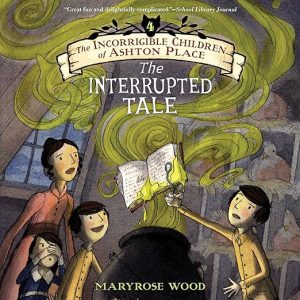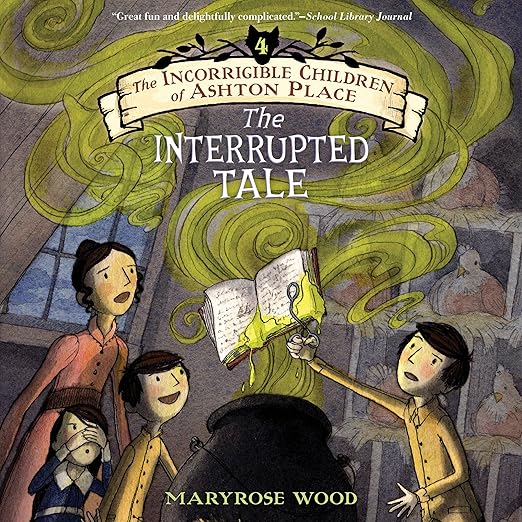
I have a genuine weakness for Victorian-set children's literature that uses period absurdity as a vehicle for saying something true about education and belonging. I encountered the Incorrigible Children series through a colleague who insisted Katherine Kellgren's narration was the only way to experience it, and she was right. Book IV, subtitled The Interrupted Tale, finds Miss Penelope Lumley receiving an invitation to speak at the annual Celebrate Alumnae Knowledge Exposition at the Swanburne Academy for Poor Bright Females, which is the kind of institutional naming this series generates effortlessly and continuously.
The plot involves Penelope bringing the three Incorrigible children, Ashton, Beowulf, and Cassiopeia, children raised wild who Penelope has been educating into something resembling Victorian propriety, to her alma mater, where she hopes to demonstrate their progress to the school's board of trustees. The future of the Academy and of her position as governess both hang in the balance. Meanwhile, the larger mysteries of the series continue to deepen: the children's origins, the curse that may hang over Ashton Place, and the question of what Penelope's own past actually contains.
What Maryrose Wood Delivers
What Maryrose Wood is doing here is genuinely sophisticated for middle-grade fiction. The Swanburne Academy, with its mission of educating poor bright females, is both an affectionate depiction of a certain Victorian progressive institution and a subtle critique of the limitations of any education system that teaches girls to fit a world designed to use them. Penelope's optimism, what the book calls being optoomuchstic, is the series's defining emotional note: genuine and earned rather than naive. She believes in the Incorrigibles not because the evidence is always encouraging but because she refuses the alternative.
Reviewer Pam M described this as perhaps the wisest and warmest of the Incorrigible books thus far, and I think that is accurate. The fourth volume allows Wood to begin giving the emotional arcs more depth than the comedy-first earlier entries. Penelope and the children are growing up within the story, and the book acknowledges that without sacrificing the wit that makes the series distinctive.
What Maryrose Wood Gets Right
Katherine Kellgren is the reason to choose audio here specifically. Her range across the Victorian cast, the board of trustees, the Swanburne students, Penelope's particular brand of sensible hopefulness, and the delightfully non-standard speech patterns of the Incorrigibles themselves, is remarkable. She plays the comedy without winking, which is harder than it sounds. Victorian comic prose requires a narrator who understands where the joke lives and doesn't announce it. Kellgren finds those moments consistently.
Reviewer Susan D. Condon noted that her ten-year-old, a reader who previously would only engage with animal books, was drawn into including people in her reading for the first time. That is a real recommendation for the series's particular combination of animal and human appeal, the Incorrigibles themselves bridge that gap, being simultaneously feral and deeply human.
Where Maryrose Wood Loses Some Ground
This is the fourth entry in an ongoing series, and it does not conclude the larger mysteries. The ongoing plot, the curse, the children's origins, Penelope's background, advances without resolving, which is by design. Reviewer Janis Ian noted being ready to be disappointed by the lack of closure and instead finding satisfaction in the way Wood ends this volume: complete enough to be satisfying, open enough to demand the next book without creating frustration.
Parents listening alongside younger children should be aware that the series's satirical layer, the critique of Victorian orphan systems embedded in the Swanburne Academy's name and structure, operates at an adult register. The comedy works on both levels simultaneously, which is part of Wood's particular skill.
Who Should Pick Up The Incorrigible Children of Ashton Place: Book IV
Ideal for family listening with children aged roughly 8 to 12, though the series rewards adult listeners independently. Best started from book one, the ongoing mysteries require the earlier context. Fans of Lemony Snicket's Series of Unfortunate Events and Trenton Lee Stewart's Mysterious Benedict Society are the natural audience, and the comparisons hold. For anyone who has not yet encountered this series, book one is the right place to begin.