Quick Take
- Narration: Malcolm Hillgartner reads Sandler’s documentary-style prose with steady authority, making the journal entries feel like primary source material rather than narrative decoration.
- Themes: Human endurance against extreme environment, leadership under impossible conditions, the forgotten heroism of ordinary men
- Mood: Tense and reverential, with the pace of a survival chronicle
- Verdict: A meticulously researched true adventure that serves readers aged ten and up who want history that reads like fiction without pretending to be it.
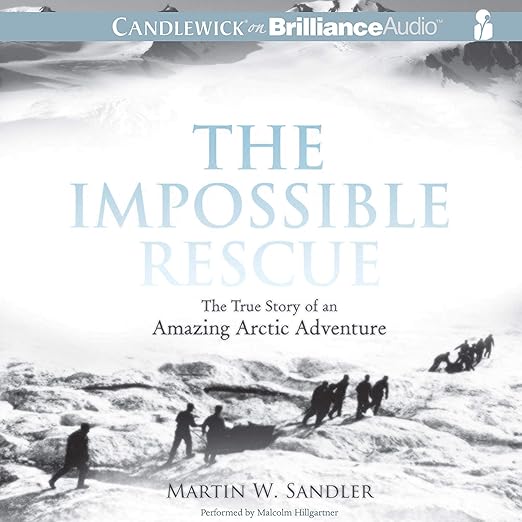
I encountered The Impossible Rescue at a moment when I was deep in survival narrative research, and Martin W. Sandler’s account of the 1897 Alaskan reindeer rescue is the kind of story that makes you pause and verify that it actually happened. It did. Three hundred sailors imprisoned in Arctic ice, ten months from any possibility of spring thaw, their ships crushed or at risk of crushing, their provisions dwindling. President McKinley ordering an overland rescue mission of fifteen hundred miles through Alaskan winter terrain. And three men driving reindeer herds across that distance to feed them.
This is narrative nonfiction written for young readers, specifically for the age range of approximately ten through fourteen that appreciates serious historical adventure without the fictional embellishment that would make it feel dishonest. Sandler is a prolific author in this space and his approach here is characteristic: primary sources front and center, photographs integrated into the story’s documentation, and prose that respects the reader’s intelligence without overloading with academic apparatus.
Three Men, Fifteen Hundred Miles, and a Herd That Could Save Everyone
The central drama is the rescue mission itself, led by three men whose names are largely absent from the popular record of American history. That obscurity is part of what Sandler is arguing against with the book’s existence. The mission covered terrain that would challenge modern expeditions with modern equipment. These men had sled dogs, reindeer, and their own determination. The journal entries from two of the three key participants give the account something that narrative reconstruction cannot manufacture: the actual texture of exhaustion, of conditions exceeding what anyone could have prepared for, of small decisions that turned out to matter enormously.
Malcolm Hillgartner’s narration serves the material by treating it with appropriate gravity. This is not a story that benefits from performance or dramatization; it benefits from clarity and pace. Hillgartner reads as if he’s been handed genuinely important documents and wants to make sure every detail registers. When the journal entries appear, his delivery shifts slightly, becoming more deliberate, honoring the firsthand voice without abandoning the listener to historical diction they might not follow.
The Photographs That Audio Cannot Show
One complication worth addressing for audio listeners is that the print edition includes photographs taken by the third key expedition member, and those images form a significant part of how Sandler substantiates the story’s credibility. At least one reviewer specifically cited the photographs as part of what made the book compelling. Audio listeners are working without that visual layer. Hillgartner acknowledges the photographs in the text where Sandler references them, which helps, but the full documentary weight of the images is simply unavailable in this format. This doesn’t undermine the audio experience, but listeners who have access to the print edition will encounter a richer version of the same story.
Where This Sits in the Young Readers Nonfiction Landscape
Sandler occupies a specific and useful niche in narrative nonfiction for young readers. He doesn’t fictionalize. He doesn’t add invented dialogue. He writes the story as it can be documented and trusts that the documented story is interesting enough, which it invariably is in his best books. The comparison that reviewers draw to Gary Paulsen’s survival fiction is useful marketing shorthand, but Sandler’s work has a different relationship with evidence. Paulsen generates emotional truth through invention. Sandler generates it through selection and arrangement of what actually happened. Both approaches produce compelling audio, but the pleasure is different, and the educational value of Sandler’s method is more straightforward to defend in a classroom context.
Who Should Listen and Who Should Skip
Listen if: you have a young reader between ten and fifteen who gravitates toward history or survival narratives; you want an audiobook that could support a social studies or history curriculum while also being genuinely absorbing; or you’re an adult listener who enjoys documented adventure in the tradition of polar history like Endurance. Skip if: your listener needs fictional drama and character development rather than documented fact, or if the absence of photographs makes the audio version feel incomplete and you’d rather read the illustrated print edition instead.
Frequently Asked Questions
Is The Impossible Rescue a true story or a fictionalized account?
Entirely true. Martin W. Sandler uses primary sources throughout, including journal entries from two of the three main rescuers and photographs taken by the third. He does not fictionalize events or add invented dialogue, which is characteristic of his approach to young readers’ narrative nonfiction.
Does the audio edition work without the photographs that appear in the print edition?
It works, but with a limitation. The print edition includes historical photographs that strengthen the documentary dimension of the story. Hillgartner references them where Sandler does, but the visual evidence is unavailable in audio. Listeners who care about full documentary context may want to supplement with the print edition.
What was the political context behind President McKinley ordering this rescue mission?
Sandler addresses this within the book. The trapped whalers were American citizens, and the political and humanitarian pressure on the McKinley administration was significant. The unconventional reindeer-drive solution was proposed when conventional rescue options were unavailable due to the ice conditions.
How does Malcolm Hillgartner handle the first-person journal entries within the narration?
He shifts register slightly when moving into the journal entries, slowing his delivery and giving the firsthand accounts a more deliberate weight that distinguishes them from the narrative prose. It’s a subtle distinction but effective, particularly in the sections where the rescuers describe conditions pushing the limits of endurance.