Quick Take
- Narration: Jonathan Todd Ross brings measured authority to Dietert’s dense scientific argument, pacing the paradigm-shift claims without overselling them.
- Themes: Microbiome science, noncommunicable disease epidemic, rethinking human biology
- Mood: Dense but revelatory, with the energy of a scientist finally given the podium
- Verdict: A genuinely paradigm-shifting read for anyone invested in understanding why chronic disease rates have exploded, though casual listeners should expect to work for their insights.
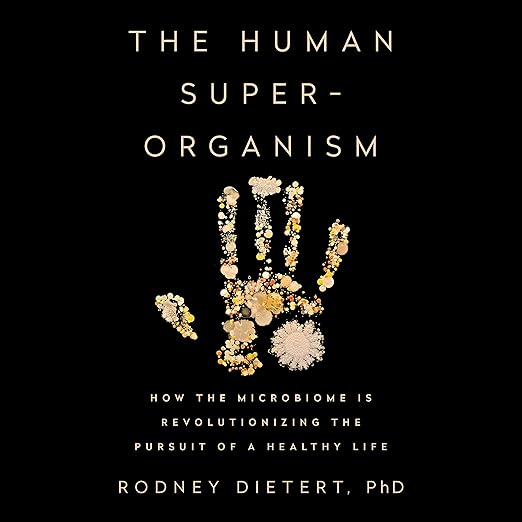
I came to this one on a Tuesday evening after spending the afternoon reading about the rise of autoimmune conditions in children, and I was already primed for something that challenged the conventional story. What I was not expecting was Rodney Dietert to dismantle two of the most foundational assumptions in Western medicine inside the first two chapters and then spend the remaining eight hours constructing something entirely different in their place. That does not happen often in health nonfiction.
Dietert is an immunotoxicologist at Cornell, and his credentials matter here in a way they do not always matter in the wellness genre. This is not a book written by a podcaster who read some studies. The central argument, that each of us is a superorganism composed of trillions of microbial partners whose systematic disruption over the past century has directly caused the epidemic of noncommunicable diseases now accounting for 63 percent of all human deaths, is presented with the rigor of someone who has spent decades in the literature.
The Two Beliefs This Book Dismantles
Dietert identifies two foundational assumptions that have shaped medical thinking for more than a century: that humans are better off as pure organisms free of foreign microbes, and that the human genome holds the key to future medical advances. He does not gently question these assumptions. He demonstrates, step by step, why both are demonstrably wrong and how our collective commitment to them has produced the very chronic disease crisis we keep trying to solve with more of the same thinking.
The statistic that stopped me mid-commute is the one about cellular composition. The microorganisms in and on the human body comprise as much as 90 percent of our cells. We are, in the most literal biological sense, more microbial than human. When you let that land, the entire framework of modern medicine, its obsession with eliminating pathogens, its reliance on broad-spectrum antibiotics, its dismissal of the gut as peripheral to systemic health, starts to look like a centuries-long misunderstanding. Kirkus gave this a starred review and called it potentially presaging a paradigm shift in medicine. That assessment is not hyperbolic.
Where Dietert Goes Beyond the Typical Gut-Health Book
By 2024, the microbiome conversation has become almost cliche in wellness circles. What separates Dietert’s work from the fermented-food Instagram content is scope and specificity. He is not simply arguing that you should eat more fiber. He draws explicit connections between microbiome disruption and asthma, autism, Alzheimer’s, allergies, cancer, heart disease, and obesity. The mechanisms he describes are not hand-wavy correlations; they involve immune system calibration, neurotransmitter production, and metabolic signaling pathways that most popular-science books never touch.
One reviewer, a woman named Elizabeth, described the experience of reading this as a paradigm shift of the “of course” variety, the kind where you suddenly see the connective tissue between things that previously seemed unrelated. That matches my experience listening. Dietert is particularly good at the historical narrative, explaining how the medical consensus around germ theory, however valuable it was in defeating infectious disease, became a kind of intellectual overcorrection that left us vulnerable to an entirely different category of illness.
What the Practical Sections Deliver
The book earns its place in the health-and-wellness category rather than pure science writing because Dietert eventually turns toward application. He identifies foods that have supported human microbiomes for millennia, which turn out not to be new superfoods but ancestral staples that industrial food systems have systematically replaced. He addresses protective measures against the chemicals and drugs most disruptive to microbial populations. One reviewer noted that the recommendations are, by the author’s own admission, somewhat speculative given how early the science still is, and that is a fair and important caveat. Dietert is not presenting a seven-day protocol. He is presenting a framework for thinking differently, and the practical guidance follows from that framework rather than preceding it.
Jonathan Todd Ross handles the narration with appropriate restraint. This is dense material with a high density of scientific terminology, and Ross reads it as if he genuinely understands it, which matters more than it sounds. He does not perform enthusiasm; he conveys it through pacing and emphasis in a way that keeps the listener moving through chapters that could otherwise feel like a lecture.
Who Should Listen, Who Should Wait
If you have spent time with books like Rob Knight’s Follow Your Gut or Tim Spector’s The Diet Myth, you will find Dietert’s work a substantial upgrade in both scope and scientific depth. If you are newer to the microbiome conversation, this is a legitimate entry point, but be prepared to pause and rewind occasionally. The science is accessible but not dumbed down.
Listeners looking for a quick action plan may find the ratio of conceptual framework to practical recommendation frustrating. Dietert is building a case for a different way of seeing the human body, and that project takes precedence over giving you a shopping list. For readers who have felt that gut-health content has been circling the same ideas without quite connecting them to the larger picture of chronic disease, this is the book that finally does that connecting work.
Frequently Asked Questions
Does The Human Superorganism require a scientific background to follow?
No. Dietert writes for a general audience and defines his terms as he goes. Listeners with some prior reading in gut health or immunology will get more from it, but it is accessible without a science degree.
How does this book differ from other microbiome titles like The Good Gut or Fiber Fueled?
Dietert’s scope is broader and his framing more radical. He is not primarily writing a dietary guide; he is arguing for a wholesale reconceptualization of human biology, connecting microbiome disruption to the full range of noncommunicable diseases rather than focusing on gut health alone.
Are the practical recommendations in this audiobook actionable, or is it mostly theory?
Both, in roughly that proportion. The first two-thirds of the book is devoted to building the scientific and historical case. The final sections address foods, chemicals to avoid, and a self-care framework, but as even a 4-star reviewer notes, some recommendations remain speculative given the current state of the research.
Does Jonathan Todd Ross’s narration handle the scientific terminology well?
Yes. Ross reads technical terms with confidence and appropriate pacing, which matters considerably in a book this dense with immunology and microbiology vocabulary. He does not speed through the science, and his measured delivery suits the material.