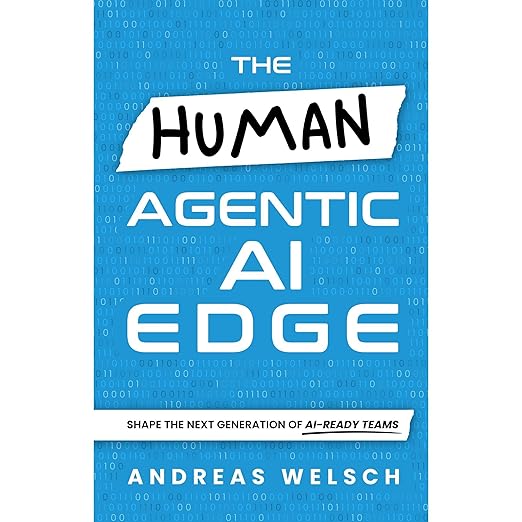
Fifty AI leaders and experts sat for interviews that became the backbone of The HUMAN Agentic AI Edge, and the question Andreas Welsch keeps circling back to is a blunt one: what happens when employees use AI without any structure at all? This audiobook argues that most organizations are already producing what Welsch calls AI workslop, generic content and fabricated facts dressed up as productivity, and that the fix is not less AI but more deliberate human judgment layered on top of it.
A Book on AI Oversight, Narrated by AI
An irony sits at the center of this production that is hard to ignore: a book arguing for rigorous human oversight of AI generated output is itself narrated by Virtual Voice, AI generated narration. The delivery is clear and evenly paced, which suits the book's structured, framework-driven content well enough for a straightforward business listen, but anyone hoping for the kind of vocal color that signals genuine enthusiasm for a case study will not find it here. For a book explicitly about the gap between AI competence and AI judgment, the mismatch is worth naming plainly rather than glossing over.
Two listeners independently reached for the same phrase to describe the book's timing. Reviewer I. Barkin wrote that it 'arrives at exactly the right moment,' and ArianaS used nearly identical language, both pointing to the same underlying fact: organizations are deploying agentic AI faster than they are building the governance to match it. That convergence from two unconnected reviewers is a more credible signal of relevance than either blurb alone would be.
ArianaS, who works in AI product and strategy, put the book's core problem in sharper terms than most business titles manage: 'the gap between AI adoption and AI quality.' That is a genuinely useful frame, since it separates two things leadership conversations often collapse into one, whether a team is using AI at all, and whether what it produces with that access is any good. Most competing titles address only the first question; this one spends the bulk of its five hours on the second.
Disorganized Teams Just Get Faster at Disorganized Output
Welsch's most useful contribution may be the vocabulary itself. Naming the problem, AI workslop, low-value filler dressed up as output, unverified claims, and weak judgment calls churned out at scale, gives leaders a concrete term to flag in a meeting instead of vaguely gesturing at quality issues. One reviewer praised the book for going 'beyond conceptual discussions of agentic AI by detailing how leaders can establish clear accountability, quality standards, and human-in-the-loop decision-making,' which is a fair description of where the book's actual value sits: not in explaining what agentic AI is, but in operationalizing how a team governs it responsibly. That distinction between conceptual awareness and operational governance is exactly the gap most competing titles in this fast-growing category fail to close.
The book itself maps a clear progression: building AI-literate skills across a workforce first, then installing accountability structures for AI-augmented work, and only then scaling the practice organization-wide without letting output quality erode into the workslop problem the book spends its opening chapters diagnosing. That progression, skills before accountability before scale, gives the audiobook a throughline even without a single dramatic case study anchoring it, which suits a five-hour business listen aimed at leaders wanting a framework more than a story.
Welsch also resists a common genre trap, promising that AI will solve organizational dysfunction on its own. The book is explicit that agentic AI amplifies whatever discipline, or lack of it, already exists on a team, meaning a disorganized team adopting agentic AI just produces disorganized output faster and at greater scale. That framing positions the book closer to a management discipline text than a technology hype book, a meaningfully different and more durable promise than most titles in this category make.
Fifty Interviews Lose Their Texture in One Register
A book built on more than fifty original interviews depends heavily on the texture of individual voices, quotable lines, distinct perspectives, moments of genuine disagreement among experts, to feel alive rather than encyclopedic. Synthetic narration renders every quoted expert in the same flat register, which flattens exactly the kind of variation that makes an interview-heavy business book memorable. Listeners who retain information better through vocal distinctiveness, remembering who said what by how they sounded saying it, will lose that anchor entirely here.
This is also squarely a leadership and organizational book, not a personal productivity guide for an individual using AI tools at their own desk. The framing throughout assumes a listener has some authority over team structure, accountability systems, or governance policy. Individual contributors curious about using agentic AI tools for their own work alone, without any organizational lever to pull, will find much of the advice here addressed past them rather than directly to them.
With twenty-two ratings behind its perfect five-star average, this book's audience so far is small and likely skews toward readers already professionally engaged with AI strategy work, the kind of audience most likely to encounter a title like this through a professional network rather than general browsing. A uniformly five-star record this early is worth treating as encouraging rather than definitive, since the sample has not yet been tested by a broader, more critical general readership outside that immediate circle, and early adopter enthusiasm does not always predict how the material lands with a wider, more skeptical business audience later.
This Confirms More Than It Reveals for Experts
Operations leaders, chief AI officers, and anyone tasked with writing their company's actual AI usage policy sit at the center of this book's intended audience, more than engineers building the models themselves. HR and learning and development professionals building reskilling programs will also find direct use in the book's workforce readiness framing, since Welsch treats skill development as inseparable from governance rather than a separate initiative running on its own track. Consultants advising multiple clients on AI adoption may also find the shared vocabulary, workslop chief among it, genuinely useful shorthand across engagements.
Fifty interviews' worth of synthesis will confirm more than it reveals for anyone already fluent in AI governance frameworks from their own consulting work. This book works best as an introduction and shared vocabulary builder for a team just starting the conversation, not as an advanced text for practitioners already deep in the weeds of building their own AI oversight programs. Listeners hoping for step-by-step technical implementation guidance, specific tooling recommendations or configuration detail, should also look elsewhere, since the book stays at the level of organizational strategy rather than engineering specifics throughout.
At a Glance
- Read by: Virtual Voice delivers clear, evenly paced AI-generated narration that suits the book's structured framework but flattens the fifty interviewed experts into one uniform register.
- At its heart: Agentic AI governance, workforce readiness, human judgment over automation
- Vibe: Practical and urgent, built for leaders under pressure to act
- Short version: A useful vocabulary-building framework for AI governance, best for team leaders starting the conversation rather than practitioners already deep into it.
Is the AI generated narration on this audiobook distracting for a business audience?
It is clear and functional for the structured, framework-driven content, though it cannot differentiate the fifty interviewed experts from one another the way a human narrator could.
What does 'AI workslop' mean in this audiobook, and is it a real term or Welsch's own coinage?
It is Welsch's own coinage for generic, fabricated, or low-quality content produced at scale when employees use AI without structure or oversight, and it functions as the book's central diagnostic term.
Is this audiobook useful for an individual employee, or only for managers and executives?
It is written primarily for people with organizational authority over team structure or AI policy; individual contributors without that authority will find much of the advice addressed past them.
Does this audiobook require prior knowledge of agentic AI concepts to follow?
No prior technical background is required. The book is framework and leadership focused rather than a technical explainer of how agentic AI systems work.