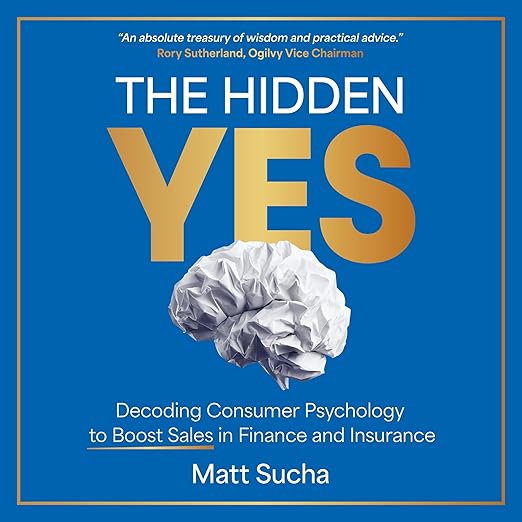
Sales books tend to arrive making the same promise in slightly different vocabulary, and one reviewer of this one opens by saying so before conceding the point. The Hidden YES runs five hours and fifty-four minutes with Tim Morgan attached as narrator, and Matt Sucha's argument turns on a single inversion that proves genuinely load-bearing: stop supplying customers with more reasons to say yes and start removing the reasons they are already saying no. That is the whole audiobook, and whether six hours is the right length for one idea is a fair question to carry into it.
The reframe deserves stating properly, because it is the reason to bother. Conventional sales training treats a hesitant customer as under-motivated and responds by adding things: more benefits, more urgency, a discount. Sucha treats hesitation as friction and responds by subtracting. One reviewer puts the shift better than the marketing copy manages, describing a customer who requires fewer grounds for refusal instead of extra encouragement toward agreement, and observing that salespeople have been overtrained to reach for motivation instead of hunting for the barrier. Once you have heard it, you cannot unhear it in your own conversations. I tested the idea against my own last three significant purchases and it held in all three, which is more than most sales frameworks manage.
The strongest evidence the book earns its length is the quality of its examples. michal tomek's five-star notice reproduces one that lands instantly: would you drive fifteen minutes to save a hundred dollars on a forty-five-thousand-dollar car? Probably not. On a two-hundred-and-ten-dollar coat? Absolutely. The same hundred dollars, opposite decisions, and the difference is context rather than absolute value. That is behavioral economics a listener can carry out of the car and into a meeting an hour later, which is a higher bar than most business titles clear and the main reason this one survives its own repetition.
Morgan Reading Material That Was Born Spoken
This material was born spoken, which matters for the format. The coat-and-car comparison is a question you put to somebody across a table, not a chart you study. The description opens with three questions rather than three claims, and one reviewer reaches for the phrase field guide in preference to treatise. Morgan is reading content whose natural home is a conversation, and the demand it makes is signposting: an argument assembled from numbered principles and stacked case studies needs clear boundaries between the framework and the story illustrating it, or a listener stops being able to tell which is which.
Sucha's background gives the book an unusual specificity that works in its favor. The description credits "a decade of experience with leading financial institutions", and Michal KUKULA's notice confirms where the material bites hardest, describing a deep structure for transforming sales conversations "especially in finance and insurance." That is narrower than the marketing implies and better for being narrow. A sales book grounded in one demanding sector tends to generalize more usefully than one written from nowhere in particular, and the financial-services setting supplies stakes no coffee-shop anecdote can match.
All Five Notices Predate Release by a Month
The review pool needs stating plainly, and it is the most important thing on this page. All five written notices carry dates between November 11 and November 13, 2025. The recording was published on December 15, 2025. Every one of them therefore predates release by roughly a month, all five award five stars, and that uniformity produces the 5.0 average currently resting on fourteen ratings. None of this indicates anything improper; advance copies circulate before publication and enthusiastic early readers are entirely ordinary. What it does mean is that a perfect average across fourteen ratings, with every written notice filed inside a three-day window before publication, is not the same object as a settled consensus.
The other caution concerns proportion. This is one strong idea plus a case-study library, and just under six hours is a lot of runtime for that shape. Andrej Winter's notice praises the absence of padding, calling the content "concrete principles, examples, and tools you can apply immediately", which is reassuring. Still, most of these notices restate the same core reframe in slightly different words, which tends to happen when a book states its thesis early and then demonstrates it repeatedly. If that pattern holds, the argument will land well before the halfway mark and the remainder will supply application, so anyone who prefers density to illustration should be ready to skip forward. My suspicion is that a tighter three-hour book would have been the stronger product, though a three-hour business title is admittedly a harder thing to sell.
Named as the Practical Follow-Up to Ariely
One reviewer supplies a helpful coordinate by naming Dan Ariely and calling this the practical follow-up. That placement is fair. If you have worked through the popular behavioral-economics shelf, enjoyed the experiments, and finished each one wondering what to actually do on Monday morning, this book occupies exactly that gap. It is not attempting original research and nobody involved claims otherwise. It is attempting translation, taking findings that already exist and converting them into moves a salesperson can make inside a specific conversation with a specific hesitant person, which is genuinely harder than it sounds and much rarer than the category pretends.
Salespeople in financial services and insurance are the bullseye, and the material was plainly built with them in view. Beyond that it serves anyone whose work involves persuading a hesitant person to commit, which covers marketers, product designers, fundraisers, recruiters and consultants; Andrej Winter's notice names sales, marketing and product design specifically as places the tools apply. Managers responsible for coaching a team will find the barrier-removal frame unusually easy to teach, a real advantage over frameworks that only function in the hands of whoever invented them. I would hand this to a new salesperson ahead of most of the classics on that shelf.
Leave it alone if you want original behavioral research rather than applied technique, or if you already run a barrier-first approach and need refinement instead of conversion. Approach the 5.0 with the reservations above and let a sample rather than the score decide it, since a perfect rating from a small pre-publication pool is the least informative number attached to this listing. On the material itself, though, the reframe is real, the examples are concrete, and I suspect most people in a selling role would earn their six hours back inside a month.
Common Questions
How does barrier removal differ from the sales training most people already know?
Standard training reads hesitation as a motivation shortfall and answers it by adding benefits, urgency or discount. Sucha reads the same hesitation as friction and answers by subtracting whatever is generating it. One reviewer summarizes the shift as giving a customer fewer reasons to refuse rather than more reasons to agree.
Why do all the reviews on this audiobook predate its publication date?
Every written notice was posted between November 11 and 13, 2025, while the recording appeared on December 15. Advance copies circulating before release explain it and nothing about the pattern is irregular. What a buyer ends up holding, though, is a 5.0 average from fourteen ratings that reflects early enthusiasm rather than settled opinion.
Is this audiobook only useful if you sell financial products?
No, though finance and insurance are where it bites hardest, and one reviewer says so directly. The underlying principles apply anywhere someone hesitates before committing. Marketers, fundraisers, recruiters, consultants and product designers all fit, and one notice names marketing and product design explicitly among the applications.