Quick Take
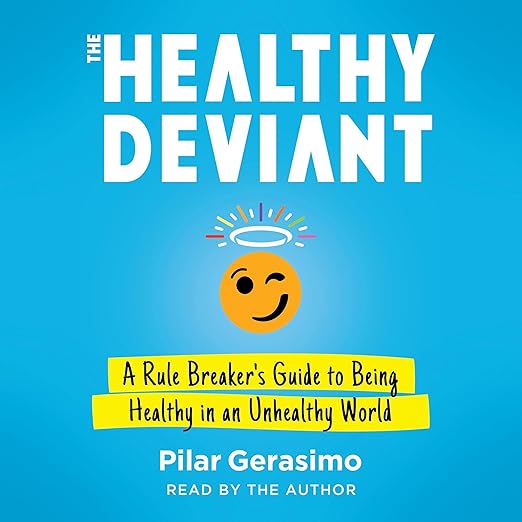
- Narration: Pilar Gerasimo narrates her own manifesto with the patient intelligence of someone who has spent twenty years developing this argument and wants to make sure it lands correctly, the self-narration is essential to the book’s non-shaming tone.
- Themes: Healthy outliers as a study group, systems-level obstacles to individual health, evolutionary biology meets functional medicine
- Mood: Thought-provoking and quietly subversive, like a long conversation with a health journalist who has lost patience with the conventional wisdom
- Verdict: A genuinely original contribution to the wellness genre that reframes the question from how do I get healthy to why does the current system make health so difficult, with a 14-day practical program as its landing point.
I finished the first few chapters of The Healthy Deviant on a Sunday evening when I was looking for something that would hold my attention without demanding too much. What I got instead was something that demanded quite a lot, in the best sense. Pilar Gerasimo, who founded Experience Life magazine and co-hosted The Living Experiment podcast, has written a book that starts from a statistical observation and spends eleven hours working out its implications: fewer than three percent of US adults are currently healthy, happy, and on track to stay that way. If almost everyone is failing at health in a culture that talks about nothing but health, the problem might not be individual failure.
That reframe is the engine of the entire book, and Gerasimo earns it methodically rather than asserting it. She draws on psychology, evolutionary biology, and functional medicine, not to offer a synthesis of those fields but to illuminate the specific ways that our default environment has been shaped to undermine the behaviors that would support health. This is a systems argument wearing the clothing of a wellness book, and it is more sophisticated than either category usually produces.
Studying the Three Percent Who Are Thriving
The book’s most original contribution is its focus on what Gerasimo calls healthy outliers or healthy deviants: the small percentage of people who are genuinely thriving, often without appearing to try very hard. By asking what they are doing differently rather than what most people are doing wrong, she arrives at a set of pattern shifts that feel qualitatively distinct from the usual prescriptions. These are not people following extreme protocols. They are, in various ways, opting out of the dominant culture’s default patterns of eating, moving, sleeping, and thinking.
Reviewer Ellen Moyer noted that the book takes the reader by the hand without being onerous or threatening, and that it leads organically to more significant actions. That is an accurate description of the structural logic. The 14-Day Healthy-Deviant Adventure program at the book’s end is not where the book starts; it is where it arrives, after building a sufficient framework that the practices make sense rather than feeling arbitrary.
The Companion PDF and Its Role in the Full Experience
Gerasimo is explicit that original infographics, self-assessments, and interactive tools are available in a supplemental PDF and downloadable bonus toolkit, included with the Audible purchase. This is honest disclosure. If you engage with only the audio, you are missing elements she considers part of the full experience. The 14-day program involves self-assessments that work better in a format you can fill in than in one you listen to.
Gerasimo’s self-narration is one of the audiobook’s genuine strengths. She reads with the measured cadence of someone who has given many public presentations, and she brings the right quality of patient conviction to the more challenging sections where she is asking listeners to question assumptions they may not have realized they were holding. Reviewer Veronica McCracken noted that the book is not about shame, and Gerasimo’s voice is the primary instrument through which that tone is maintained throughout eleven hours.
Where It Sits in the Wellness Landscape
Compared to the program-forward wellness audiobooks that dominate the category, The Healthy Deviant is unusually interested in why the problem exists before it gets to what to do about it. This makes the first several hours feel more like a diagnosis than a prescription, which is either compelling or frustrating depending on what you came looking for. Reviewer marjorie hope hammond praised exactly this quality, noting the book’s flexibility of engagement and its connections to additional resources throughout. The 290-plus ratings and 4.5 average suggest Gerasimo has found her audience.
Who Should Listen and Who Should Skip
Health-motivated listeners who have tried multiple programs, achieved inconsistent results, and want to understand the structural reasons for that inconsistency will find this more illuminating than anything in the conventional wellness library. Download the companion PDF before you begin so you can engage with the program and self-assessments. Skip it if you want a straightforward 30-day protocol without the systems-level context: the book gives you the framework first and the program second, and that order is non-negotiable.
Frequently Asked Questions
Is the companion PDF essential to getting full value from the audiobook, or is it truly supplementary?
Gerasimo describes the PDF as containing infographics, self-assessments, and interactive tools that are part of the full experience. The 14-day program involves assessments that work better in a fillable format. Download it from your Audible library before starting, it is included with the purchase.
How long is the 14-Day Healthy-Deviant Adventure program relative to the full audiobook’s runtime?
The 14-day program is positioned at the book’s end as the practical application of the framework built over the preceding chapters. The majority of the 11-hour runtime is devoted to diagnosis, context, and reframing rather than program instruction.
Is Gerasimo’s approach primarily based on evolutionary biology, functional medicine, or behavioral psychology?
All three, without reducing the argument to any single framework. She uses evolutionary biology to explain why modern default environments undermine health, functional medicine to identify what the body actually needs, and behavioral psychology to address habit formation and the structural obstacles to sustainable change.
Does Pilar Gerasimo’s self-narration affect how the book’s more challenging arguments land?
Substantially, yes. The book’s central claim that culture actively makes health difficult rather than easy requires a narrator who can deliver it without condescension. Gerasimo’s patient, thoughtful delivery prevents the argument from reading as alarmist or superior, which is crucial to the book’s success as a listening experience.