Quick Take
- Narration: Jim Denison handles the co-authored material with consistency, giving the dense neurological sections enough clarity that they remain followable without a science background.
- Themes: brain inflammation, neuroplasticity and lifestyle intervention, ADHD and Alzheimer’s prevention across the lifespan
- Mood: Optimistic and comprehensive, with genuine clinical warmth underneath the science
- Verdict: One of the more balanced and accessible brain-health guides in its category, with enough depth to satisfy readers beyond the self-help tier.
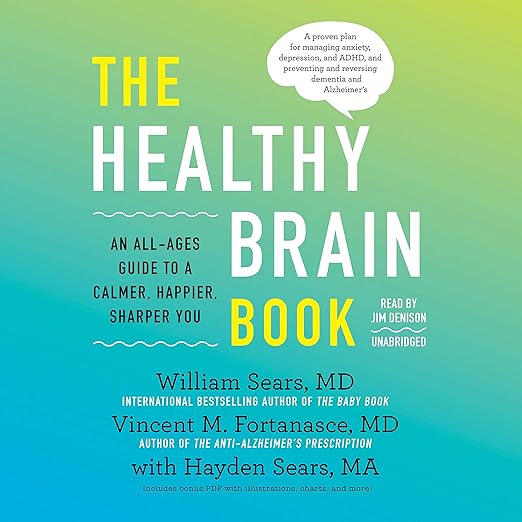
I tend to be cautious about brain-health books. The space is cluttered with titles that promise to reverse aging or cure anxiety through a combination of blueberries and positive thinking, and sifting the genuinely substantive from the marketing-forward takes real time. So when I started The Healthy Brain Book on a long Sunday drive, I was prepared for the familiar platitudes. I did not expect to still be listening when I pulled into the driveway, reluctant to stop.
What William Sears and Vincent Fortanasce have put together here is more rigorous than the cover and the title suggest. Sears is best known as a pediatric author, the voice behind The Baby Book and The Pregnancy Book, and his reputation is built on making complex medical information approachable without dumbing it down. Fortanasce is a neurologist and psychiatrist whose clinical work with Alzheimer’s patients informs the book’s understanding of brain vulnerability and resilience. Together, they produce something that feels less like a wellness manifesto and more like a genuine synthesis of current neuroscience for a general audience.
The Inflammation Thread Running Through Everything
The book’s organizing principle is that most brain disorders, whether depression, anxiety, ADHD, or the neurodegenerative conditions of aging, share a common mechanism: inflammatory imbalance in the brain. This is not a new idea in the research literature, but Fortanasce’s neurological background gives the explanation here more precision than it typically receives in popular science writing. He is careful to distinguish between conditions where the inflammation hypothesis is well-supported and conditions where it remains more speculative, which is a sign of intellectual honesty that too many brain-health authors skip.
The actionable advice that follows from this argument is organized into what the authors call a Think Smart framework, which addresses nutrition, physical activity, sleep, and psychological approaches in sequence. Reviewer Janet Jendron noted the book’s use of current research and its accessibility for a range of ages, and that observation holds: the citations embedded in the prose are recent enough and specific enough to distinguish this from books that recycle decade-old studies in new packaging.
How Patient Stories Carry the Science
One of the book’s more effective structural choices is its use of patient and family narratives to ground the science. The stories are not sensationalized, and they are not chosen to make the authors look heroic. They are chosen to illustrate the specific mechanisms being discussed, which means they actually help the listener retain the information rather than just providing emotional relief from technical content. Reviewer Jacob Schultz described the combination of research and true stories as unlike any other brain and mental health book he had read, and that is a fair characterization. The stories are clinical tools, not decoration.
The book’s subtitle, the promise of helping readers think-change their brain, is the most marketing-inflected element of the package. The phrase suggests a simplicity and speed that the book itself does not actually promise or deliver, and listeners should not expect a transformation program in eleven hours. What they will find is a serious introduction to how the brain can be supported and protected over a lifetime, delivered with the sympathy and practicality that Sears has spent decades developing.
Jim Denison and the Companion PDF
Jim Denison’s narration across nearly eleven hours is reliable and well-paced. He does not try to differentiate the two authorial voices, which is the right call for a book written as a unified whole rather than a dialogue, and he handles the technical terminology without stumbling in ways that would undercut the book’s credibility. The pace is slightly deliberate, but for material this dense that quality is a feature rather than a limitation. You have time to absorb what is being said before the next concept arrives.
The Audible edition includes a companion PDF, which is worth noting because some of the book’s diagrams and structural frameworks work better visually. If you are listening primarily, you will not be lost, but having the PDF open during the sections on the brain’s structural components adds clarity that the audio alone cannot fully provide. Reviewer dolores lieberg noted purchasing it as a follow-up to Prime Time Health, Sears’s earlier adult-focused work, which gives a sense of where the primary audience sits.
Who This Suits Best
Recommended for adults who want a comprehensive, evidence-oriented understanding of brain health across the lifespan, particularly those managing or concerned about depression, anxiety, ADHD, or early cognitive decline. The book’s all-ages framing is genuine: there is content relevant to parents of children with ADHD, to adults navigating midlife burnout, and to older listeners thinking about Alzheimer’s prevention. That breadth is both a strength and a mild weakness, since no single section goes as deep as a dedicated title on that specific condition would. Think of it as the best single-volume introduction to the field rather than the definitive guide to any one area within it.
Frequently Asked Questions
Does the book address medication for conditions like depression and ADHD, or is it focused on natural alternatives?
Sears and Fortanasce take a both-and approach rather than an either-or. The subtitle explicitly includes ‘with or without medication,’ and the text examines how drugs interact with the brain’s healing capacity and how lifestyle factors can complement or in some cases reduce the need for medication. It is not an anti-medication argument.
Is this a book for healthy people trying to optimize, or is it primarily for those managing existing conditions?
Both, genuinely. The book is structured to address diagnosed conditions like depression, ADHD, and dementia as well as what the authors call normal mental and emotional burnout. The inflammation framework applies across the spectrum. Reviewer Jacob Schultz specifically recommended it for families and medical professionals, which suggests the intended audience is not limited to patients.
How does the companion PDF supplement the audio experience?
The PDF provides visual versions of the diagrams and structural frameworks the authors describe in the text. Sections explaining the brain’s architecture and the visual representations of their intervention model work better with the printed diagrams alongside. The audio is complete without the PDF, but having it available during the more anatomical sections adds useful reference material.
William Sears is known for pediatric writing. How much of this book is specifically about children’s brain health?
There are sections addressing ADHD and childhood development that reflect Sears’s background, but the majority of the book spans all age groups. The co-authorship with Fortanasce, a neurologist focused on adult and aging brain conditions including Alzheimer’s, pulls the book firmly into adult territory as well. Think of the all-ages framing as genuine coverage rather than a marketing claim.