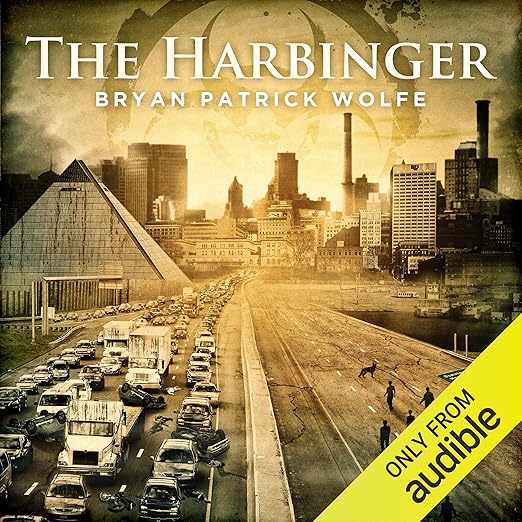
Quick Take
- Narration: Michael Ahr handles a sprawling cast of four distinct protagonists with commendable range, though the sheer volume of characters sometimes blurs voices in busier sequences.
- Themes: Survival instinct, identity under catastrophe, human cruelty vs. human solidarity
- Mood: Propulsive and unsettling, with periodic eruptions of graphic horror
- Verdict: A densely populated apocalypse novel that works best as a character study in extreme conditions, though listeners squeamish about graphic content should proceed with full awareness of the warnings the author himself provides.
I started The Harbinger on a Thursday night thinking I would listen for an hour before bed. I finished a section around midnight in which a closeted minor-league baseball player named Logan King watches everything he has carefully constructed about himself collapse alongside civilization itself, and I realized I was not going to sleep anytime soon. Bryan Patrick Wolfe is not a subtle writer, but subtlety is not really the point when the world ends in a matter of days.
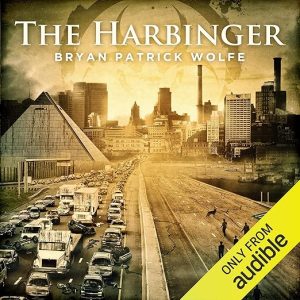
The Harbinger collects four books into a single omnibus running nearly thirty hours: Pathogen, The Curtain Falls, Creepers, and Numbers. The androvirus at the story’s center is a persuasively drawn catastrophe. Discovered in Alaskan permafrost, reanimated, and then bungled by Russian theocratic scientists attempting to weaponize it, the airborne strain hits with 100% communicability and a 90%-plus mortality rate. Survivors either suppress it and remain human or transform into what the narrative calls gray horrors. It is the kind of plague concept that generates plot momentum on its own, which is fortunate, because the novel has a lot of characters to manage.
Our Take on The Harbinger
Four loosely connected strangers anchor the narrative: wealthy Memphis executive Alex Connelly and his pregnant wife Madison; Kirk Foster, a self-absorbed aging gay man clinging to youth and sex appeal; Meredith Brinkley, a breast cancer patient facing a double mastectomy; and Logan King, who is still negotiating with himself about who he actually is. Wolfe’s decision to let them begin as strangers and only slowly draw them into a shared orbit is structurally sound, even if it occasionally produces the monotony one reviewer noted: the same apocalypse filtered through four different consciousness sieves can feel repetitive across a thirty-hour runtime.
What saves it is Wolfe’s genuine interest in the gray areas of personhood. The most disturbing passages in this book are not the scenes of plague carnage but the ones that ask whether the survivors’ cruelty toward each other is more monstrous than the infected themselves. That question lands harder because the author has spent considerable time making you care about the people asking it.
Why Listen to The Harbinger
Michael Ahr’s narration is reliable work throughout. He differentiates the four leads without resorting to caricature, and his pacing in the early plague sequences is particularly effective, keeping the catastrophe feeling clinical and incremental rather than operatic. Where he occasionally loses the thread is in scenes requiring simultaneous emotional extremity across multiple registers, as when grief and violence and darkly comic survivor behavior are all happening in the same chapter. Those are difficult passages to narrate regardless of skill level, and Ahr gets through them professionally if not always memorably.
The listening context matters here. This is a long, frequently intense commitment. One reviewer admitted they could not stop despite needing to go to work. Another found the author’s LGBTQ advocacy eventually too prominent for their comfort, a reaction worth noting not as a reason to avoid the book but as an accurate signal of what it contains: gay characters whose sexuality is treated as unremarkable and present throughout, including in the horror sequences. Wolfe’s own content advisory in the synopsis is worth reading carefully before you begin.
What to Watch For in The Harbinger
The omnibus format creates an unusual pacing problem. The first two books build with genuine menace, establishing the world, the virus mechanics, and the character dynamics with admirable control. Books three and four push further into territory that some listeners will find inventive and others will find too strange for the narrative to bear. The zombie erotica sequence that at least one reviewer found inexplicable is indeed in there, and it is the kind of creative choice that either reads as bold genre commentary or as a significant tonal miscalculation depending on your patience for provocation.
The Memphis setting is one of the novel’s understated pleasures. Wolfe uses the city specifically rather than generically, and the details of a Southern American city collapsing under biological catastrophe carry a regional texture that generic apocalyptic fiction often lacks.
Who Should Listen to The Harbinger
Listeners who enjoy character-driven apocalypse fiction with diverse casts and who can absorb significant graphic content will find this a rewarding if exhausting experience. The LGBTQ content is integral and often central; this is not incidental representation. Fans of Glen Duncan’s The Last Werewolf or early Paul Tremblay will likely find Wolfe’s instincts familiar.
Skip it if you want a tightly plotted survival thriller with a lean runtime, if graphic violence and sexual content are dealbreakers, or if you cannot commit to the full thirty-hour omnibus, since the four books build cumulatively and work best consumed as intended.
Frequently Asked Questions
Does The Harbinger need to be listened to in order, or can I start with book two?
The omnibus releases all four books as a single continuous listen, so order is built in. But even structurally, the character groundwork laid in Pathogen is essential to the emotional payoff later. Starting anywhere else would diminish the cumulative effect significantly.
How graphic is the content in The Harbinger?
Wolfe includes a detailed content advisory in the synopsis itself: profanity, graphic violence, male-male intimacy, and erotic content including sequences involving infected characters. It is not gratuitous in intent, but it is explicit in execution.
Is the LGBTQ representation woven throughout the story or limited to specific characters?
It is woven throughout. Logan King’s arc of coming to terms with his identity runs alongside the apocalypse as a parallel narrative. Kirk Foster is openly gay from the outset. The author has stated explicitly that the cast includes straight, gay, and characters who exist somewhere in between.
Is The Harbinger part of a longer series beyond these four books?
The omnibus covers the first four books. Multiple reviewers mention that further installments exist and that the story ends with the expectation of continuation, so be prepared for the narrative to remain open-ended rather than fully resolved at the thirty-hour mark.