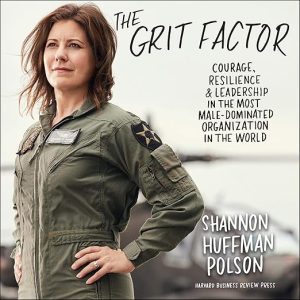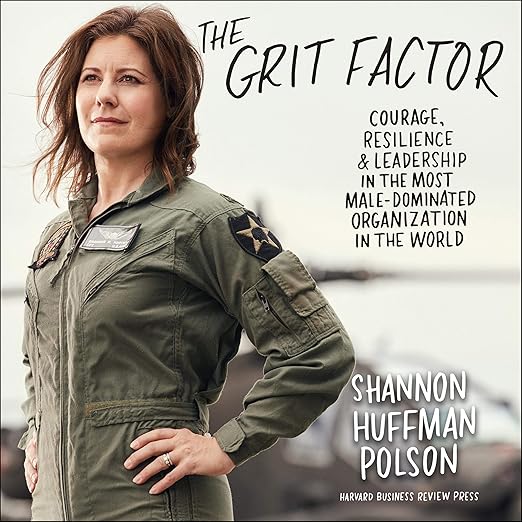
The Grit Factor earns its bold claims simply by getting out of the way and letting genuinely extraordinary women talk. Shannon Huffman Polson, who became the youngest woman ever to summit Denali at nineteen before flying Apache helicopters for the Army, including a combat deployment leading a flight platoon in Bosnia-Herzegovina, built this audiobook around candid interviews with an equally striking roster: Heather Penney, one of the first female F-16 pilots, tasked with a suicide mission on September 11th; General Ann Dunwoody, the Army's first female four-star general; and Amy McGrath, the first woman to fly an F/A-18 in Marine combat. The result reads less like a motivational business book than an oral history with a leadership framework built on top of it.
A Coast Guard Veteran Praises Polson's Reach
What keeps this from collapsing into a parade of impressive resumes is Polson's own framing discipline. She isn't just collecting war stories; she's extracting a consistent argument about where grit actually comes from, not talent, not toughness for its own sake, but specific crucibles that force a decision point. One reviewer, a business leadership author himself, said he found himself treating the book as a collection of memoirs rather than a single-author leadership title, and that's an accurate read: the structure genuinely privileges these women's individual voices over Polson synthesizing them into one tidy thesis.
The military specificity is a real asset rather than a limitation. A reviewer who spent her own career in the Coast Guard praised how Polson 'magnifies the power of storytelling by reaching beyond her experiences', and having lived the demands of a male-dominated command structure herself gives Polson's interview questions a precision an outside journalist likely couldn't match. She knows exactly which details to press on, because she's stood in a version of the same rooms.
Valuable Regardless of Gender, by Design
It's worth noting what Polson means by grit specifically, since the word gets used loosely across the leadership-book genre. She isn't describing simple toughness or an ability to endure discomfort; each profiled leader's grit emerges from a specific moment where continuing forward required a real decision against real risk, not just gritted teeth through a bad quarter. That precision keeps the book from collapsing into the vague resilience talk that crowds this shelf.
The synopsis explicitly frames this as valuable regardless of gender, and that inclusive framing holds up in practice; Polson isn't writing a book exclusively for women in leadership, even though every profiled leader broke a specific gender barrier. The leadership principles she extracts, about fear, decision-making under pressure, and building trust within a team, apply regardless of who's listening.
Marlo's Restraint With Penney's Suicide Mission Account
Coleen Marlo narrates, and her restraint is exactly right for combat testimony that could easily tip into overwrought. She doesn't inflate Penney's account of a suicide mission or Dunwoody's account of breaking a rank ceiling for theatrical effect; she lets the historical weight of what actually happened carry the scene, which matches the book's own refusal to oversell its subjects. Marlo maintains that same even register through the more analytical, framework-building sections, so the shift between interview and leadership synthesis never feels jarring.
At six hours and nine minutes, the book moves briskly for something covering this many distinct life stories, which works in its favor, since little padding sits between one account and the next. One reviewer specifically praised the combination of inspiration with actionable exercises to surface purpose and grit, noting the book earns a second function as a practical leadership tool, not just an inspiring collection of interviews, which is a real distinction from most as-told-to leadership titles.
Polson's own Denali summit at nineteen, mentioned in the synopsis, isn't just biographical color; it establishes her credibility to ask other extreme achievers pointed questions about fear and decision-making, since she's navigated a comparable kind of high-stakes uncertainty herself, if in a different arena entirely.
Polson structures each chapter around a clear throughline question rather than a chronological career recap, which keeps the interviews feeling purposeful rather than like a loosely connected anthology, and that structure is part of why the book reads more like a sustained argument than a collection of profiles loosely stapled together.
Powerful but Comparatively Brief, Story by Story
The military lens is consistent throughout, and while multiple reviewers stressed how accessible the material is to civilians, including one reader who called the history of women's integration into the armed services genuinely fascinating even without prior interest, the book's core examples and vocabulary skew heavily toward combat leadership and command structure. Readers hunting for corporate case studies exclusively may need to do some translation work themselves.
Because Polson interviews so many distinct women across different service branches, no single figure beyond Polson herself gets truly extended treatment; each woman's story is powerful but comparatively brief. Listeners hoping for a deep, book-length biography of any one of these pilots or generals specifically should treat this as an introduction to several remarkable careers rather than a full account of any single one.
Because each woman's story is condensed to make room for the full roster, the book occasionally moves quickly past details a reader might want lingered on, particularly around how each leader actually navigated institutional resistance day to day rather than in a single dramatic moment. The framework sections compensate somewhat by pulling out the generalizable lesson, but detail-hungry readers of any single career may want to seek out a fuller biography of their favorite figure afterward.
Readers already familiar with any of the specific women profiled, through their own individual memoirs or public profiles, may find some biographical details here feel like a condensed refresher rather than new information; the value in that case shifts toward Polson's synthesis and framework rather than toward new facts about any single figure.
Fresh Entry Next to Extreme Ownership and Lean In
This is a strong fit for anyone in or considering a leadership role who wants case studies grounded in genuinely high-stakes decisions rather than boardroom hypotheticals, and especially for listeners drawn to military history's more personal, testimony-driven corner. Both male and female listeners, per the synopsis's own framing, get real value here; the leadership lessons don't require shared gender experience to land.
Readers of leadership titles like Extreme Ownership or Lean In who want the genre's usual takeaways delivered through less commonly heard voices, women who broke specific institutional barriers in combat and aviation, will find The Grit Factor a genuinely fresh entry in a fairly crowded category.
Civilian listeners with zero interest in military structure or aviation may find some of the procedural detail in the flying and command sections slower going than the interpersonal leadership material, though the interview format keeps even those stretches relatively brief.
Questions Listeners Ask
Does this audiobook require a military background to understand or enjoy?
No. Multiple reviewers specifically note it's accessible and relevant to civilian readers, even though its case studies are drawn largely from military careers.
Who are the women interviewed in The Grit Factor audiobook?
The interviews include Heather Penney, one of the first female F-16 pilots; General Ann Dunwoody, the Army's first female four-star general; Amy McGrath, the first woman to fly an F/A-18 in Marine combat; and other decorated leaders alongside author Shannon Huffman Polson's own story.
Is The Grit Factor written more like a memoir or a business leadership book?
Both at once; one reviewer described it as reading like a collection of memoirs, since it privileges the individual women's voices and stories over a single unified authorial thesis.
Does the audiobook include practical exercises, or is it purely narrative?
It includes both; reviewers specifically praise the actionable exercises paired with the interview-driven storytelling.