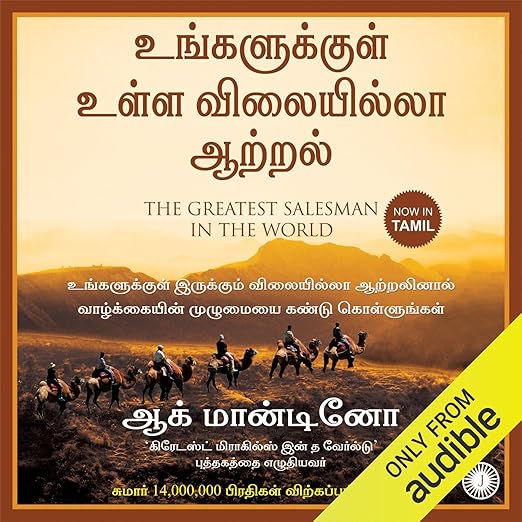
In Brief
- Narrator: Dinu Vairapathi delivers the Tamil-language performance; no listener reviews are attached yet to weigh in on his specific interpretive choices, so treat the language itself as the main casting fact to confirm before buying.
- Subjects: Parable-driven self-improvement, sales as spiritual discipline, habit formation
- Tone: Compact and aphoristic
- Bottom line: A landmark success parable in a Tamil edition, best for listeners who read and listen comfortably in Tamil and want inspiration over tactics.
The Listing Notes This Audiobook Is Narrated in Tamil
Ten scrolls of ancient wisdom carry this audiobook's entire structure, and that architecture is really the whole story of why Og Mandino's The Greatest Salesman in the World has stayed in print, and in sales-training curricula, since 1968. This particular edition adds a wrinkle worth stating plainly up front: the listing notes this audiobook is narrated entirely in Tamil, not English, so anyone browsing by the familiar English title should pause before buying. That is not a defect. Mandino's parable has been translated and localized for decades, and a Tamil-language production signals a real, deliberate market for it among Tamil-speaking business and sales audiences rather than a scraping error. Narrator Dinu Vairapathi carries the performance, though with zero reviews attached to this specific listing, I can't yet tell you how he handles the shift between the frame story's Biblical-adjacent imagery and the scrolls' more instructional cadence.
The story itself is deceptively small. Hafid, a camel boy two thousand years removed from us, is sent by the caravan merchant Pathros to sell a single ornate robe, fails, and instead gives it away to warm a newborn child sheltering in a cave near an inn. That act of pity, not salesmanship, is what earns him the ten scrolls that structure the rest of the book, each one built around a single discipline he must absorb before moving to the next. It is worth knowing going in that this is allegory dressed as a sales manual, or maybe the reverse, a sales manual dressed as a Nativity-adjacent fable. Readers expecting case studies and modern tactics, the kind implied by the business-careers genre tag here, will instead get something closer to scripture: repetition, memorization, and moral instruction standing in for technique.
Mandino himself is worth a sentence of context, because his own biography shaped this book more than most business authors' do. He was a struggling insurance salesman who rebuilt his career at Success Unlimited magazine after a period of real personal collapse, and The Greatest Salesman in the World became the book he is remembered for, reportedly selling tens of millions of copies worldwide and spawning sequels of its own. A 4.8 average across more than six thousand ratings on this listing suggests that reputation still holds, even decades later and even in translation.
A Dedicated Full Production for Tamil Listeners
The appeal here has never been subtlety. Mandino writes in short, hammering sentences meant to be internalized rather than merely read, and that style tends to translate well to audio, where repetition and cadence carry more weight than they do on the page. Each scroll is built to be absorbed almost like a memorized prayer, which is a genuinely different listening experience than a typical business audiobook's chapter-by-chapter argument. If you've spent any time with parable-driven success literature, Paulo Coelho's The Alchemist or George S. Clason's The Richest Man in Babylon both use a similar trick, wrapping practical philosophy inside a simple adventure so the lesson feels earned rather than lectured. Mandino got there decades before most of his imitators, and that historical priority is part of what keeps this text assigned in sales training programs still.
A real emotional hook sits buried in the frame story too, one the genre tags undersell. The moment where Hafid gives away the one robe he was sent to sell, out of pity rather than strategy, and is rewarded for it, is the book's actual thesis: that generosity and character precede any technique worth learning. For listeners raised on more cynical modern sales content, hustle culture, growth hacking, the relentless close, this older and gentler framing can land as a genuine relief. It helps explain the dual genre tagging here, business-careers sitting right alongside religion-spirituality, because the book genuinely does not separate the two. Success, in Mandino's telling, is inseparable from moral formation.
For this specific edition, the strongest reason to listen is linguistic access. Tamil-speaking listeners who want this exact text, not a summary, not a paraphrase read aloud from English subtitles, finally get a dedicated full production. That matters more than it might sound on paper. A huge amount of English-language self-help and business literature is functionally unavailable to non-English-first audiences except through print translations that vary wildly in quality, and an audiobook narrated natively in the target language is a meaningfully different, more accessible product than a translated ebook. If that describes you, this listing is doing something genuinely useful that an English-only version of this same catalog page cannot.
Thousands of Ratings Say Nothing About This Narration
Runtime is the first thing to recalibrate your expectations around. At two hours and four minutes, this audiobook is short by typical business-nonfiction standards, but that brevity is not a sign of an abridged edition. The source material runs barely over a hundred pages in print; Mandino's original design was a slim, ten-part parable meant to be reread in cycles, not a doorstop with case studies and appendices. Judge the length against the actual book, and it reads as complete rather than truncated. The more genuine caveat is the total absence of listener reviews on this listing. A strong aggregate rating built from thousands of ratings tells you the underlying text has proven itself, but it tells you nothing about how this particular Tamil narration handles pacing or tone.
The dual genre tagging deserves a second look too. Anyone approaching this expecting a secular, tactics-first sales guide, the kind implied by a pure business-careers classification, should know the religious and allegorical framing is not incidental. The newborn-in-a-cave imagery and the star Hafid is said to be followed by are deliberate Nativity echoes, and the entire moral architecture leans on faith-adjacent language about destiny, divine sign, and scrolls handed down like commandments. That will read as either deeply resonant or slightly heavy-handed depending on your own relationship to that kind of allegory, and it's worth knowing before you press play rather than discovering it three scrolls in and feeling like the book quietly switched genres on you.
Skip This Listing If English Is Your Only Language
This audiobook makes the most sense for Tamil-speaking listeners in business, sales, or entrepreneurship roles who want direct access to a text that has genuinely shaped how generations of salespeople think about persistence and character. It also suits anyone drawn to short, repeatable, almost devotional self-help formats they can return to on a loop, since the scroll structure is explicitly designed for rereading rather than one-and-done consumption. If parable-driven wisdom literature already works for you, and you're comfortable with its faith-inflected register, the strong rating here across thousands of listeners is a meaningful signal that the underlying material earns its reputation regardless of edition.
Skip this particular listing if English is your only working language; nothing here will be intelligible without Tamil, however much you might already love Mandino's ideas secondhand. It's also not the right pick if you want granular, modern sales tactics, cold outreach scripts, negotiation frameworks, objection handling, since the book operates entirely in allegory and general moral instruction rather than technique. And if a strongly religious frame sits uncomfortably against your expectations for a business book, that friction is baked into the text itself, not something a different edition or narrator would smooth away.
Questions Listeners Ask
Is this audiobook narrated in English or only in Tamil?
Only in Tamil. The listing states plainly that this edition of The Greatest Salesman in the World is narrated entirely in Tamil by Dinu Vairapathi, with no English version attached to this specific product page, so English-only listeners should look for a separate edition.
Is the Greatest Salesman in the World audiobook the complete text, or a shortened version?
It appears complete rather than abridged. At two hours and four minutes, the runtime matches the source book's actual length; Mandino's original text runs barely over a hundred pages in print, so a short audiobook here reflects a short source, not a cut edition.
Do I need to listen to the sequel, Greatest Salesman Part II, to understand this one?
No. This original book is a self-contained parable built around Hafid and the ten scrolls. Mandino's sequel expands the story further, but nothing here requires prior or follow-up reading to make sense on its own.
Is this book religious, or does its message work for a secular business audience?
It's both at once. The framing leans on faith-adjacent, Nativity-echoing imagery throughout, and the genre tags reflect that by listing religion-spirituality alongside business-careers. Secular listeners can still take practical lessons from it, but should expect the allegory to be genuinely devotional in tone, not incidental.