In Brief
- Read by: Bonnie Friel brings period warmth and real differentiation to a large ensemble of real women.
- At its heart: labor organizing, gender discrimination, 1960s aviation culture.
- Vibe: Outraged but affectionate, with real narrative momentum.
- Short version: A strong, well-narrated labor history that improves on its own print pacing.
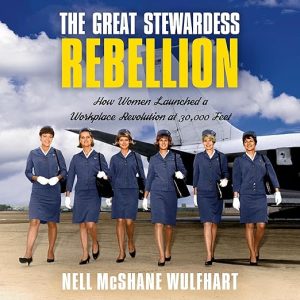
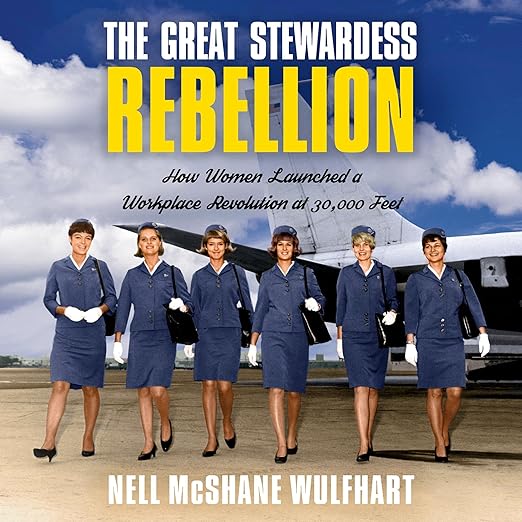
Girdles were mandatory. Weight was checked and enforced with real consequences. Marriage meant automatic termination, and every stewardess, regardless of performance, was forced out of the job entirely at thirty-two. Nell McShane Wulfhart opens this audiobook with the specific, almost absurd texture of the rules governing 1960s stewardesses, and builds outward from there into a genuine labor history: how a generation of women who were sold a glamorous jet-setting fantasy discovered the fine print and organized to rewrite it.
Steinem's Blurb Frames a Story Women Actually Won
Wulfhart's real achievement is refusing to let the Golden Age of Travel nostalgia do any of the book's work for it. The early chapters lean into the genuine appeal that drew women toward the job, the promise of travel and independence outside traditional roles like nursing or teaching, before methodically dismantling that promise's underside: the weigh-ins, the girdle checks, the forced resignations. That structure, seduction first, mechanism of control second, makes the eventual organizing and pushback land with real earned weight rather than feeling like a foregone conclusion.
Gloria Steinem's cover blurb calls it the story of stewardesses who 'stood up to huge corporations and won, creating momentous change for all working women,' and the book backs that framing with real specificity rather than treating the labor victory as inevitable. Wulfhart names the individual women who filed complaints, organized unions, and pushed back against airline policy, giving the listener actual protagonists rather than an abstracted movement, which matters a great deal in a story that could easily have flattened into generic feminist history.
The specific age cutoff, thirty-two, is worth sitting with for a moment: airlines were not simply discouraging older stewardesses, they were mandating an entire career end at an age when most professions consider a worker to be hitting their stride. Wulfhart uses that specific number repeatedly as shorthand for how deliberately the industry treated stewardesses as decorative and disposable rather than as career professionals building toward anything.
The Infantilizing Undertone Behind Sky Girls
Wulfhart also traces how the stewardesses' specific grievances, weight limits, girdle checks, forced retirement, connected to the broader legal tools becoming available at the time, particularly the newly passed Civil Rights Act's protections against sex discrimination in employment, which the stewardesses and their lawyers used in genuinely creative, precedent-setting ways.
The era's own nickname for the job, sky girls, carries the same infantilizing undertone the book spends its opening chapters documenting; grown women in a demanding, safety-critical profession were routinely described in language more suited to children, and Wulfhart treats that linguistic detail as one more piece of evidence rather than a throwaway aside.
The Audiobook That Outperforms Its Own Print Edition
Bonnie Friel's narration brings genuine period warmth to what could otherwise read as a fairly dry institutional history, differentiating the ensemble of real stewardesses whose stories anchor the book without losing the listener in a sea of similar names. Her steady, warm delivery matches the material's own tonal balance: outrage at the specific policies, but affection for the women who fought them.
One reviewer flags the middle section of the book as exceedingly repetitive on the page, even while praising the underlying information, and Friel's pacing in the audio edition genuinely mitigates that issue better than print likely does; the narration keeps momentum through sections that a silent reader might experience as the same complaint restated several times. That is a real case where the audiobook is the stronger version of this particular book.
The book also benefits from Wulfhart's access to primary sources: interviews with the actual women who lived through this history, now in their seventies and eighties, give the later organizing chapters an eyewitness immediacy that secondary historical accounts of 1960s labor movements often lack. Friel's narration handles these first-person-adjacent passages with a slightly different register than the more journalistic framing sections, a subtle but real distinction.
One reviewer's pointed observation, essentially amazement that the era's casual sexism did not provoke more open confrontation, captures the book's own tonal balance well: Wulfhart lets the sheer accumulated absurdity of the specific rules do the persuasive work rather than editorializing heavily on top of the documented facts themselves.
How Marriage Itself Triggered Automatic Termination
This is history with an explicit point of view, not a neutral institutional account, and Wulfhart is not trying to present both sides of whether the airline weight and marriage restrictions were reasonable policy. Listeners should know upfront that the book's sympathies sit entirely with the stewardesses, though that stance is backed by extensive documentation rather than left as unsupported opinion.
At just over ten hours, the book covers roughly two decades of organizing history in real depth, and a reviewer's note about repetitiveness in the middle stretch is worth taking seriously even accounting for how much Friel's narration smooths it over; listeners expecting a tightly plotted narrative arc from start to finish should adjust for a book that sometimes circles back to reinforce a point already well established.
Listeners should also know this is airline-specific labor history rather than a broader survey of 1960s and 70s feminism; readers wanting the wider movement context will get airline-specific applications of that context rather than the full national picture painted from scratch.
The book's title itself signals its argument plainly: this was a rebellion, not a gradual, polite negotiation, and Wulfhart's pacing across ten hours matches that framing, building toward specific confrontations and legal victories rather than a slow accumulation of incremental policy tweaks.
The marriage and childbearing restrictions functioned as two separate but related rules, and Wulfhart is careful to treat them as such: a stewardess could theoretically date without consequence, but marriage itself, not just parenthood, triggered automatic termination, a distinction that reveals the policy was really about controlling women's long-term life choices rather than narrowly about workplace practicality.
Aviation History Fans Get Real Value Too
Readers of labor history and workplace-equality nonfiction will find a genuinely under-told story here, populated with specific, memorable women rather than abstracted statistics, and reviewers consistently connect the 1960s and 70s fight documented in the book to conversations still happening in workplaces today. Friel's narration is a strong reason to choose audio over print specifically, given how it handles the pacing issue noted above.
Listeners interested in aviation history generally, not just labor or feminist history specifically, will also find real value here, since the book is grounded in accurate, well-researched detail about how the airline industry itself operated and marketed itself during this specific window of rapid commercial growth.
Skip it if institutional or corporate history reads as dry regardless of subject matter, or if a tighter, faster-moving narrative is the priority; this book trades some narrative economy for real depth and specificity, and that tradeoff will not suit every listener equally.
Before You Listen
Does this audiobook present a balanced view of the airline industry's side of the story?
No, and it does not claim to. The book's sympathies sit clearly with the stewardesses, backed by extensive documentation, rather than giving airline management's counterargument equal weight.
Is Bonnie Friel's narration a reason to choose the audiobook over the print edition?
Yes. One reviewer notes the book's middle section reads as repetitive in print, and Friel's pacing in the audio edition genuinely smooths that over better than a silent read would.
How long is this audiobook and how much ground does it cover?
At just over ten hours, it covers roughly two decades of organizing history, from the earliest stewardess restrictions through the legal and union victories that changed them.