Quick Take
- Narration: Jack Stack narrates his own book, which adds an authenticity and personal conviction to the material that a professional narrator hired for the job could not replicate.
- Themes: Financial transparency as a management philosophy, employee ownership and genuine engagement, the relationship between economic dignity and organizational performance
- Mood: Evangelical and energetic, the voice of a true believer who has seen the system work across forty years of implementation
- Verdict: One of the most influential management books of the last three decades, still readable, still genuinely different from the mainstream, and still arguing for something that most organizations have not actually tried.
I first encountered the concept of open-book management through a profile of a company that had practiced it for over a decade. The employees described the experience in terms that sounded almost religious: the financial transparency changed how they understood their work, what they felt genuine ownership of, and what the company meant to them as a place they had invested themselves in rather than a place that employed them. That language made considerably more sense after I listened to Jack Stack's account of how he accidentally invented the approach while trying to save Springfield Remanufacturing Corporation from bankruptcy in the early 1980s.
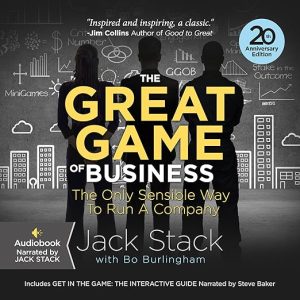
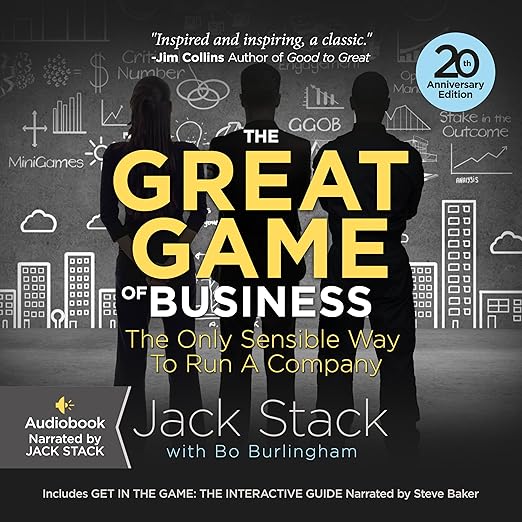
Stack narrates his own book, which is the right decision. At 7 hours and 7 minutes, The Great Game of Business has the energy of someone who still cannot quite believe the thing worked and needs you to understand why it did. The narration has the evangelical conviction of a founder speaking from memory and conviction rather than from a script prepared for professional delivery, and that quality is infectious in ways that a polished professional performance would have smoothed away entirely. This is a book that needs to sound like it comes from a person, not a persona.
The core proposition of Stack's system is that if you give everyone in a company a genuine voice in how it is run and a genuine stake in the financial outcome, you get better performance, more sustained engagement, and more resilience in difficult conditions. This sounds obvious stated plainly, and Stack acknowledges that directly. What he built at SRC was not the theory but the specific practice: how you actually teach a factory floor worker without a high school education to read a profit and loss statement, how you structure the game so that employees have both the information to understand their impact and the motivation to care about outcomes that previously felt like someone else's concern entirely.
Reviewer O. Halabieh's summary of the book's core proposition, that the best way to operate a business is to give everybody in the company a voice in saying how the company is run and a stake in the financial outcome good or bad, is accurate as far as it goes. What the summary cannot quite capture is the texture of Stack's examples: the specific meetings where SRC employees debated and voted on bonus structures, the specific metrics that each team owned and tracked, the specific ways that the game's rules evolved and were refined as the company survived and then grew. These concrete details are what transform the book from a management philosophy into something closer to a working manual.
What Makes The Great Game of Business, Expanded and Updated Worth Hearing
SRC was a division of International Harvester that faced closure in the early 1980s recession. Stack and a small group of managers bought it in a leveraged buyout with a debt-to-equity ratio he describes as 89 to 1, which he characterizes as one of the worst financial structures in the history of American commerce. The survival story is genuinely dramatic, and Stack tells it with the specificity that the best narrative nonfiction provides: he knows the exact numbers, the specific decisions, the individual moments when the whole enterprise nearly failed and what saved it. The desperation that produced open-book management is visible throughout the book and gives every principle he articulates a weight that purely theoretical management writing cannot match.
This narrative foundation is what separates The Great Game of Business from most business books, which tend to be constructed from frameworks illustrated by anecdotes. Stack's ideas emerged from specific, life-or-death conditions, and the people who were asked to learn P&L statements and vote on company direction were not doing so in comfortable circumstances. They were doing so because the alternative was unemployment in a failing economy. That context matters for understanding why the system worked when it did and what conditions it requires to work elsewhere.
Things to Know Before Starting The Great Game of Business, Expanded and Updated
The updated edition includes additional material that grounds Stack's original argument in thirty-plus years of implementations across industries and company sizes far outside the original SRC context. This matters because one of the persistent skeptical questions about open-book management is whether it worked at SRC because of SRC's specific crisis conditions and culture rather than because of universal principles. The expanded material addresses that objection directly by documenting how the system was adapted, where it worked, and what implementation challenges appeared in different organizational contexts.
Stack narrates both the original and the new material with equal conviction, and the whole holds together as a coherent argument for a fundamentally different relationship between workers, management, and financial reality. Reviewer John's characterization of it as tried and true for forty years and worth every minute of your time captures the assessment of the many practitioners who have built on Stack's work. The Great Game of Business is not a book that ages out. The principles it argues for are as absent from most organizational culture today as they were when Stack first articulated them, which makes the book feel both historical and urgently current.
Who Should Pick Up The Great Game of Business, Expanded and Updated
One of the most interesting implicit questions running through The Great Game of Business is why, after forty years of documented results and widespread influence, open-book management remains a minority practice in most organizational cultures. Stack gestures at this without fully answering it, but the answer is not mysterious: financial transparency is genuinely threatening to people in organizations whose power and authority depend on information asymmetry. Teaching everyone to read the P&L removes a category of managerial advantage. Giving employees a stake in the financial outcome means accepting that their stake gives them a genuine voice, which is a different kind of accountability than most managers are comfortable with.
The book's value in 2025 is partly diagnostic for this reason. Reading Stack's account of what SRC actually did and comparing it to what most organizations actually do reveals the distance between the management philosophy that sounds good in conference room presentations and the organizational reality that most employees experience daily. That diagnostic function is worth a great deal, regardless of whether any specific listener works in an organization that will ever implement Stack's system.
Good to Know
Is The Great Game of Business relevant to small businesses and startups, or is it primarily for established organizations?
Stack is explicit that the system was forged in a manufacturing context, but he and the expanded edition argue for its broader applicability. The principles of financial transparency and employee stake-holding have been implemented in startups, service businesses, nonprofits, and enterprises across multiple sectors with documented success.
Jack Stack narrating his own book: does his non-professional delivery work for audio listening?
It works very well. Stack's voice has the evangelical energy of someone who built something from nothing and needs you to understand both the desperation that produced it and the method that emerged. The personal conviction is more valuable here than professional polish would have been.
How does open-book management compare to other employee engagement frameworks like EOS or the Lean approach?
Open-book management is specifically focused on financial transparency and economic participation rather than process optimization or operational structure. It can coexist with Lean and EOS approaches because it addresses a different problem: what employees know and feel genuine ownership of rather than how processes are structured or decisions are made.