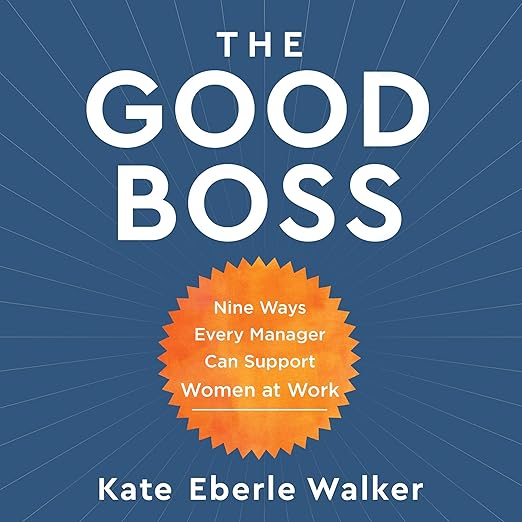
Nine rules make up Kate Eberle Walker’s core argument in The Good Boss, a six-hour, twenty-one-minute audiobook built from her years coaching managers and her own climb up the corporate ladder. The central claim is simple and specific: of everything that shapes a woman’s day-to-day experience and career trajectory at work, her direct manager matters more than almost anything else, which means the book is aimed less at women employees themselves and more at the managers, of any gender, responsible for supporting them. Chloe Cannon narrates the full listen, which moves through concrete, tactical rules rather than abstract organizational theory.
Betting on One Manager Over Institutional Policy
The specific content Eberle Walker previews is genuinely concrete rather than vague inspirational management-speak: how to build stronger working relationships by staying authentic rather than performing a management persona, how she personally balances work and family and what that suggests for supporting employees doing the same, what to do and what to avoid when a new mother returns to work, how to identify and address problematic coworker comments and behavior, and how to judge when a tough conversation is actually necessary.
She also draws on insights from CEOs across a range of industries who’ve built their own creative approaches to supporting women organization-wide, which extends the book’s scope beyond her own individual coaching experience into a broader cross-industry pattern. The synopsis previews several of these nine rules directly but leaves the complete list to unfold across the listen itself.
Centering the book on individual managers, rather than broader HR policy or organization-wide systems, is a deliberate scope choice worth naming directly: Eberle Walker is betting that changing how one person manages is a more achievable, faster lever than waiting on institutional policy to catch up.
Choosing Boss Over the Corporate Word Manager
Eberle Walker draws directly on her own experience balancing work and family, sharing specifically how she manages that tension herself rather than offering only abstract advice about supporting employees who face the same challenge. That personal disclosure, modeling the balance rather than just prescribing it from a distance, is a meaningfully different rhetorical choice than a pure how-to framework would make, and it likely accounts for some of the trusted, lived-experience quality reviewers describe.
Business books built around a fixed number of rules often build sequentially, early rules establishing groundwork the later ones depend on, and nothing in the synopsis suggests this one breaks from that convention; listeners should expect the nine rules to accumulate rather than function as nine interchangeable, standalone tips.
Calling the book The Good Boss rather than something like The Good Manager is a small but deliberate choice; “boss” carries a more direct, less corporate-sounding weight than “manager” does, which fits the book's generally plainspoken, rule-based approach rather than an academic management-theory register.
No Review Mentions Cannon's Narration Specifically
None of the three attached reviews single out Chloe Cannon’s narration specifically, which is worth stating honestly rather than assuming a performance quality no one on record has confirmed. The genre itself, direct coaching-style business nonfiction, generally rewards a clear, professional register over dramatic flair, which is the reasonable baseline expectation here.
Reviewer Cole Dudley singles out one chapter by name, writing that the “Rule 4: Don’t Sit in Her Chair” section was the one they found “most profound,” and more broadly calls the book “a humbling reminder that I still have much to learn as a manager and leader” despite having grown “somewhat dismissive” of business books generally in recent years. Reviewer Mark Chen, writing as a manager himself, credits the book with pointing out “many ways where I could be better,” a useful signal that the material resonates with male managers reflecting on their own practice, not only with the women the book is ultimately trying to support.
That specific chapter title reads as a pointed metaphor even without more context: a warning against assuming your own experience of a role tells you everything about someone else’s experience in that same role, exactly the kind of specific, memorable framing that makes tactical advice stick.
What stands out across all three attached reviews (despite coming from genuinely different professional contexts: a finance-industry manager, a self-described skeptic of business books generally, and a man reflecting on his own management style) is that all three land at a full 5.0 rating. That consistency across such different starting points suggests the book’s core advice travels well beyond any single industry or reader profile, rather than resonating narrowly with one specific type of reader.
Reviewer Kim G., Juggling Meetings and a Nanny
Reviewer Kim G. writes about working in finance (“a male dominated industry”) and juggling last-minute meetings against needing to relieve a nanny, giving a strong sense of the specific corporate context the book draws its sharpest examples from. Listeners in less traditional or non-corporate work structures (freelance, remote-first, entrepreneurial) should expect to do some translation work adapting the specific scenarios to their own situation.
Fifty-five ratings is a real but still fairly small sample for a 4.8 average, and the full breakdown of all nine rules isn’t spelled out in the synopsis itself; listeners get a strong preview of several, but the complete framework is something you have to actually listen through to get, not something confirmable in advance from the marketing copy alone.
Little Help for a Woman Ready to Advocate Upward
The book is explicitly framed around supporting “the women on their team,” which is a clear and deliberate scope choice; managers looking for equally specific guidance on supporting other underrepresented groups will need to look beyond this particular book for that material.
The entire framework is written from the manager's perspective, addressed to the person with authority rather than to the employee being managed, which means it offers little direct guidance for a woman whose own manager isn't following any of these rules and is instead looking for how to advocate for herself upward.
Individual Contributors Without Reports Will Find Little
Managers of any gender who currently oversee women on their team, whether one person or a thousand, are the explicit target audience, especially newer managers looking for specific, actionable steps instead of a broad philosophy of leadership to interpret on their own.
HR professionals and anyone in an organization-wide DEI-focused role are a natural secondary audience beyond line managers themselves, since the CEO insights Eberle Walker gathers from across industries speak directly to systemic patterns as much as to individual one-on-one management technique.
First-time managers navigating the transition into authority for the first time are a distinct, strong audience here, separate from experienced managers looking to refine an established style, since the book's concrete, rule-based structure suits someone building management instincts essentially from scratch.
Individual contributors without any direct reports will find considerably less to hold onto here, since the entire framework assumes real authority over hiring, scheduling, and one-on-one conversations that a non-manager simply doesn’t have occasion to use.
Common Questions
Who narrates The Good Boss audiobook?
Chloe Cannon narrates the full six-hour, twenty-one-minute listen.
Is this audiobook based on real coaching experience?
Yes. Kate Eberle Walker draws on her own corporate career and her work coaching managers directly, plus insights she gathered from CEOs across multiple industries.