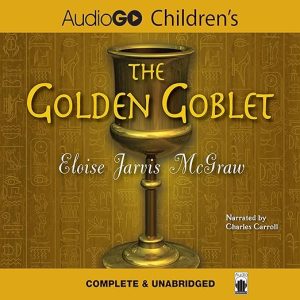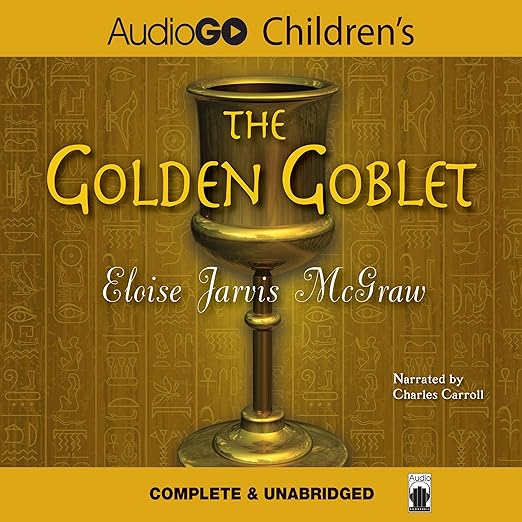
I have been slowly building a list of children's audiobooks that hold up for adult listeners, not as nostalgia but as actual craft, and The Golden Goblet by Eloise Jarvis McGraw is the kind of title that belongs on that list. I came to it through a recommendation attached to a note about it being a Newbery Honor winner from 1962, and I was not prepared for how completely it would put me inside ancient Egypt within the first thirty minutes.
The setup is tight. Ranofer is a boy training as a goldsmith's apprentice, living under the control of his half-brother Gebu, a man who exploits him economically and prevents him from pursuing the goldsmithing craft that was his father's life work. When Ranofer discovers that Gebu is involved in tomb robbery, one of the most serious crimes in ancient Egyptian society, he is placed in an impossible position: to do nothing is to collude, but to act against Gebu means risking everything he has left. The novel builds this dilemma with patience and care, never reducing it to an adventure template where the right move is obvious. What makes the book unusual for its intended audience is that it trusts the reader to hold moral ambiguity without resolving it prematurely, which is rarer in middle-grade fiction than it should be.
What We Made of It
The research behind this novel is not window-dressing. McGraw constructs a world where the details of daily life, the social structure, the economics of craft work, the specific weight of tomb robbery as a crime in a civilization that built its entire afterlife theology around the inviolability of burial, feel genuinely integrated rather than decoratively applied. Reviewers who used the book in history curricula note that it gave their children a more intuitive sense of ancient Egyptian society than textbooks could provide, not because it is a textbook, but because it embeds historical specificity in human choices. One homeschooled student described how the book helped her visualize ancient food, clothing, and customs in ways that enriched her subsequent study. That kind of lateral cultural absorption is exactly what great historical fiction for young people can achieve. Carroll's narration of those details never makes them feel like lessons inserted between plot points; they feel like the texture of a world Ranofer actually lives in and takes for granted.
Why Listen to The Golden Goblet
Children's literature has a tendency to resolve its protagonists' problems through luck, adult intervention, or sudden reversals that the child did not really cause. McGraw avoids this. Ranofer's eventual confrontation with Gebu and with the larger criminal enterprise his half-brother is part of requires him to make a choice that costs him something, to take a risk that is not guaranteed to work, and to find allies through demonstrated trustworthiness rather than automatic goodwill. That is a more sophisticated moral architecture than many adult thrillers manage. Carroll's narration captures the texture of Ranofer's fear and determination without making him seem either recklessly brave or passively acted upon. The pacing of the mystery plot is well-calibrated for the target audience: tense without becoming traumatic, suspenseful without requiring violence to maintain momentum through seven-plus hours of audio.
What Might Not Land
The book's vocabulary is rich in ways that some reviewers flagged as potentially challenging for younger listeners or those with language processing difficulties. One parent described reading it aloud to her daughter and stopping frequently to explain words, which she found enjoyable rather than frustrating given the quality of the material. Another noted that her five-year-old found it boring while her older children were fully engaged. The sweet spot for unassisted listening is probably ages nine to thirteen, with younger children benefiting from sharing it with an adult who can provide context. The audio format actually helps here, because Carroll's delivery provides tonal cues that make the historical language accessible in ways that silent reading does not. His consistency with the Egyptian names and settings builds familiarity through repetition rather than requiring listeners to decode unfamiliar proper nouns on their own.
Who Should Pick Up The Golden Goblet
The Golden Goblet is suited for upper elementary and middle school listeners who are studying ancient Egypt or simply want an adventure story set in a fully realized historical world. Homeschooling families using ancient civilization curricula will find it an exceptional companion. Very young children or those who find historical fiction demanding may struggle with the pace and vocabulary. For everyone else, this is the rare children's audiobook that respects its audience's capacity for genuine tension and moral seriousness. The free audiobook format makes it an easy choice as a starting point for families exploring classical historical fiction, and the seven-and-a-half-hour runtime is exactly right for an adventure that takes its world seriously without overwhelming its readers. Carroll delivers it with the care the story deserves. The seven-and-a-half-hour runtime sits at the right length for a middle-grade adventure that takes its world seriously: long enough to build genuine investment in Ranofer's situation, short enough that younger listeners can sustain the focus without adult prompting. McGraw's control of pacing, moving between the workshop scenes that establish Ranofer's craft identity and the mystery plot that forces him into action, is one of the book's less-discussed accomplishments, and Carroll's narration gives it the structural clarity that audio adaptations of plotted fiction require. For a book first published in 1961, its narrative instincts feel remarkably contemporary, and Carroll's reading makes those instincts feel alive rather than preserved.
Questions Listeners Ask
How does Charles Carroll's narration handle the ancient Egyptian names and settings that might confuse younger listeners?
Carroll is consistent and confident with the names and vocabulary, which helps younger listeners absorb them through repetition rather than stumbling over pronunciation uncertainty. His delivery gives the ancient Egyptian world a sense of lived reality rather than theatrical distance, which reviewers identify as one of the reasons the setting feels genuinely transporting.
My child enjoyed The Golden Goblet. What similar historical fiction audiobooks might work next?
Elizabeth George Speare's The Bronze Bow, set in Roman-occupied Judea, has a similar combination of historical specificity and moral seriousness. Rosemary Sutcliff's Eagle of the Ninth offers comparable depth for readers ready for more complexity. For readers who want to stay in the ancient world, Mara, Daughter of the Nile by the same author Eloise Jarvis McGraw is a natural next step.