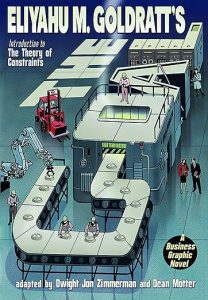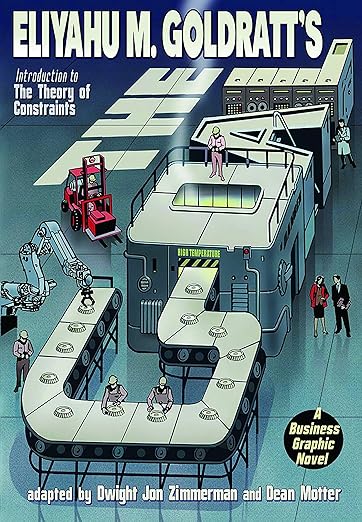
Alex Rogo has ninety days to save a factory that headquarters has already mentally shut down, and that countdown drives every page of this audiobook adaptation of Eliyahu Goldratt's business classic. This particular edition is the graphic novel version of The Goal, illustrated and restructured from the 1984 original, which raises an immediate question for anyone weighing the audio format: what happens to a book built around visual panels once you strip away the pictures? I went in skeptical and came out with a clearer answer than expected.
A Boy Scout Hike Explains Every Bottleneck
Jonah, the mentor who needles Alex out of conventional plant-management thinking, functions the way Socrates functions in Plato's dialogues: never simply handing over the answer, always making Alex reason his way to the Theory of Constraints on his own. That structure, a manager stumbling toward a real operational insight through dialogue rather than lecture, is why this 1984 novel became one of the most cited business books ever written, translated into 32 languages and taught in business schools worldwide. The graphic novel treatment keeps that Socratic backbone intact even while compressing description into panel-style pacing, and Cullen Reed's review captures why it still lands: the story format makes an academic discipline like operations management feel less like a textbook and more like a workplace drama with real stakes for real people's jobs.
What surprised me most is how well the bones of the story survive translation into a listening-only format. J. Singleton's review mentions picking this up as a pre-course assignment and not being able to put it down, which tracks with my own experience: the plant-closure deadline gives Goldratt's constraint theory an urgency a straight textbook never manages. Kay's review calls it a quick read that explains the Theory of Constraints at a high level, and that assessment holds for the audio edition too. This is not a deep technical manual, it is an entry point, and a genuinely engaging one, into a framework that has shaped how entire industries think about bottlenecks, throughput, and where to spend limited attention on a factory floor.
One of Goldratt's most famous teaching moments involves a Boy Scout hiking trip, where Alex watches a slow-moving scout unintentionally reveal exactly how bottlenecks constrain an entire system's throughput. That scene alone has entered operations-management folklore, cited in business schools independent of the book itself, and hearing it narrated rather than summarized secondhand is worth the price of admission on its own.
Listening to the Questions Beats Reading Them Silently
The case for the audiobook rests on pacing rather than depth. Goldratt structured the original novel so that every operational lesson arrives bundled inside Alex's marriage troubles, his corporate politics, his genuine fear of failing three hundred employees, and that narrative scaffolding survives the shift to a graphic novel adaptation better than a dry summary would. Listening to Alex work through Jonah's questions out loud, rather than reading them silently, suits the Socratic method well: dialogue is dialogue, whether it appears in a speech bubble or comes through a pair of headphones, and hearing the back-and-forth land in real time gives the reasoning a momentum a page can't quite replicate.
A legitimate case exists too for choosing this specific edition over the original prose novel, if what you want is the fastest possible route to the core concepts. A graphic novel by design trims description to make room for its visual storytelling, and even without the pictures, that leaner structure carries over into a shorter, more focused audio runtime than an unabridged reading of the full 1984 text would need. At just under twelve hours, this is a genuinely accessible way to absorb a framework, the Theory of Constraints, that business schools still assign as required reading nearly four decades after publication.
Goldratt did not stop at one novel either. Alex Rogo's story continues in It's Not Luck, a direct sequel applying the same Socratic method to marketing and sales bottlenecks, and Goldratt extended the underlying Theory of Constraints framework further still in Critical Chain, focused on project management specifically. None of those follow-ups are part of this particular graphic novel treatment, but listeners who finish this adaptation hungry for more of Alex Rogo's story, or more of Goldratt's constraint-based thinking applied to new problems, now know exactly where to look next.
This Edition Carries No Named Performer
The elephant in the room is the format mismatch. This is explicitly billed as a graphic novel, described in its own synopsis as 'visual and fun to read', and that framing matters because a graphic novel's core appeal, panel composition, character expressions rendered in illustration, sequential visual pacing, simply cannot travel into an audio-only edition. Kay's review even flags a real formatting frustration with the print edition, itself a small clue about how format-dependent the layout is. An audiobook can carry Alex's dialogue with Jonah and the narrative beats just fine, but any diagrams explaining specific constraint calculations or the visual gags that make a graphic novel a graphic novel simply will not exist in this edition.
The narrator credit itself is also worth flagging honestly: this edition carries no named performer, so no specific vocal choices can be evaluated, and listeners who care about narrator chemistry with the material, the way Jonah's patience needs to sound different from Alex's mounting panic, won't find that information here. The content itself is strong enough on Goldratt's reputation alone, the original has sold more than seven million copies and made a well-known list of the twenty-five most influential business management books, but go in knowing this is read by an uncredited performer rather than a known quantity.
The Charts and the Artwork Both Go Missing
This suits listeners who want the Theory of Constraints explained through story rather than through a stack of case studies, especially anyone new to operations management who finds traditional business textbooks a slog. Team leads, new plant managers, and business students assigned this as prep reading will get real value from an audio pass, particularly since Kay and Cullen Reed both independently describe it as a fast, accessible way into a genuinely influential framework. If you already know you retain information better through narrative than through diagrams, the graphic novel's compressed, dialogue-forward structure is arguably a better match for audio than a denser business title would be.
Skip this one if the actual appeal for you is the graphic novel's artwork itself, since none of that survives the format switch, or if you specifically need the visual charts and constraint diagrams a working manager would want to reference on the job. Readers who already know Goldratt's original 1984 novel well may also find this adaptation redundant rather than illuminating, since the underlying lessons and character arcs are unchanged, just restructured. For everyone else circling a beginner-friendly business classic, this is a genuinely low-friction way in.
In Brief
- Performance: No performer is credited for this edition, so the reading itself cannot be evaluated on its own merits.
- What it covers: Constraint-based operations management, mentorship through Socratic questioning, factory survival under deadline pressure
- Feel: Brisk and instructive, business fable energy
- Our call: A fast, accessible entry point into the Theory of Constraints, best suited to listeners drawn to the story rather than the graphic novel's missing artwork.