Quick Take
- Narration: Claire Duncan brings steady professionalism to Emma Griffin’s world, reliable, clear, and emotionally grounded without overplaying.
- Themes: Secret society and institutional abuse, cold case unraveling, family separation and reunion
- Mood: Taut and quietly disturbing
- Verdict: A solid entry in a long-running series that rewards committed fans while still functioning for listeners new to Emma Griffin.
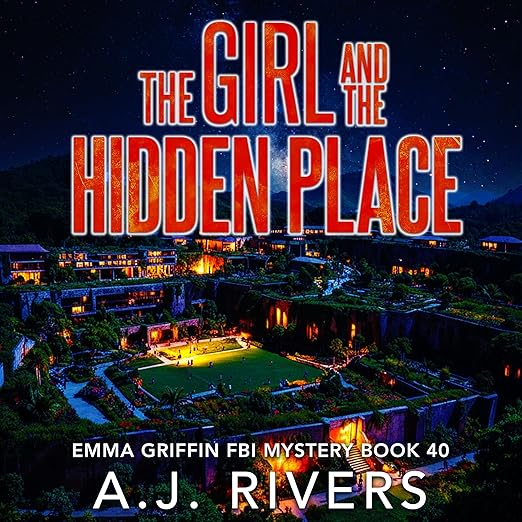
I was deep into the Emma Griffin series long before I reached book forty, which tells you something about how A.J. Rivers builds loyalty. By the time I got to The Girl and the Hidden Place, I had watched Emma develop across dozens of cases, and there is something almost comfortable about returning to her now, the same way you might revisit a television procedural where the formula is the point. The familiarity is not a weakness here. It is the entire engine.
This installment begins with a premise that carries genuine weight: Mark and Jill Pearson were abducted from their home in what the synopsis calls one cruel summer day, and their sister Penny has spent her life searching for them. When skeletal remains are identified as Mark Pearson, the cold case cracks open, and Jill remains missing. Emma Griffin, called in to work the investigation, arrives in a community frozen by the event, where whispers and conspiratorial silence have calcified over a decade.
Our Take on The Girl and the Hidden Place
Rivers does something genuinely effective here that does not always get the credit it deserves in long-running series: she finds a case that echoes Emma’s own history with loss and missing people without making that connection heavy-handed. The secret society at the heart of the mystery, built, according to the synopsis, on cruelty, malice, and abuse, functions as both the procedural antagonist and a structural mirror to institutional power protecting itself. That combination gives the book more thematic texture than a standard procedural entry.
The pacing is efficient. Rivers has forty books of practice keeping Emma’s investigations moving, and it shows. The community-of-whispers setup is well-executed: the people Emma encounters feel authentically evasive rather than generically suspicious. When she begins connecting the missing-person thread to something larger and darker, the revelations arrive at intervals that keep the listen propulsive without tipping into breathless chaos. The mass grave discovery at a construction site and the human trafficking undertones that surface mid-investigation give the case a scale that justifies the forty-installment runtime of the series, Rivers is not coasting, she is building.
Why Listen to The Girl and the Hidden Place
Claire Duncan’s narration is a significant part of why this series sustains across forty installments. She handles Emma’s first-person voice with consistent emotional intelligence, finding the places where resolve cracks without making Emma melodramatic. Longtime fans noted in reviews that this case felt particularly satisfying to close, even as it intersects with other ongoing plot threads. One reviewer flagged some disappointment at not getting resolution on a separate arc involving a character called Doe, worth knowing if you’re mid-series and tracking multiple threads simultaneously.
For newcomers, this book is accessible enough to function as a standalone procedural, though the emotional payoff deepens considerably with series context. The family reunion element, which forms the emotional core of the resolution, lands harder if you’ve spent time with Emma’s established understanding of what loss does to families over years.
What to Watch For in The Girl and the Hidden Place
Rivers is ambitious with the scope here, weaving human trafficking overtones, secret communal community structures, and a mass grave at a construction site into what begins as a single missing-person cold case. That ambition occasionally outpaces the space available to explore it fully. Some of the secret society’s internal logic is gestured at rather than fully unpacked. If you come to the book wanting procedural airtightness, there are corners where the resolution moves quickly. But if you come wanting emotional closure around a family severed by violence, this delivers the kind of ending that keeps readers returning to Emma Griffin book after book.
Who Should Listen to The Girl and the Hidden Place
Existing Emma Griffin fans should listen without hesitation, it’s among the stronger recent entries and contains threads that connect to the wider series arc. New listeners who enjoy slow-burn procedurals with female FBI protagonists and dark institutional conspiracies will find it approachable, though starting at an earlier installment would enrich the experience. Listeners who require every plot strand tied off neatly by the final chapter should note that some threads carry forward.
Frequently Asked Questions
Do I need to have read the previous 39 Emma Griffin books before starting The Girl and the Hidden Place?
Not strictly. The case in this book functions as a standalone mystery with its own beginning and resolution. That said, Rivers rewards series readers with emotional layering and ongoing character threads that newcomers will miss. If you’re new to Emma Griffin, this is a reasonable entry point, but earlier books will deepen the experience.
How does Claire Duncan handle the tonal shifts between Penny’s grief and Emma’s FBI professionalism?
Claire Duncan navigates the shifts with practiced emotional intelligence. She doesn’t dramatically differentiate voices but maintains clarity throughout, which suits Rivers’s restrained prose style. Longtime fans of the series will find her narration consistent with earlier installments and reliably grounded.
What makes the secret society in The Girl and the Hidden Place distinctive compared to similar thriller antagonists?
Rather than relying on occult mystique, Rivers grounds the society in systemic abuse and institutional protection of powerful men. It functions more as a commentary on how communities shield predators than as a genre trope. That grounding gives the antagonist structure more staying power than a purely sensational approach would.
Is the Doe storyline resolved in this book, or does it carry over to the next installment?
Based on reviewer feedback, the Doe storyline is not fully resolved in The Girl and the Hidden Place, which was a source of mild frustration for some readers. The primary case involving the Pearson siblings is resolved, but Doe appears to be a thread Rivers is stretching across multiple books.